


Murine macrophage transcriptional responses to Bacillus anthracis infection and intoxication
- PMID: 15664951
- PMCID: PMC547061
- DOI: 10.1128/IAI.73.2.1069-1080.2005
Murine macrophage transcriptional responses to Bacillus anthracis infection and intoxication
Abstract
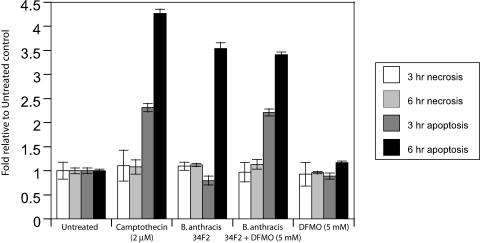
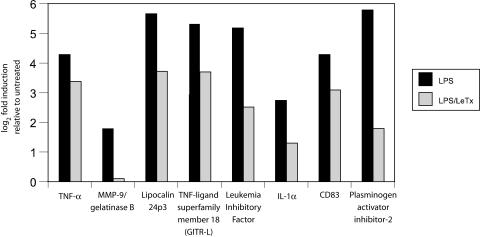
Interactions between Bacillus anthracis and host macrophages represent critical early events in anthrax pathogenesis, but their details are not clearly understood. Here we report the first genomewide characterization of the transcriptional changes within macrophages infected with B. anthracis and the identification of several hundred host genes that were differentially expressed during this intracellular stage of infection. These loci included both genes that are known to be regulated differentially in response to many other bacterial pathogens and those that appear to be differentially regulated in response to B. anthracis but not other bacterial species that have been tested. These data provide a transcriptional basis for a variety of physiological changes observed during infection, including the induction of apoptosis caused by the infecting bacteria. The expression patterns underlying B. anthracis-induced apoptosis led us to test further the importance of one very highly induced macrophage gene, that for ornithine decarboxylase. Our data show that this enzyme plays an important and previously unrecognized role in suppressing apoptosis in B. anthracis-infected cells. We have also characterized the transcriptional response to anthrax lethal toxin in activated macrophages and found that, following toxin treatment, many of the host inflammatory response pathways are dampened. These data provide insights into B. anthracis pathogenesis as well as potential leads for the development of new diagnostic and therapeutic options.
Figures
References
-
- Abulencia, J. P., R. Gaspard, Z. R. Healy, W. A. Gaarde, J. Quackenbush, and K. Konstantopoulos. 2003. Shear-induced cyclooxygenase-2 via a JNK2/c-Jun-dependent pathway regulates prostaglandin receptor expression in chondrocytic cells. J. Biol. Chem. 278:28388-28394. - PubMed
-
- Agrawal, A., J. Lingappa, S. H. Leppla, S. Agrawal, A. Jabbar, C. Quinn, and B. Pulendran. 2003. Impairment of dendritic cells and adaptive immunity by anthrax lethal toxin. Nature 424:329-334. - PubMed
-
- Belcher, C., J. Drenkow, B. Kehoe, T. Gingeras, N. McNamara, H. Lemjabbar, C. Basbaum, and D. Relman. 2000. The transcriptional responses of respiratory epithelial cells to Bordetella pertussis reveal host defensive and pathogen counter defensive strategies. Proc. Natl. Acad. Sci. USA 97:13847-13852. - PMC - PubMed
-
- Bhatnagar, R., and S. Batra. 2001. Anthrax toxin. Crit. Rev. Microbiol. 27:167-200. - PubMed
Publication types
MeSH terms
Grants and funding
LinkOut - more resources
Full Text Sources
Medical
Molecular Biology Databases
