. 2005 Feb;114(2):263-71.
doi: 10.1111/j.1365-2567.2004.02071.x.

Haptoglobin dampens endotoxin-induced inflammatory effects both in vitro and in vivo

Affiliations

Haptoglobin dampens endotoxin-induced inflammatory effects both in vitro and in vivo

Mohamed S Arredouani et al. Immunology. 2005 Feb.

Abstract

We report that haptoglobin, an acute-phase protein produced by liver cells in response to interleukin-6 (IL-6), can modulate the inflammatory response induced by endotoxins. We provide evidence that haptoglobin has the ability to selectively antagonize lipopolysaccharide (LPS) effects in vitro by suppressing monocyte production of tumour necrosis factor-alpha, IL-10 and IL-12, while it fails to inhibit the production of IL-6, IL-8 and IL-1 receptor antagonist. In two animal models of LPS-induced bronchopulmonary hyperreactivity and endotoxic shock, haptoglobin knockout mice were more sensitive to LPS effects compared to their wild-type counterparts. The present data suggest that haptoglobin regulates monocyte activation following LPS stimulation. The increase in haptoglobin levels during an acute-phase reaction may generate a feedback effect which dampens the severity of cytokine release and protects against endotoxin-induced effects.


Figures

Figure 1
Figure 1
Dose-dependent effect of haptoglobin on LPS-induced cytokine release by PBMC. (a) PBMC (1 × 10⁶/ml) were incubated in serum-free culture medium. LPS (1 μg) was added at the beginning of the culture, Hp was added simultaneously resulting in final concentrations of 0, 50, 250, 500, or 1000 μg/ml. Cytokine production was assessed by ELISA after 72 hr of culture. Results are reported as mean ± SEM of four (TNF-α and IL-10) and three (IL-12p70) independent experiments. (b) Results for IL-1ra, IL-6 and IL-8 are reported as mean ± SEM from six experiments. (c) PBMC (1 × 10⁶/ml) were cultured in X-Vivo15 medium in the presence of 1 μg LPS, 250 U rIFN-γ, and increasing Hp concentrations. TNF-α and IL-12p70 concentration was assessed after 3 days of culture using ELISA. Results are reported as mean ± SEM of four independent experiments. *P < 0·05, **P < 0·01 vs. control.
Figure 2
Figure 2
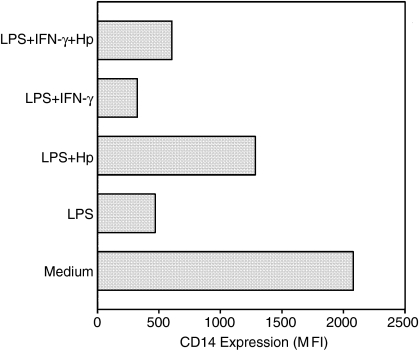
Effect of Hp on the expression of surface CD14 by LPS-stimulated monocytes. One million monocyte-enriched PBMCs were cultured overnight in the presence of LPS (1 μg/ml) with or without Hp (1 mg/ml) and IFN-γ (250 U/ml). Cells were labelled for CD14, and CD14 expression on the gated monocyte population was expressed as the MFI. Results are reported from one representative out of two experiments.
Figure 3
Figure 3
Effect of anti-CD11b mAb and/or Hp on LPS-induced cytokine production by monocytes. PBMCs (1 × 10⁶/ml) were incubated with or without 10 μg of the anti-CD11b mAb (clone 44) for 30 min at room temperature. Then 1 μg of LPS and/or 500 μg of Hp were added. TNF-α and IL-10 production were evaluated after 2 days of culture. The results shown are from three different donors.
Figure 4
Figure 4
PBMCs (1 × 10⁶/ml) were incubated in either serum-free culture medium (SFM) or 10% Hp-free serum (HFS)-supplemented medium. At the beginning of the culture, 1 μg of LPS and Hp was added, the latter at final concentrations of 0, 50, 250, 500, or 1000 μg/ml. TNF-α production was assessed using ELISA after 72 hr of culture. Results are reported as mean ± SEM of four independent experiments. *P < 0·05, **P < 0·01 versus control.
Figure 5
Figure 5
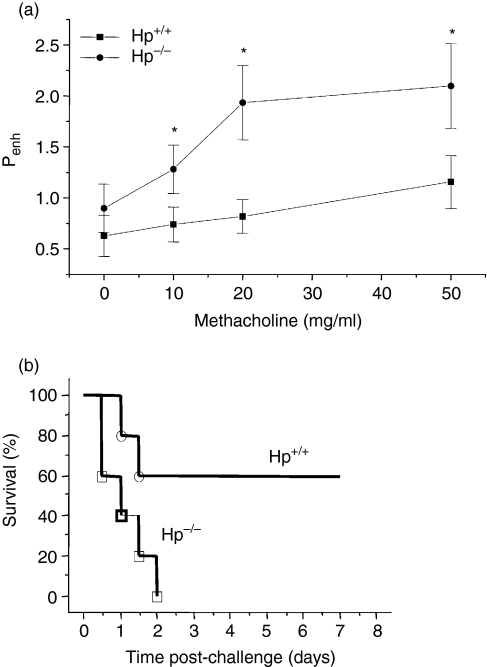
Hp-deficient mice are more susceptible to LPS-induced bronchopulmonary hyperresponsiveness and endotoxic shock. (a) Hp+/+ and Hp−/− mice were injected i.p. with 10 μg of LPS. Thirty-six hours later, they received a second i.p. injection of 25 μg LPS. Penh was measured in response to nebulized saline and to different doses of methacholine using the Buxco® body plethysmograph. Results are reported as the mean ± SEM of 10 mice per group. *P < 0·05. (b) Mice (10 per group) were given an i.p. injection of 500 μg E. coli LPS and survival was monitored daily for 1 week.

References

    1. Fenton MJ, Golenbock DT. LPS-binding proteins and receptors. J Leukoc Biol. 1998;64:25–32. - PubMed
    1. Means TK, Lien E, Yoshimura A, Wang S, Golenbock DT, Fenton MJ. The CD14 ligands lipoarabinomannan and lipopolysaccharide differ in their requirement for Toll-like receptors. J Immunol. 1999;163:6748–55. - PubMed
    1. Beutler B. Tlr4: central component of the sole mammalian LPS sensor. Curr Opin Immunol. 2000;12:20–6. - PubMed
    1. Flaherty SF, Golenbock DT, Milham FH, Ingalls RR. CD11/CD18 leukocyte integrins: new signaling receptors for bacterial endotoxin. J Surg Res. 1997;73:85–9. . - DOI - PubMed
    1. Medvedev AE, Flo T, Ingalls RR, Golenbock DT, Teti G, Vogel SN, Espevik T. Involvement of CD14 and complement receptors CR3 and CR4 in nuclear factor-kappaB activation and TNF production induced by lipopolysaccharide and group B streptococcal cell walls. J Immunol. 1998;160:4535–42. - PubMed

Publication types

LinkOut - more resources