Developing and adapting a family-based diabetes program at the U.S.-Mexico border
- PMID: 15670473
- PMCID: PMC1323323
Developing and adapting a family-based diabetes program at the U.S.-Mexico border
Abstract
Context: The prevalence of diabetes among Hispanics is more than twice that of non-Hispanic whites in communities along the U.S.-Mexico border. The University of Arizona and two community health agencies on the Arizona border, Campesinos Sin Fronteras and Mariposa Community Health Center, collaborated to design, pilot and assess the feasibility of a lay health-outreach worker- (promotora-) delivered diabetes education program for families. La Diabetes y La Unión Familiar was developed to build family support for patients with diabetes and to teach primary prevention behaviors to family members.
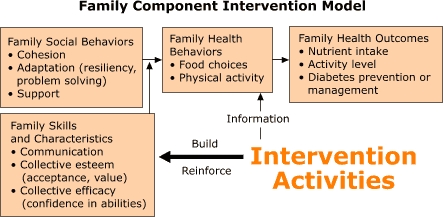
Method: Community and university partners designed a culturally appropriate program addressing family food choices and physical activity, behavior change, communication, and support behaviors. The program offers educational content and activities that can be presented in home visits or multifamily group sessions. Community partners led the implementation, and university partners guided the evaluation.
Consequences: Seventy-two families (249 total participants) including children and grandchildren participated. Preintervention and postintervention questionnaires completed by adults (n = 116) indicate a significant increase in knowledge of eight diabetes risk factors (P values for eight factors range from < 001 to .006) and a significant increase in family efficacy to change food (P < .001) and activity behaviors (P < .001). Interviews with participants highlight the program's positive psychosocial impact.
Interpretation: Community and university collaboration involved building upon the promotoras' expertise in engaging the community and the university's expertise in program design and evaluation. A promotora-delivered family-based diabetes prevention program that emphasizes family support, communication, and health behaviors is feasible and can yield change in family knowledge, attitude, and behavior relative to diabetes risk factors.
Figures
References
-
- National Institute of Diabetes and Digestive and Kidney Disease. Diabetes in Hispanic Americans [Internet] Bethesda (MD): The Institute, National Diabetes Information Clearinghouse; [Accessed 2004 Oct 18].
-
- Harris MI, Klein R, Cowie CC, Rowland M, Byrd-Holt DD. Is the risk of diabetic retinopathy greater in non-Hispanic blacks and Mexican Americans than in non-Hispanic whites with type 2 diabetes. A U.S. population study. Diabetes Care. 1998;21(8):1230–1235. - PubMed
-
- Harris MI, Cowie CC, Eastman RC. Symptoms sensory neuropathy in adults with NIDDM in the US population. Diabetes Care. 1993;16 (11):1446–1452. - PubMed
-
- von Goeler DS, Rosal MC, Ockene JK, Scavron J, De Torrijos F. Self-management of type 2 diabetes; a survey of low-income urban Puerto Ricans Diabetes Educator . 2003;29(4):663–672. - PubMed
-
- Stern MP, Mitchell BD. Diabetes in Hispanic Americans. In: National Diabetes Data Group, editor. Diabetes in America. 2nd ed. Bethesda (MD): National Institute of Diabetes and Digestive and Kidney Diseases, National Institutes of Health; 1995. pp. 631–659. NIH Publication No. 95-1468.
MeSH terms
LinkOut - more resources
Full Text Sources
Medical