


doi: 10.1073/pnas.0409413102.
Epub 2005 Jan 26.
Chromatin remodeling by DNA bending, not twisting
Affiliations
- PMID: 15677336
- PMCID: PMC546017
- DOI: 10.1073/pnas.0409413102
Item in Clipboard
Chromatin remodeling by DNA bending, not twisting
Proc Natl Acad Sci U S A.
.
Abstract
Single-stranded regions (gaps) in nucleosomal DNA interfere with action of the RSC chromatin-remodeling complex, monitored by exposure of restriction endonuclease cutting sites. Single-strand breaks (nicks) in the DNA, by contrast, have no effect. Gaps on one side of the cutting site are inhibitory, but gaps on the other side are not. A gap >100 bp from the cutting site is as effective as a gap <20 bp from the site. These findings suggest a remodeling process involving bending, but not twisting, of the DNA and further point to the propagation of a bent region (loop or bulge) from one end of the nucleosome to the other.
Figures
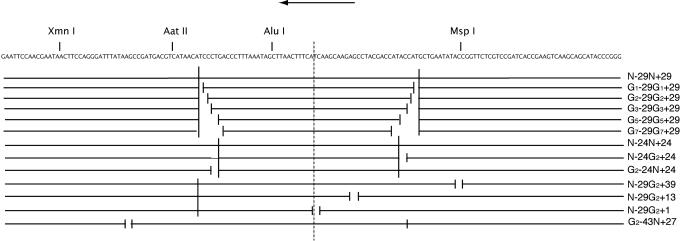
Nicked and gapped nucleosomal DNAs. The locations of nicks and gaps in the 160-bp DNAs used in this work are indicated schematically beneath the sequence of the DNA. The DNAs are named according to the presence of a nick (N) or gap (G), followed by the location (distance from the dyad axis of the nucleosome, indicated by a vertical dashed line). Nicks and gaps are on the strand whose sequence is shown, and the size of the gap is indicated by a subscript. An arrow at the top indicates the downstream direction (the inferred direction of chromatin remodeling by RSC in this case).
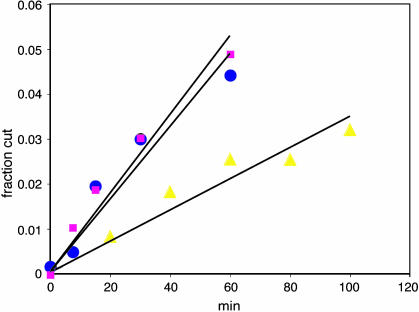
Time course of AluI digestion of unnicked, nicked, and gapped DNAs. The extent of AluI digestion, determined from the amount of 70-bp fragment in a gel, is plotted as a function of time. The DNAs were unnicked (blue circles), nicked (N-29N + 29, magenta squares) and gapped (N-29G2 + 13, yellow triangles).
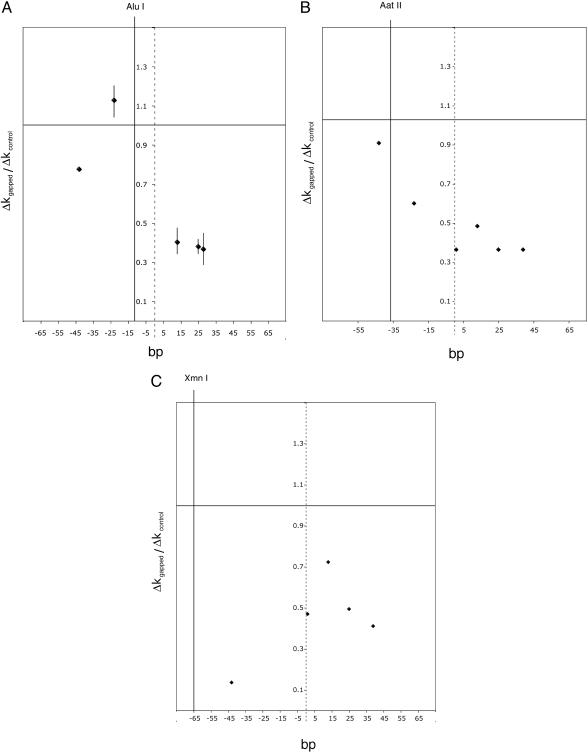
Interfering effect of a gap in nucleosomal DNA on remodeling by RSC and ATP, as a function of location of the gap. The increase, Δkgapped, due to RSC and ATP, in the rate constant of cutting gapped nucleosomal DNA (Δk = k+ATP - k-ATP), divided by the Δkcontrol value for unnicked, ungapped DNA, is plotted on the ordinate, and the location of the gap is plotted on the abscissa. (A), AluI; (B) AatII; (C) XmnI. The locations of the cutting site and of the dyad axis of the nucleosome are indicated by solid and dashed vertical lines. All data are averages of at least three independent determinations, and error bars (SDs) are shown in cases where four or more determinations were made.
References
-
- Cote, J., Quinn, J., Workman, J. L. & Peterson, C. L. (1994) Science 265, 53-60. - PubMed
-
- Cairns, B. R., Lorch, Y., Li, Y., Zhang, M., Lacomis, L., Erdjument-Bromage, H., Tempst, P., Du, J., Laurent, B. & Kornberg, R. D. (1996) Cell 87, 1249-1260. - PubMed
-
- Imbalzano, A. N., Kwon, H., Green, M. R. & Kingston, R. E. (1994) Nature 370, 481-485. - PubMed
-
- Lorch, Y., Cairns, B. R., Zhang, M. & Kornberg, R. D. (1998) Cell 94, 29-34. - PubMed
-
- Langst, G., Bonte, E. J., Corona, D. & Becker, P. B. (1999) Cell 97, 843-852. - PubMed
Publication types
MeSH terms
Substances
Grants and funding
LinkOut - more resources
Full Text Sources
Miscellaneous
