. 2005 Feb;79(4):2050-7.
doi: 10.1128/JVI.79.4.2050-2057.2005.

Role of CCL11 in eosinophilic lung disease during respiratory syncytial virus infection

Affiliations

Role of CCL11 in eosinophilic lung disease during respiratory syncytial virus infection

Stephen P Matthews et al. J Virol. 2005 Feb.

Abstract

Respiratory syncytial virus (RSV) is a major viral pathogen of infants and the elderly. Significant morbidity is caused by an overexuberant mixed lung cell infiltrate, which is thought to be driven by chemokines. One of the main chemotactic mediators responsible for the movement of eosinophils is CCL11 (eotaxin). Using a mouse model of eosinophilic bronchiolitis induced by RSV, we show here that treatment in vivo with a blocking antibody to CCL11 greatly reduces lung eosinophilia and disease severity. In addition, anti-CCL11 caused a striking inhibition of CD4-T-cell influx and shifted cytokine production away from interleukin-5 without reducing the resistance to viral replication. These results suggest that in addition to influencing eosinophil diapedesis and survival, anti-CCL11 has an action on T cells. These studies strengthen the case for anti-CCL11 treatment of Th2-driven diseases.


Figures
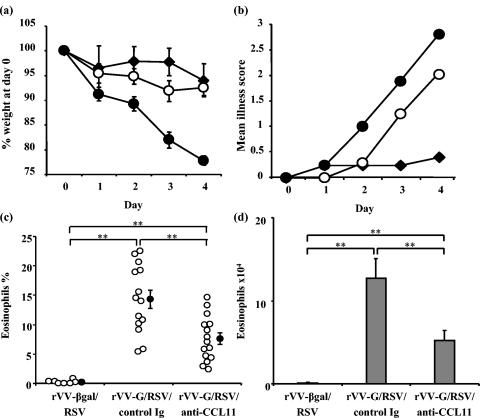
FIG. 1.
FIG. 1.
Treatment with anti-CCL11 during RSV challenge of rVV-G-primed mice reduces severity of illness and pulmonary eosinophilia. rVV-β gal (♦)- or rVV-G-primed mice were challenged with RSV on day 0. rVV-G-primed animals were given anti-CCL11 (○) or control Ig (•) daily. Mean weight loss (a) and mean illness scores (b) are presented for four to five mice per group. These data are representative of three separate experiments. Differential counts were performed with hematoxylin-and-eosin-stained cytospin preparations of BAL cells from individual mice and were used to determine proportions (c) and total numbers (d) of eosinophils. Combined data from four independent experiments are shown, together with means ± SEM for each group. **, P < 0.01.
FIG. 2.
FIG. 2.
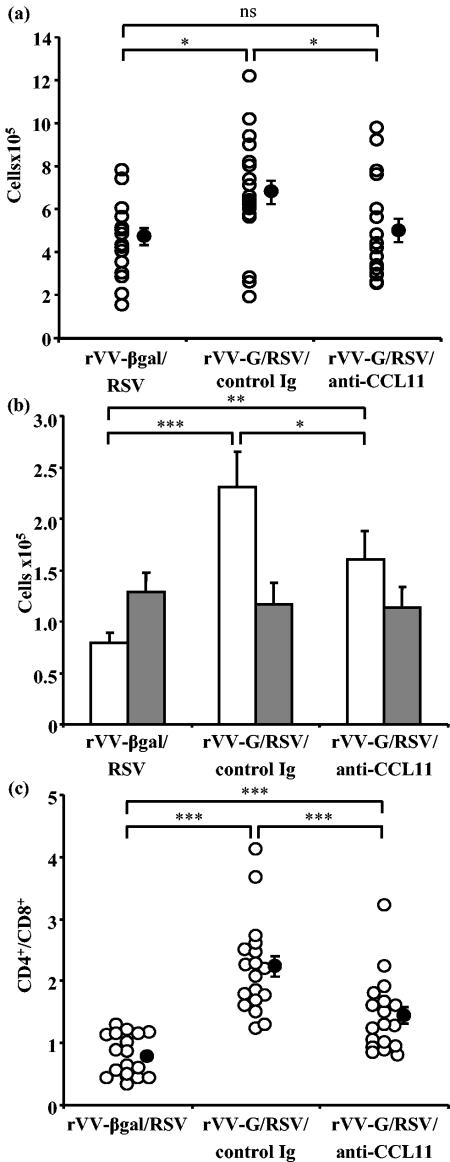
Treatment with anti-CCL11 during RSV challenge of rVV-G-primed mice alters the balance of CD4+ and CD8+ T cells recruited to the lungs. Combined data from four independent experiments show total BAL cell infiltrates (a), numbers of CD4+ (open bars) and CD8+ (filled bars) T cells recovered from BAL fluid (b), and ratios of CD4+ to CD8+ cells (c). Means ± SEM for each group are shown. P values are represented as follows: *, P < 0.05; **, P < 0.01; ***, P < 0.001; ns, not significant.
FIG. 3.
FIG. 3.
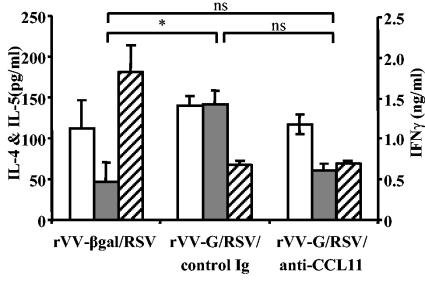
Treatment with anti-CCL11 reduces IL-5 in the lungs. The levels of IL-4 (open bars; left axis), IL-5 (filled bars; left axis), and IFN-γ (hatched bars; right axis) in cell-free BAL supernatants were measured by ELISA. P values are shown for differences in IL-5 production between groups, with P values represented as follows: *, P < 0.05; **, P < 0.01; ***, P < 0.001; ns, not significant. Similar data were obtained in other independent experiments.
FIG. 4.
FIG. 4.
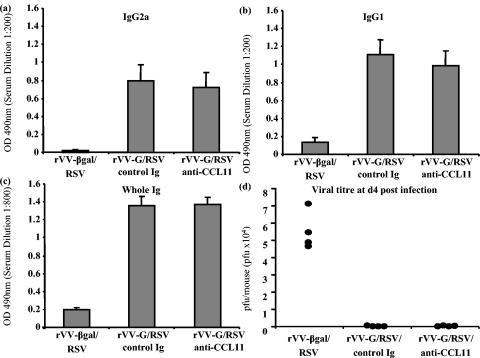
Treatment with anti-CCL11 does not compromise protection. Levels of RSV-specific IgG1 (a), IgG2a (b), and Ig (c) were measured by ELISA. The data presented are mean absorbance values ± SEM of four mice per group at a serum dilution of 1:200 (a and b) or 1:800 (c). Similar results were obtained at other serum dilutions. (d) Recovery of infectious virus from whole lung homogenates of individual mice, primed and treated as indicated, was measured by titration on HEp-2 monolayers 4 days after challenge with RSV. Each data point represents a single mouse.
FIG. 5.
FIG. 5.
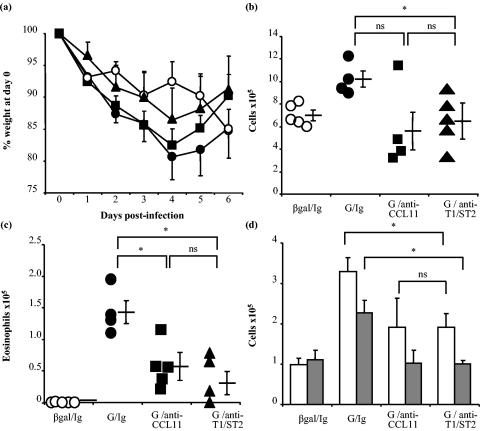
Treatment with anti-T1/ST2 or anti-CCL11 has similar beneficial effects upon eosinophilic RSV disease. (a) Weight changes were monitored during RSV challenge of rVV-β gal (open symbols)- or rVV-G (filled symbols)-primed mice that were either mock treated (100 mg of normal rabbit Ig; circles) or given daily doses of 50 mg of anti-CCL11 (squares) or 100 mg of anti-T1/ST2 (triangles). Pulmonary infiltrates were sampled by BAL on day 6, and total cells (b), eosinophils (c), and CD4+ and CD8+ T cells (d; open and filled bars, respectively) were enumerated as described previously. Means ± SEM of four mice per group are shown. P values are represented as follows: *, P < 0.05; ns, not significant.

References

    1. Chensue, S. W., N. W. Lukacs, T. Y. Yang, X. Shang, K. A. Frait, S. L. Kunkel, T. Kung, M. T. Wiekowski, J. A. Hedrick, D. N. Cook, A. Zingoni, S. K. Narula, A. Zlotnik, F. J. Barrat, A. O'Garra, M. Napolitano, and S. A. Lira. 2001. Aberrant in vivo T helper type 2 cell response and impaired eosinophil recruitment in CC chemokine receptor 8 knockout mice. J. Exp. Med. 193:573-584. - PMC - PubMed
    1. D'Ambrosio, D., A. Iellem, R. Bonecchi, D. Mazzeo, S. Sozzani, A. Mantovani, and F. Sinigaglia. 1998. Selective up-regulation of chemokine receptors CCR4 and CCR8 upon activation of polarized human type 2 Th cells. J. Immunol. 161:5111-5115. - PubMed
    1. Daugherty, B. L., S. J. Siciliano, J. A. DeMartino, L. Malkowitz, A. Sirotina, and M. S. Springer. 1996. Cloning, expression, and characterization of the human eosinophil eotaxin receptor. J. Exp. Med. 183:2349-2354. - PMC - PubMed
    1. de Lavareille, A., F. Roufosse, L. Schandene, P. Stordeur, E. Cogan, and M. Goldman. 2001. Clonal Th2 cells associated with chronic hypereosinophilia: TARC-induced CCR4 down-regulation in vivo. Eur. J. Immunol. 31:1037-1046. - PubMed
    1. Fujisawa, T., Y. Kato, J. Atsuta, A. Terada, K. Iguchi, H. Kamiya, H. Yamada, T. Nakajima, M. Miyamasu, and K. Hirai. 2000. Chemokine production by the BEAS-2B human bronchial epithelial cells: differential regulation of eotaxin, IL-8, and RANTES by TH2- and TH1-derived cytokines. J. Allergy Clin. Immunol. 105:126-133. - PubMed

Publication types

MeSH terms