. 2005 Feb 8;102(6):2093-8.
doi: 10.1073/pnas.0409823102. Epub 2005 Jan 31.

Mechanism for nucleoside analog-mediated abrogation of HIV-1 replication: balance between RNase H activity and nucleotide excision

Affiliations

Mechanism for nucleoside analog-mediated abrogation of HIV-1 replication: balance between RNase H activity and nucleotide excision

Galina N Nikolenko et al. Proc Natl Acad Sci U S A. .

Abstract

Understanding the mechanisms of HIV-1 drug resistance is critical for developing more effective antiretroviral agents and therapies. Based on our previously described dynamic copy-choice mechanism for retroviral recombination and our observations that nucleoside reverse transcriptase inhibitors (NRTIs) increase the frequency of reverse transcriptase template switching, we propose that an equilibrium exists between (i) NRTI incorporation, NRTI excision, and resumption of DNA synthesis and (ii) degradation of the RNA template by RNase H activity, leading to dissociation of the template-primer and abrogation of HIV-1 replication. As predicted by this model, mutations in the RNase H domain that reduced the rate of RNA degradation conferred high-level resistance to 3'-azido-3'-deoxythymidine and 2,3-didehydro-2,3-dideoxythymidine by as much as 180- and 10-fold, respectively, by increasing the time available for excision of incorporated NRTIs from terminated primers. These results provide insights into the mechanism by which NRTIs inhibit HIV-1 replication and imply that mutations in RNase H could significantly contribute to drug resistance either alone or in combination with NRTI-resistance mutations in reverse transcriptase.


Figures
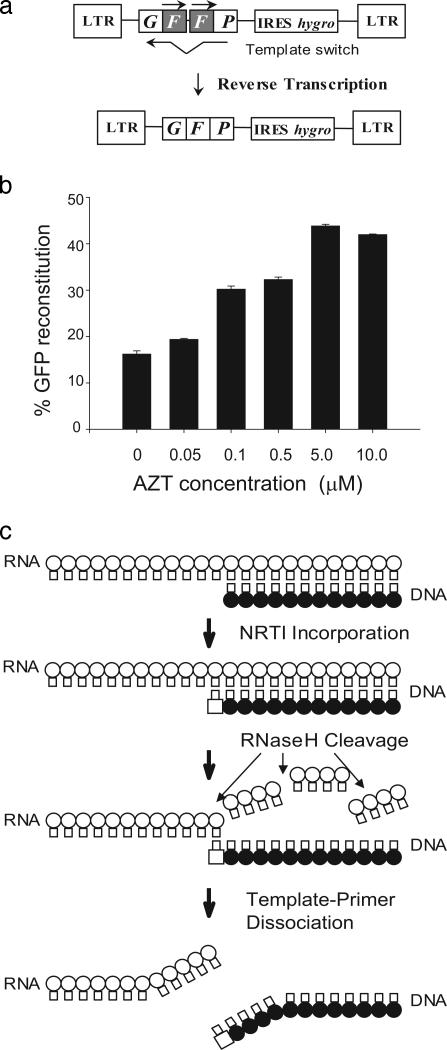
Fig. 1.
Fig. 1.
Effect of AZT treatment on RT template switching and model for NRTI-mediated abrogation of HIV-1 replication. (a) Simplified structure of GN-HIV-GFFP provirus, which contains long terminal repeats (LTR) and all cis-acting elements of HIV-1 (not shown). Overlapping fragments (GF and FP) of reporter gene GFP with the directly repeated 250-bp F portion (shaded) and the hygromycin-resistance gene (hygro), which is expressed by using an internal ribosomal entry site (IRES) of encephalomyocarditis virus, are shown. During reverse transcription, the repeated F portion is deleted with a high frequency to reconstitute a functional GFP. (b) Direct-repeat deletion and GFP-reconstitution frequencies of HIV-1 RT in the presence of different AZT concentrations. The percentage of GFP reconstitution represents the proportion of infected 293T target cells that exhibited fluorescence after hygromycin selection. Bar graphs and error bars represent the mean and standard error of the percentage of GFP reconstitution, respectively. (c) A model for NRTI-mediated abrogation of HIV-1 replication. A schematic outline of HIV-1 minus-strand DNA synthesis is presented. Thick arrows indicate the sequence of events postulated to be critical for NRTI-mediated abrogation of HIV-1 replication. These events consist of NRTI incorporation, RNase H cleavage, and template–primer dissociation. Open circles, RNA template; filled circles, growing DNA strand; open squares, incorporated NRTI; thin arrows, RNase H cleavage of the template RNA after it is copied.
Fig. 2.
Fig. 2.
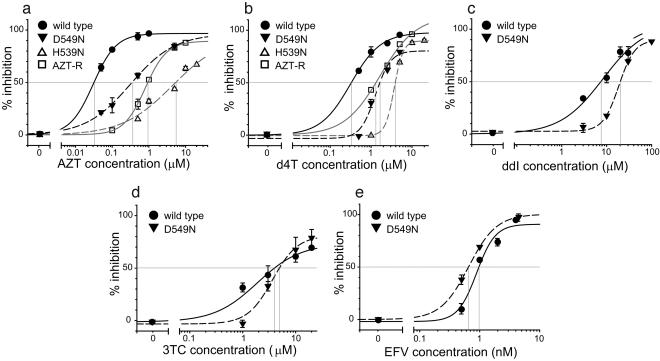
Single-replication-cycle drug-susceptibility assays. Phenotypic drug-susceptibility testing for AZT (a), d4T (b), ddI (c), 3TC (d), and EFV (e) was performed with pNLuc-based viruses. The genotypes of the viruses were wild type (filled circles), AZT-resistant mutant (AZT-R) with four TAM (D67N, K70R, T215Y, and K219Q) (open squares), RNase H mutant D549N (inverted filled triangles), and RNase H mutant H539N (open triangles). Intersections of vertical lines with the drug concentration axis show the IC50 value for each curve. Representative graphs are shown.
Fig. 3.
Fig. 3.
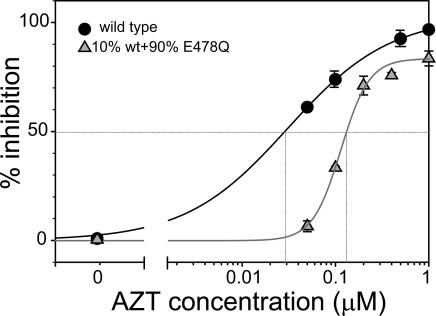
AZT-susceptibility profile for phenotypically mixed RNase-H-defective HIV-1 virions. RNase-H-defective HIV-1 virions were generated by cotransfection of wild-type pNLuc DNA and RNase-H-defective mutant pNLuc-E478Q DNA at a 1:9 ratio. Intersections of vertical lines with the drug concentration axis show the IC50 value for each curve. Representative graphs are shown.
Fig. 4.
Fig. 4.
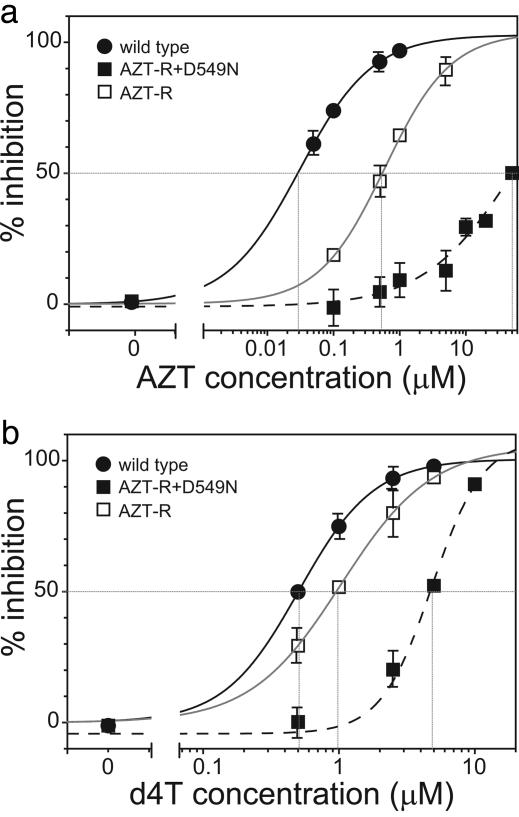
Drug-susceptibility profile for HIV-1 RT mutants containing a combination of TAM and RNase H mutations. Phenotypic drug-susceptibility testing for AZT (a) and d4T (b) was performed with pNLuc-based viruses. The genotypes of the viruses were wild type (filled circles), AZT-resistant mutant (AZT-R) with four TAM (D67N, K70R, T215Y, and K219Q) (open squares), and mutant containing a combination of four TAM and RNase H mutation D549N (AZT-R+549N) (filled squares). Intersections of vertical lines with the drug concentration axis show the IC50 value for each curve. Representative graphs are shown.

References

    1. Havlir, D. V. (2002) Proc. Natl. Acad. Sci. USA 99, 4-6. - PMC - PubMed
    1. Shafer, R. W., Winters, M. A., Palmer, S. & Merigan, T. C. (1998) Ann. Intern. Med. 128, 906-911. - PubMed
    1. Goldschmidt, V. & Marquet, R. (2004) Intern. J. Biochem. Cell Biol. 36, 1687-1705. - PubMed
    1. Arion, D., Kaushik, N., McCormick, S., Borkow, G. & Parniak, M. A. (1998) Biochemistry 37, 15908-15917. - PubMed
    1. Meyer, P. R., Matsuura, S. E., Mian, A. M., So, A. G. & Scott, W. A. (1999) Mol. Cell 4, 35-43. - PubMed