


doi: 10.1073/pnas.0409336102.
Epub 2005 Feb 4.
Nanoparticle-based detection in cerebral spinal fluid of a soluble pathogenic biomarker for Alzheimer's disease
Affiliations
- PMID: 15695586
- PMCID: PMC548981
- DOI: 10.1073/pnas.0409336102
Item in Clipboard
Nanoparticle-based detection in cerebral spinal fluid of a soluble pathogenic biomarker for Alzheimer's disease
Proc Natl Acad Sci U S A.
.
Abstract
The recently developed ultrasensitive bio-barcode assay was used to measure the concentration of amyloid-beta-derived diffusible ligands (ADDLs), a potential soluble pathogenic Alzheimer's disease (AD) marker, in the cerebrospinal fluid (CSF) of 30 individuals. ADDL concentrations for the subjects diagnosed with AD were consistently higher than the levels in the CSF taken from nondemented age-matched controls. Studies of ADDLs or for any other potential pathogenic AD markers in CSF have not been possible because of their low concentration in CSF (<1 pM). This study is a step toward a diagnostic tool, based on soluble pathogenic markers for the debilitating disease.
Figures
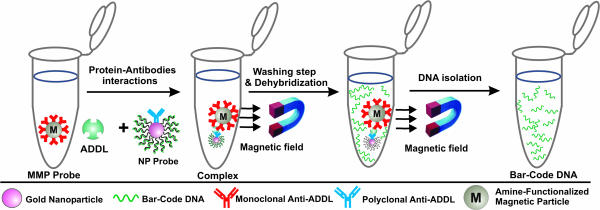
The bio-barcode amplification assay. The assay uses MMPs functionalized with mAbs that recognize and bind ADDLs. The ADDLs are then sandwiched with an NP probe, modified with double-stranded DNA and an anti-ADDL pAb. After repeated washing while using a magnet to immobilize the MMPs, a dehybridization step releases hundreds of barcode DNA strands for each antigen-binding event.

Schematic representation of scanometric detection. The method is based on capturing the barcode DNA on a microarray with spots of oligonucleotides that are complementary to half of the barcode DNA sequence. NPs with oligonucleotides that are complementary to the other half of the barcode DNA are hybridized to the captured barcode strands. The signal is enhanced by using silver amplification, and the results are recorded with the Verigene ID system, which measures scattered light intensity from each spot (see Materials and Methods). Depending on the silver amplification time and the experimental conditions, the response can vary for each slide. For this reason, the grayscale intensity of the developed spots is then measured and averaged for each ADDL concentration (Inset).
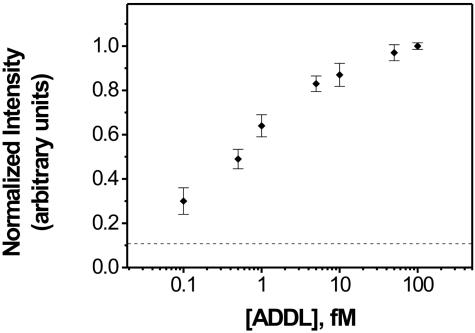
A normalized grayscale intensity calibration curve for synthetic ADDL concentration based on a serial dilution study. Each point is an average of at least four responses.

Scatter plot from the scanometric detection of barcode DNA released from the bio-barcode assay for 30 subjects. The response for the negative human control subject (brain extract) was similar to that observed for the chip control (dashed line in Fig. 1). The positive control exhibited a response that was off scale and could not be quantified. The data points are averages of three separate experiments normalized for each assay based on the highest response in a series of runs. The mean values for ADDL concentrations (solid lines) are estimated for each group based on the calibration curve in Fig. 1.
Comment in
-
Nanoscience enables ultrasensitive detection of Alzheimer's biomarker.Proc Natl Acad Sci U S A. 2005 Feb 15;102(7):2263-4. doi: 10.1073/pnas.0500024102. Epub 2005 Feb 9. Proc Natl Acad Sci U S A. 2005. PMID: 15703290 Free PMC article. No abstract available.
References
-
- Citron, M. (2002) Nat. Neurosci. 5, 1055-1057. - PubMed
-
- Prussiner, S., Rosenberg, R., Di Mauro, S. & Barche, R., eds. (1997) The Molecular and Genetic Basis of Neurological Disease (Butterworth–Heinemann, Boston), 2nd Ed.
-
- Phelps, C., Khachaturian, Z. & Trojanowski, J. Q. (1997) Neurobiol. Aging 18, S1-S2.
-
- Heckl, S., Pipkorn, R., Nägele, T., Vogel, U., Küker, W. & Voight, K. (2004) Histol. Histopathol. 19, 651-668. - PubMed
Publication types
MeSH terms
Substances
Grants and funding
LinkOut - more resources
Full Text Sources
Other Literature Sources
Medical
Research Materials
