


A variant in the HS1-BP3 gene is associated with familial essential tremor
- PMID: 15699368
- PMCID: PMC1201396
- DOI: 10.1212/01.WNL.0000153481.30222.38
A variant in the HS1-BP3 gene is associated with familial essential tremor
Abstract
Background: Genetic linkage studies have identified two susceptibility loci for essential tremor (ET) on chromosomes 3q13 (ETM1) and 2p24.1 (ETM2). Linkage disequilibrium studies in separate population samples from the United States and Singapore suggest an association between ET and loci at ETM2.
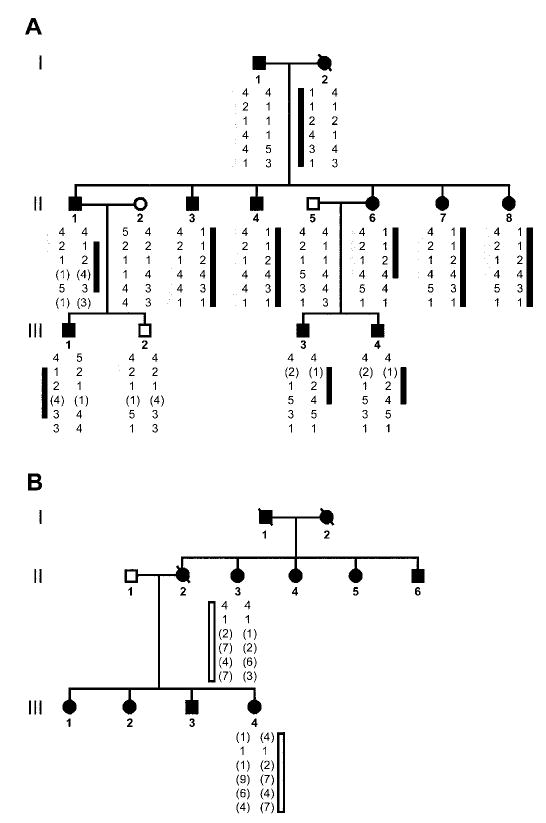
Methods: Fine mapping studies were conducted on multiplex and singleton US families linked to ETM2 using newly detected loci within the candidate interval to establish the minimal critical region (MCR) harboring an ET gene. The genes and transcripts within this interval were systematically analyzed by single-strand conformational polymorphism analysis and DNA sequencing.
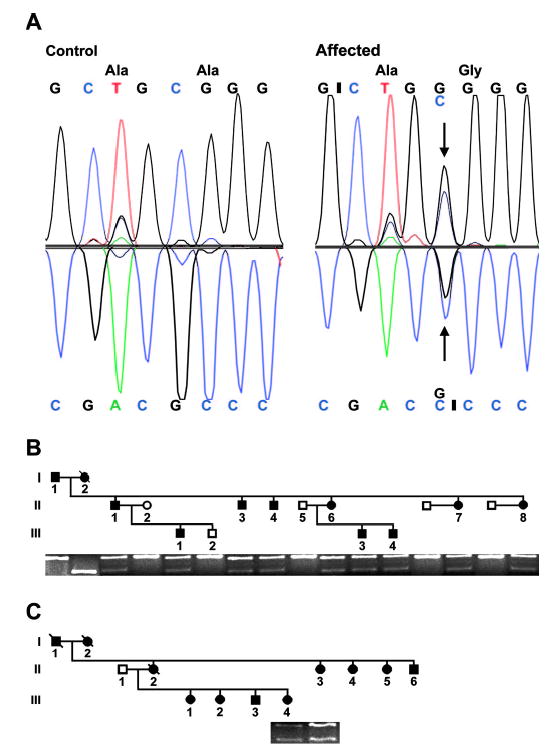
Results: A 464-kb region between loci D2S2150 and etm1231 was defined as the MCR. The coding regions and flanking intronic splice sites of two genes and seven transcripts in this interval were evaluated for mutations. A missense mutation (828C-->G) in the transcript FLJ14249 (HS1-BP3) was identified in one US family. This mutation was found in another apparently unrelated US family with ET and was absent in 150 control samples (300 chromosomes). The 828C-->G mutation causes a substitution of a glycine for an alanine residue in the HS1-BP3 protein. The HS1-BP3 protein binds to proteins that are highly expressed in motor neurons and Purkinje cells and regulate the Ca2+/calmodulin-dependent protein kinase activation of tyrosine and tryptophan hydroxylase.
Conclusions: A rare variant in the HS1-BP3 gene that is associated with essential tremor (ET) in two families is reported. This finding will facilitate research on the functional role of this gene and related genes in the pathogenesis of ET.
Figures
Comment in
-
A variant in the HS1-BP3 gene is associated with familial essential tremor.Neurology. 2005 Dec 27;65(12):1995; author reply 1995. doi: 10.1212/01.wnl.0000200984.10076.e5. Neurology. 2005. PMID: 16380635 No abstract available.
References
-
- Louis ED, Ottman R, Hauser WA. How common is the most common adult movement disorder? Estimates of the prevalence of essential tremor throughout the world. Mov Disord. 1998;13:5–10. - PubMed
-
- Gulcher JR, Jonsson P, Kong A, et al. Mapping of a familial essential tremor gene, FET1, to chromosome 3q13. Nat Genet. 1997;17:84–87. - PubMed
-
- Illarioshkin SN, Rakhmonov RA, Ivanova-Smolenskaia IA, et al. [Molecular genetic analysis of essential tremor] Genetika. 2002;38:1704–1709. - PubMed
-
- Higgins JJ, Pho LT, Nee LE. A gene (ETM) for essential tremor maps to chromosome 2p22-p25. Mov Disord. 1997;12:859–864. - PubMed
-
- Higgins JJ, Loveless JM, Jankovic J, Patel PI. Evidence that a gene for essential tremor maps to chromosome 2p in four families. Mov Disord. 1998;13:972–977. - PubMed
Publication types
MeSH terms
Substances
Grants and funding
LinkOut - more resources
Full Text Sources
Other Literature Sources
Molecular Biology Databases
Research Materials
Miscellaneous
