Immunization of Saimiri sciureus monkeys with a recombinant hybrid protein derived from the Plasmodium falciparum antigen glutamate-rich protein and merozoite surface protein 3 can induce partial protection with Freund and Montanide ISA720 adjuvants
- PMID: 15699417
- PMCID: PMC549299
- DOI: 10.1128/CDLI.12.2.242-248.2005
Immunization of Saimiri sciureus monkeys with a recombinant hybrid protein derived from the Plasmodium falciparum antigen glutamate-rich protein and merozoite surface protein 3 can induce partial protection with Freund and Montanide ISA720 adjuvants
Abstract
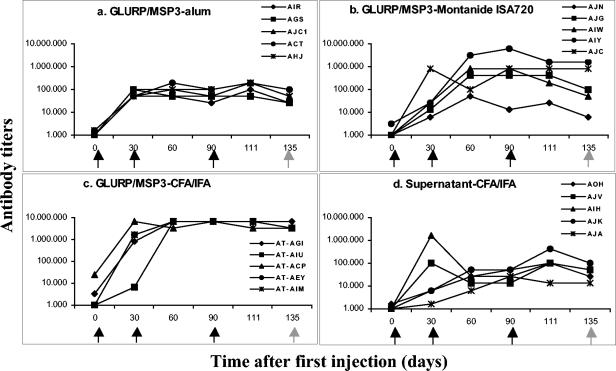
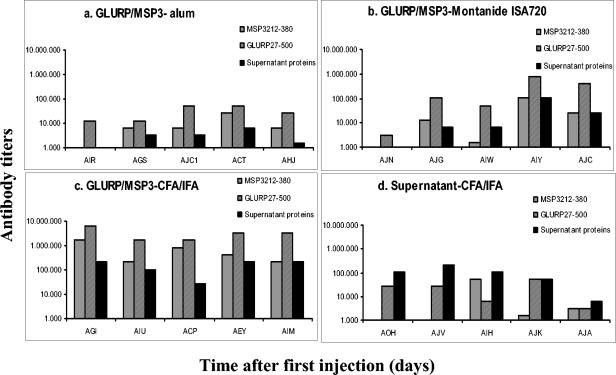
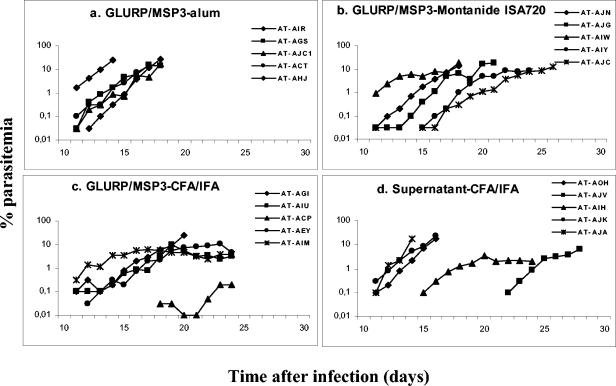
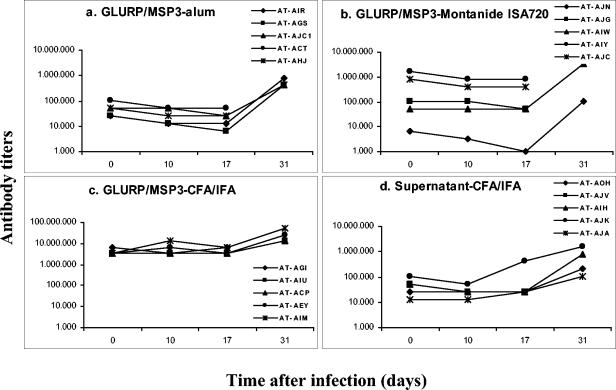
The immunogenicity and efficacy of a hybrid recombinant protein derived from the N-terminal end of the glutamate-rich protein (GLURP) and the C-terminal portion of the merozoite surface protein 3 (MSP3) of Plasmodium falciparum was evaluated in Saimiri sciureus monkeys. The GLURP/MSP3 hybrid protein, expressed in Lactococcus lactis, was administered in association with alum, Montanide ISA720, or complete or incomplete Freund adjuvant (CFA/IFA) in groups of five animals each. The three formulations were shown to be immunogenic, but the one with alum was shown to be weak compared to the other two, particularly CFA/IFA, which provided very high antibody titers (enzyme-linked immunosorbent assay titers of >3,000,000 and immunofluorescence antibody test titers of 6,400). After a challenge infection with P. falciparum FUP strain, all five monkeys from the GLURP/MSP3-alum group showed a rapid increase in parasitemia, reaching 10% and were treated early. The two monkeys with the highest antibody titers in group GLURP/MSP3-Montanide ISA720 had a delay in the course of parasitemia and were treated late due to a low hematocrit. In the GLURP/MSP3-CFA/IFA group, parasitemia remained below this threshold in four of the five animals and, after it reached a peak, parasitemia started to decrease and monkeys were treated late. When all animals were grouped according to the outcome, a statistically significant association between high antibody titers and partial protection was observed. The challenge infection boosted the antibody titers, and the importance of this event for vaccine efficacy in areas where this parasite is endemic is discussed. In conclusion, these data suggest that GLURP and MSP3 can induce protection against malaria infection if antibodies are induced at properly high titers.
Figures
References
-
- Breman, J. G. 2001. The ears of the hippopotamus: manifestations, determinants, and estimates of the malaria burden. Am. J. Trop. Med. Hyg. 64:1-11. - PubMed
-
- Borre, M. B., B. M. Dziegel, Hogh, E. Petersen, K. Rieneck, R. Riley, J. F. Meis, M. Aikawa, K. Nakamura, M. Harada, A. Wind, P. H. Jakobsen, J. Cowland, S. Jepsen, N. H. Axelsen, and J. Vuust. 1991. Primary structure and localization of a conserved immunogenic Plasmodium falciparum glutamate-rich protein (GLURP) expressed in both the pre-erythrocytic and erythrocytic stages of the vertebrate life cycle. Mol. Biochem. Parasitol. 49:119-132. - PubMed
-
- Carvalho, L. J. M., F. A. Alves, S. G. Oliveira, R. D. R. Valle, A. A. M. Fernandes, J. A. P. C. Muniz, and C. T. Daniel-Ribeiro. 2003. Severe anemia affects both splenectomized and non-splenectomized Plasmodium falciparum-infected Aotus infulatus monkeys. Mem. Inst. Oswaldo Cruz. 98:679-686. - PubMed
-
- Carvalho, L. J. M., C. T. Daniel-Ribeiro, and H. Goto. 2002. Malaria vaccine: candidate antigens, mechanisms, constraints, and prospects. Scand. J. Immunol. 56:327-343. - PubMed
-
- Carvalho, L. J., S. G. Oliveira, M. Theisen, F. A. Alves, M. C. Andrade, G. M. Zanini, M. C. Brigido, C. Oeuvray, M. M. Povoa, J. A. Muniz, P. Druilhe, and C. T. Daniel-Ribeiro. 2004. Immunization of Saimiri sciureus monkeys with Plasmodium falciparum merozoite surface protein-3 and glutamate-rich protein suggests that protection is related to antibody levels. Scand. J. Immunol. 59:363-372. - PubMed
Publication types
MeSH terms
Substances
LinkOut - more resources
Full Text Sources
Other Literature Sources