


Nitrolinoleic acid: an endogenous peroxisome proliferator-activated receptor gamma ligand
- PMID: 15701701
- PMCID: PMC548962
- DOI: 10.1073/pnas.0408384102
Nitrolinoleic acid: an endogenous peroxisome proliferator-activated receptor gamma ligand
Abstract
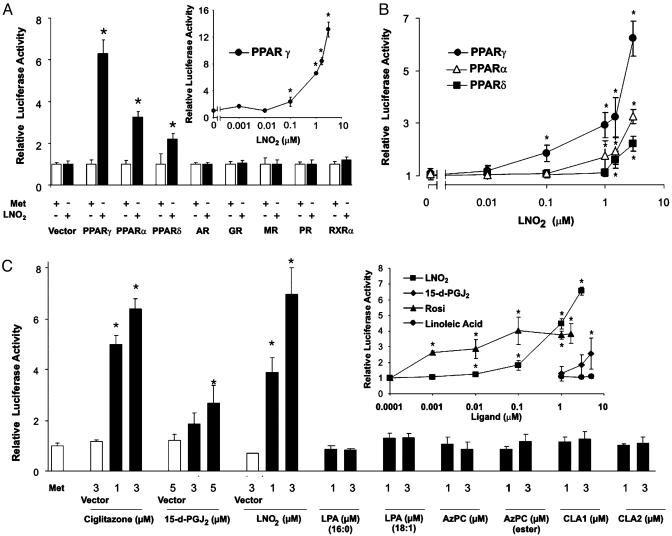
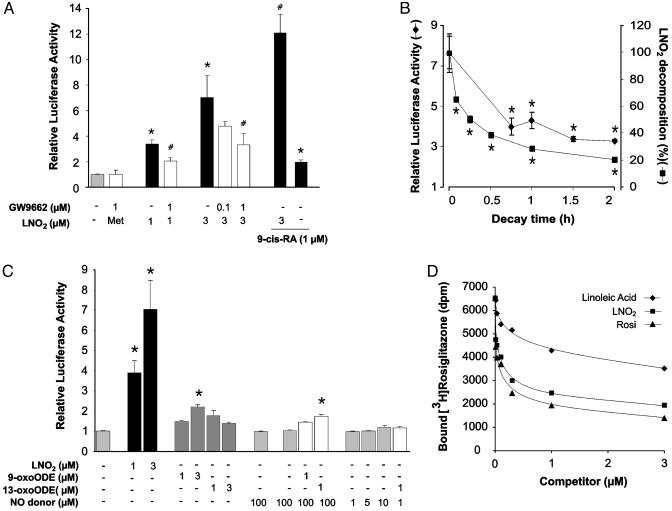
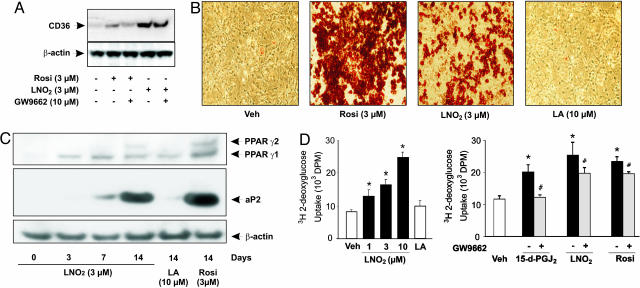
Nitroalkene derivatives of linoleic acid (nitrolinoleic acid, LNO2) are formed via nitric oxide-dependent oxidative inflammatory reactions and are found at concentrations of approximately 500 nM in the blood of healthy individuals. We report that LNO2 is a potent endogenous ligand for peroxisome proliferator-activated receptor gamma (PPARgamma; Ki approximately 133 nM) that acts within physiological concentration ranges. This nuclear hormone receptor (PPARgamma) regulates glucose homeostasis, lipid metabolism, and inflammation. PPARgamma ligand activity is specific for LNO2)and not mediated by LNO2 decay products, NO donors, linoleic acid (LA), or oxidized LA. LNO2 is a significantly more robust PPARgamma ligand than other reported endogenous PPARgamma ligands, including lysophosphatidic acid (16:0 and 18:1), 15-deoxy-Delta12,14-PGJ2, conjugated LA and azelaoyl-phosphocholine. LNO2 activation of PPARgamma via CV-1 cell luciferase reporter gene expression analysis revealed a ligand activity that rivals or exceeds synthetic PPARgamma agonists such as rosiglitazone and ciglitazone, is coactivated by 9 cis-retinoic acid and is inhibited by the PPARgamma antagonist GW9662. LNO2 induces PPARgamma-dependent macrophage CD-36 expression, adipocyte differentiation, and glucose uptake also at a potency rivaling thiazolidinediones. These observations reveal that NO-mediated cell signaling reactions can be transduced by fatty acid nitration products and PPAR-dependent gene expression.
Figures
References
-
- Schopfer, F. J., Baker, P. R. & Freeman, B. A. (2003) Trends Biochem. Sci. 28, 646-654. - PubMed
-
- Hogg, N. (2002) Annu. Rev. Pharmacol. Toxicol. 42, 585-600. - PubMed
-
- Rubbo, H., Radi, R., Anselmi, D., Kirk, M., Barnes, S., Butler, J., Eiserich, J. P. & Freeman, B. A. (2000) J. Biol. Chem. 275, 10812-10818. - PubMed
-
- Marnett, L. J., Wright, T. L., Crews, B. C., Tannenbaum, S. R. & Morrow, J. D. (2000) J. Biol. Chem. 275, 13427-13430. - PubMed
-
- O'Donnell, V. B. & Freeman, B. A. (2001) Circ. Res. 88, 12-21. - PubMed
Publication types
MeSH terms
Substances
Grants and funding
- HL03676/HL/NHLBI NIH HHS/United States
- R01 HL068878/HL/NHLBI NIH HHS/United States
- R37 HL058115/HL/NHLBI NIH HHS/United States
- S06GM08248/GM/NIGMS NIH HHS/United States
- R01 HL058115/HL/NHLBI NIH HHS/United States
- T32HL07457/HL/NHLBI NIH HHS/United States
- R25 HL003676/HL/NHLBI NIH HHS/United States
- T32 HL007457/HL/NHLBI NIH HHS/United States
- S06 GM008248/GM/NIGMS NIH HHS/United States
- HL64937/HL/NHLBI NIH HHS/United States
- UH1 HL003676/HL/NHLBI NIH HHS/United States
- R01 HL064937/HL/NHLBI NIH HHS/United States
- HL075397/HL/NHLBI NIH HHS/United States
- R01 HL075397/HL/NHLBI NIH HHS/United States
- HL58115/HL/NHLBI NIH HHS/United States
- HL068878/HL/NHLBI NIH HHS/United States
LinkOut - more resources
Full Text Sources
Other Literature Sources
