. 2005 Apr;16(4):2018-27.
doi: 10.1091/mbc.e04-12-1056. Epub 2005 Feb 9.

Developmental activation of the Rb-E2F pathway and establishment of cell cycle-regulated cyclin-dependent kinase activity during embryonic stem cell differentiation

Affiliations

Developmental activation of the Rb-E2F pathway and establishment of cell cycle-regulated cyclin-dependent kinase activity during embryonic stem cell differentiation

Josephine White et al. Mol Biol Cell. 2005 Apr.

Abstract

To understand cell cycle control mechanisms in early development and how they change during differentiation, we used embryonic stem cells to model embryonic events. Our results demonstrate that as pluripotent cells differentiate, the length of G(1) phase increases substantially. At the molecular level, this is associated with a significant change in the size of active cyclin-dependent kinase (Cdk) complexes, the establishment of cell cycle-regulated Cdk2 activity and the activation of a functional Rb-E2F pathway. The switch from constitutive to cell cycle-dependent Cdk2 activity coincides with temporal changes in cyclin A2 and E1 protein levels during the cell cycle. Transcriptional mechanisms underpin the down-regulation of cyclin levels and the establishment of their periodicity during differentiation. As pluripotent cells differentiate and pRb/p107 kinase activities become cell cycle dependent, the E2F-pRb pathway is activated and imposes cell cycle-regulated transcriptional control on E2F target genes, such as cyclin E1. These results suggest the existence of a feedback loop where Cdk2 controls its own activity through regulation of cyclin E1 transcription. Changes in rates of cell division, cell cycle structure and the establishment of cell cycle-regulated Cdk2 activity can therefore be explained by activation of the E2F-pRb pathway.


Figures
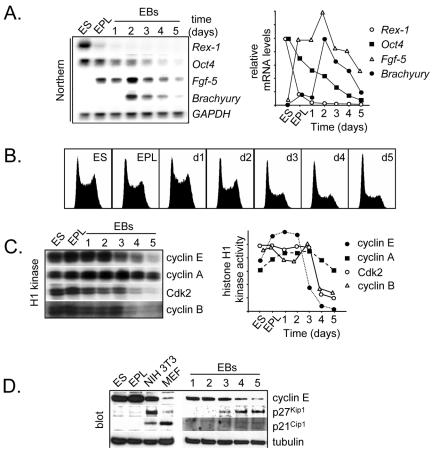
Figure 1.
Figure 1.
Changes in Cdk activity accompany restructuring of the cell cycle during ES cell differentiation. (A) EPL cells derived directly from ES cells were grown as EBs for 5 d in the absence of LIF. At each day, transcript levels for Rex1, Oct4, Fgf5, Brachyury, and GAPDH were evaluated by Northern blot. Quantitation of mRNA levels was by phosphorimaging and is shown relative to GAPDH levels. (B) Flow cytometry of PI-stained cells from ES cells, EPL cells, and EBs at the times indicated. (C) Cdk2, cyclin A2, B1, and E1 immunoprecipitates from whole cell lysates (100 μg of protein) were assayed for histone H1 activity and then quantitated by phosphorimaging. (D) Lysates (20 μg of protein) from ES cells, EPL cells, MEFs (passage 3), NIH 3T3 fibroblasts, and EBs (day 1–5) were subject to immunoblot analysis by probing for cyclin E1, p21Cip1, p27Kip1, and β-tubulin (load control).
Figure 2.
Figure 2.
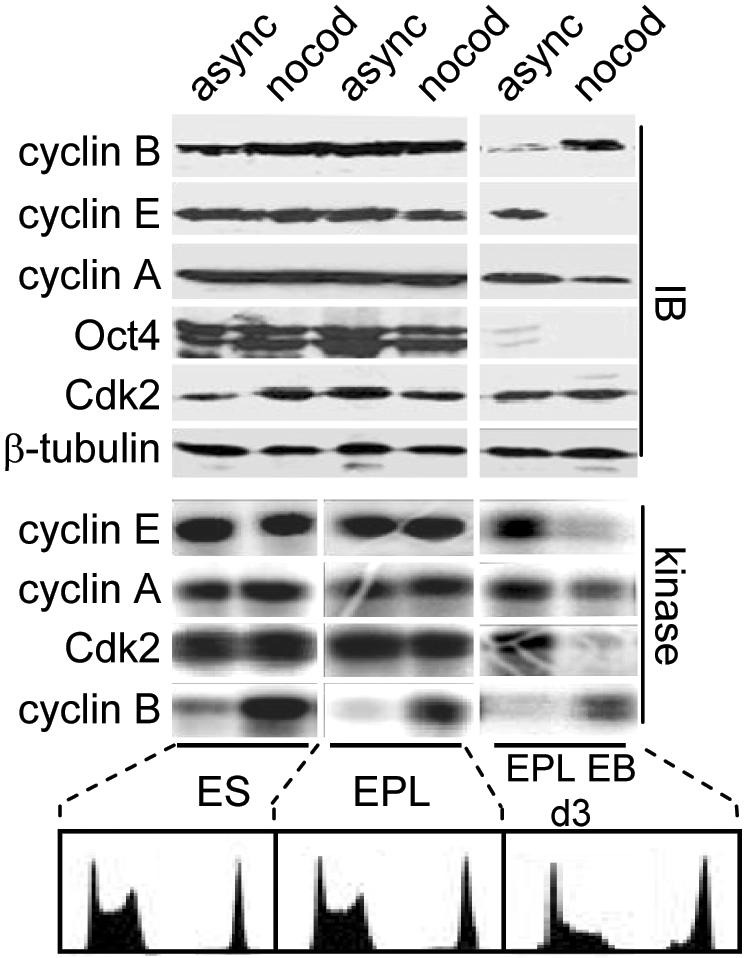
Establishment of cell cycle-regulated Cdk activity during EB differentiation. Asynchronous (async) or nocodazole (nocod)-blocked ES cells, EPL cells, or day 3 EBs were harvested and subject to immunoblot analysis (IB) or assayed for H1 kinase activity. Cell cycle profiles of PI-stained cells are shown (bottom).
Figure 3.
Figure 3.
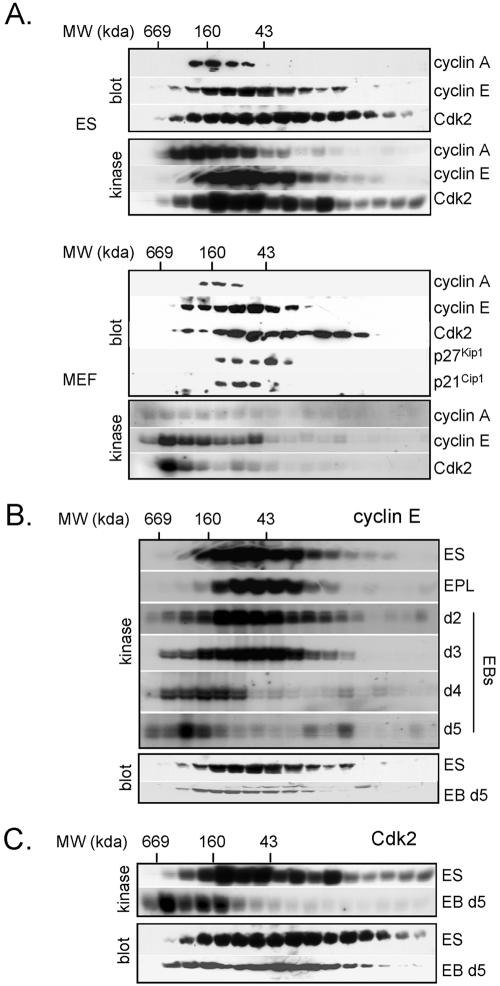
Redistribution of active Cdk activity into higher order complexes during differentiation. (A) Whole cell lysates from ES cells and MEFs (passage 3) were fractionated by size exclusion chromatography. Cdk2, cyclin A2, and cyclin E1 H1 kinase activities and protein levels were evaluated in alternate fractions. Gel filtration columns were calibrated using molecular mass markers. Lysates from ES cells, EPL cells, and EBs (day 2–5) were fractionated as described in A and assayed for cyclin E1 (B) or Cdk2 activity (C). Corresponding fractions also were subject to immunoblot analysis. To highlight differences in elution profiles, equivalent exposures are not represented; ES, EPL, and EPLEB days 2 and 3 are similar exposures, whereas EBs days 4 and 5 are longer exposures. Note that immunoblots and kinase assays in A were exposed for longer periods for analysis of MEF lystates to allow a more direct comparison of elution profiles with ES cell lysates.
Figure 4.
Figure 4.
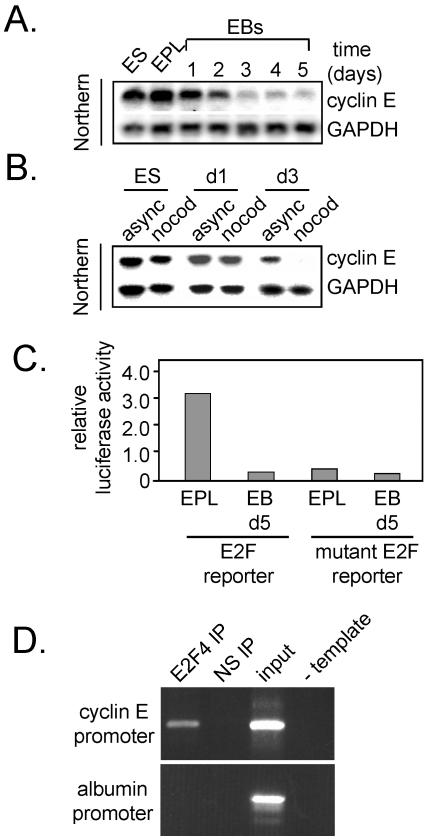
Down-regulation of cyclin E1 mRNA due to the collapse of E2F transcriptional activity during EB differentiation. (A) Cyclin E1 and GAPDH mRNA levels in cell samples (as in Figure 1) were evaluated by Northern blotting. Quantitation of transcript levels was determined by PhosphorImager analysis relative to the GAPDH control. (B) Cyclin E1 and GAPDH mRNA levels in asynchronous or nocodazole-blocked ES cells and day 1 and day 3 EBs. (C) Clonal ES cell lines with stably integrated luciferase reporters driven by E2F or mutated E2F sites were differentiated into EPL or day 5 EBs. Protein harvested from cells and bodies was analyzed for luciferase activity. Luciferase units were normalized using protein concentrations. Data represents a typical experiment. (D) ChIP analysis of E2F4 binding activity on the cyclin E1 and albumin promoters in ES cells. Cross-linked chromatin (700 μg) from asynchronous ES cells was incubated with E2F4 or cdc25a (nonspecific) antibodies. Immunoprecipitated DNA was analyzed by PCR by using primers specific for different promoters. PCR controls included analysis of 0.03% of the total input chromatin (input) and the addition of water instead of input DNA (– template).
Figure 5.
Figure 5.
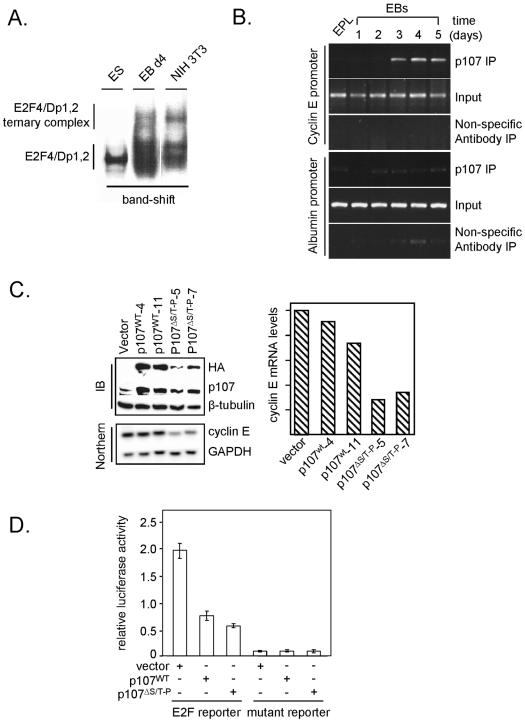
Recruitment of p107 to the cyclin E1 promoter corresponds to changes in cyclin E1 mRNA during differentiation. (A) E2F ternary complexes form during ES cell differentiation. Band shift analysis using extracts from asynchronous ES, EB day 4, and NIH 3T3 cells. (B) ChIP analysis of p107 binding activity on the cyclin E1 and albumin promoters in EPL cells and during differentiation. Cross-linked chromatin (700 μg) from asynchronous EPL cells and EPLEBs was incubated with p107 or cdc25a (nonspecific) antibodies. Immunoprecipitated DNA was analyzed by PCR by using primers specific for the cyclin E1 and albumin promoters. To ensure equal concentrations of chromatin was analyzed, PCRs on 0.03% of the total input chromatin (input) were conducted. (C) Ectopic p107 represses endogenous cyclin E1 transcription in ES cells. ES cells were stably transfected with pCAG vector (vector), pCAG-p107wt or pCAG-p107ΔS/T-P. Stably integrated forms of p107, from different clonal lines, were detected via HA tags by immunoblot analysis. Cyclin E1 and GAPDH mRNA levels in cell samples were evaluated by Northern blotting. Quantitation of transcript levels was determined by phosphorimager analysis relative to the GAPDH control. (D) Ectopic p107 represses endogenous E2F activity in ES cells. ES cells were transfected with the E2F- or mutated E2F-luciferase reporter, a Renilla control, and 50 ng of empty pCAG expression vector (Vector), wild-type p107 (p107wt), or mutant p107 (p107ΔS/T-P). Firefly luciferase activity was normalized to Renilla luciferase activity, and data are presented as relative activity. Experiments were performed in triplicate, and data represent a typical experiment.
Figure 6.
Figure 6.
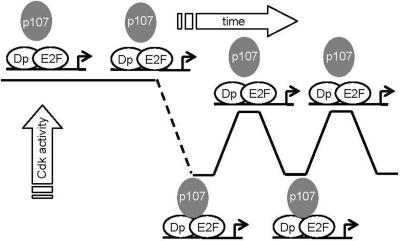
Establishment of G1 regulatory (R-point) controls through cell cycle-regulated Cdk2 activity during ES cell differentiation. Pluripotent ES cells exhibit elevated, constitutive Cdk activities, pRb family members are inactive and E2F-dependent transcription is cell cycle independent. During differentiation, Cdk activities collapse and become cell cycle regulated. As part of the establishment of cell cycle regulation, p107 and other pocket proteins (such as pRb and p130) become active and are able to repress E2F target genes during G1. Which of these events occurs first is unknown.

References

    1. Ashizawa, S., Nishizawa, H., Yamada, M., Higashi, H., Kondo, T., Ozawa, H., Kakita, A., and Hatakeyama, M. (2001). Collective inhibition of pRB family proteins by phosphorylation in cells with p16INK4a loss or cyclin E overexpression. J. Biol. Chem. 276, 11362-11370. - PubMed
    1. Blow, J. J., and Hodgson, B. (2002). Replication licensing-defining the proliferative state? Trends Cell Biol. 12, 72-78. - PMC - PubMed
    1. Breeden, L. L. (2003). Periodic transcription: a cycle within a cycle. Curr. Biol. 13, R31-R38. - PubMed
    1. Bremner, R., Cohen, B. L., Sopta, M., Hamel, P. A., Ingles, C. J., Gallie, B. L., and Phillips, R. A. (1995). Direct transcriptional repression by pRB and its reversal by specific cyclins. Mol. Cell. Biol. 15, 3256-3265. - PMC - PubMed
    1. Cartwright, P., Muller, H., Wagener, C., Holm, K., and Helin, K. (1998). E2F-6, a novel member of the E2F family is an inhibitor of E2F-dependent transcription. Oncogene 17, 611-623. - PubMed

MeSH terms