Multidrug-resistant Acinetobacter baumannii
- PMID: 15705318
- PMCID: PMC3294361
- DOI: 10.3201/eid1101.040001
Multidrug-resistant Acinetobacter baumannii
Abstract
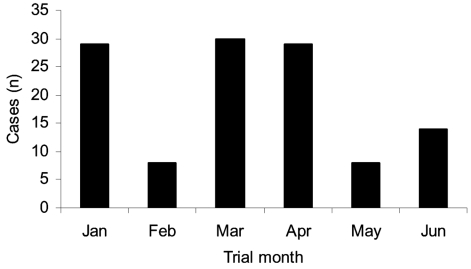
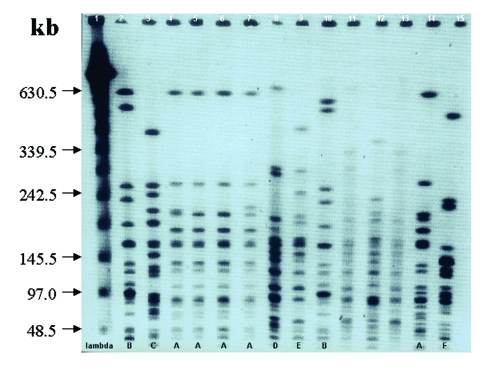
To understand the epidemiology of multidrug-resistant (MDR) Acinetobacter baumannii and define individual risk factors for multidrug resistance, we used epidemiologic methods, performed organism typing by pulsed-field gel electrophoresis (PFGE), and conducted a matched case-control retrospective study. We investigated 118 patients, on 27 wards in Israel, in whom MDR A. baumannii was isolated from clinical cultures. Each case-patient had a control without MDR A. baumannii and was matched for hospital length of stay, ward, and calendar time. The epidemiologic investigation found small clusters of up to 6 patients each with no common identified source. Ten different PFGE clones were found, of which 2 dominated. The PFGE pattern differed within temporospatial clusters, and antimicrobial drug susceptibility patterns varied within and between clones. Multivariate analysis identified the following significant risk factors: male sex, cardiovascular disease, having undergone mechanical ventilation, and having been treated with antimicrobial drugs (particularly metronidazole). Penicillins were protective. The complex epidemiology may explain why the emergence of MDR A. baumannii is difficult to control.
Figures
Similar articles
-
A prospective multicenter study on the evaluation of antimicrobial resistance and molecular epidemiology of multidrug-resistant Acinetobacter baumannii infections in intensive care units with clinical and environmental features.Ann Clin Microbiol Antimicrob. 2019 Jul 2;18(1):19. doi: 10.1186/s12941-019-0319-8. Ann Clin Microbiol Antimicrob. 2019. PMID: 31266519 Free PMC article.
-
Emergence and characterization of nosocomial multidrug-resistant and extensively drug-resistant Acinetobacter baumannii isolates in Tehran, Iran.J Infect Chemother. 2018 Jul;24(7):515-523. doi: 10.1016/j.jiac.2018.02.009. Epub 2018 Mar 16. J Infect Chemother. 2018. PMID: 29555392
-
Clonal evolution multi-drug resistant Acinetobacter baumannii by pulsed-field gel electrophoresis.Indian J Med Microbiol. 2015 Jan-Mar;33(1):87-91. doi: 10.4103/0255-0857.148390. Indian J Med Microbiol. 2015. PMID: 25560008
-
Acinetobacter baumannii: an emerging opportunistic pathogen.Virulence. 2012 May 1;3(3):243-50. doi: 10.4161/viru.19700. Epub 2012 May 1. Virulence. 2012. PMID: 22546906 Free PMC article. Review.
-
An increasing threat in hospitals: multidrug-resistant Acinetobacter baumannii.Nat Rev Microbiol. 2007 Dec;5(12):939-51. doi: 10.1038/nrmicro1789. Nat Rev Microbiol. 2007. PMID: 18007677 Review.
Cited by
-
Poly-N-acetyl-β-(1-6)-glucosamine is a target for protective immunity against Acinetobacter baumannii infections.Infect Immun. 2012 Feb;80(2):651-6. doi: 10.1128/IAI.05653-11. Epub 2011 Nov 21. Infect Immun. 2012. PMID: 22104104 Free PMC article.
-
Carbapenem Resistance in Acinetobacter baumannii and Other Acinetobacter spp. Causing Neonatal Sepsis: Focus on NDM-1 and Its Linkage to ISAba125.Front Microbiol. 2016 Aug 8;7:1126. doi: 10.3389/fmicb.2016.01126. eCollection 2016. Front Microbiol. 2016. PMID: 27551277 Free PMC article.
-
Piscidin is highly active against carbapenem-resistant Acinetobacter baumannii and NDM-1-producing Klebsiella pneumonia in a systemic Septicaemia infection mouse model.Mar Drugs. 2015 Apr 14;13(4):2287-305. doi: 10.3390/md13042287. Mar Drugs. 2015. PMID: 25874924 Free PMC article.
-
Further increase of vancomycin-resistant Enterococcus faecium, amikacin- and fluoroquinolone-resistant Klebsiella pneumoniae, and imipenem-resistant Acinetobacter spp. in Korea: 2003 KONSAR surveillance.Yonsei Med J. 2006 Feb 28;47(1):43-54. doi: 10.3349/ymj.2006.47.1.43. Yonsei Med J. 2006. PMID: 16502484 Free PMC article.
-
The Importance of Acinetobacter Species in the Hospital Environment.Med Arch. 2018 Nov;72(5):325-329. doi: 10.5455/medarh.2018.72.330-334. Med Arch. 2018. PMID: 30524162 Free PMC article.
References
-
- Gales AC, Jones RN, Forward KR, Linares J, Sader SH, Verhoef J. Emerging importance of multidrug-resistant Acinetobacter species and Stentrophomonas maltophilia as pathogens in seriously ill patients: geographic patterns, epidemiological features and trends in the SENTRY Antimicrobial Surveillance Program (1997–1999). Clin Infect Dis. 2001;32(Suppl 2):104–13. 10.1086/320183 - DOI - PubMed
-
- Go ES, Urban C, Burns J, Kreiswirth B, Eisner W, Mariano N, et al. Clinical and molecular epidemiology of Acinetobacter infections sensitive only to polymyxin B and sulbactam. Lancet North Am Ed. 1994;344:1329–32. - PubMed
MeSH terms
LinkOut - more resources
Full Text Sources