. 2005 Mar;79(5):2823-30.
doi: 10.1128/JVI.79.5.2823-2830.2005.

Detection of antibody-dependent complement-mediated inactivation of both autologous and heterologous virus in primary human immunodeficiency virus type 1 infection

Affiliations

Detection of antibody-dependent complement-mediated inactivation of both autologous and heterologous virus in primary human immunodeficiency virus type 1 infection

Marlén M I Aasa-Chapman et al. J Virol. 2005 Mar.

Abstract

Specific CD8 T-cell responses to human immunodeficiency virus type 1 (HIV-1) are induced in primary infection and make an important contribution to the control of early viral replication. The importance of neutralizing antibodies in containing primary viremia is questioned because they usually arise much later. Nevertheless antienvelope antibodies develop simultaneously with, or even before, peak viremia. We determined whether such antibodies might control viremia by complement-mediated inactivation (CMI). In each of seven patients studied, antibodies capable of CMI appeared at or shortly after the peak in viremia, concomitantly with detection of virus-specific T-cell responses. The CMI was effective on both autologous and heterologous HIV-1 isolates. Activation of the classical pathway and direct viral lysis were at least partly responsible. Since immunoglobulin G (IgG)-antibodies triggered the CMI, specific memory B cells could also be induced by vaccination. Thus, consideration should be given to vaccination strategies that induce IgG antibodies capable of CMI.


Figures
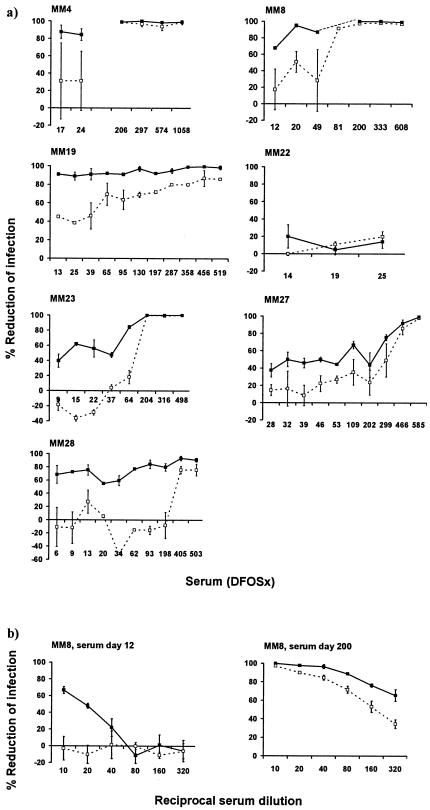
FIG. 1.
FIG. 1.
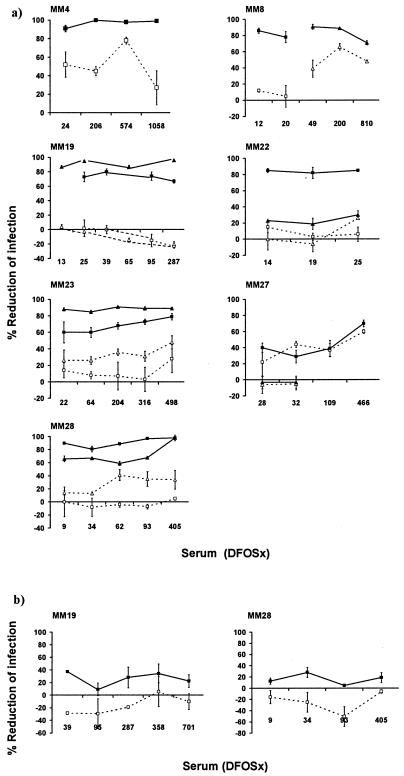
Development of CMI and neutralization activity in HIV-1-infected patients. (a) Percent reduction in infection of 100 FFU of autologous virus in the presence of sequential patient sera (at a dilution of 1:10), assayed in the presence (closed symbols) or absence (i.e., neutralization) (open symbols) of complement. HIV-1-seronegative sera served as the complement source (added at a final concentration of 10% [vol/vol]), and heat-inactivated aliquots served as negative controls. The error bars show standard deviations between two or three independent experiments. (b) Typical CMI and neutralization with increasing dilution of patient sera from an early and a later infection time point. The error bars show standard deviations between two independent experiments.
FIG. 2.
FIG. 2.
CMI and neutralization of heterologous viruses. For experimental details, see the legend to Fig. 1. Closed symbols represent CMI, and open symbols represent neutralization. The error bars show standard deviations between two or three independent experiments. (a) CMI and neutralization of heterologous viruses produced in 293T cells. Data for HIV-1YU2 are indicated with squares, and those for HIV-14.1.33 are indicated with triangles. (b) Data for HIV-1YU2 passaged through PBMC.
FIG. 3.
FIG. 3.
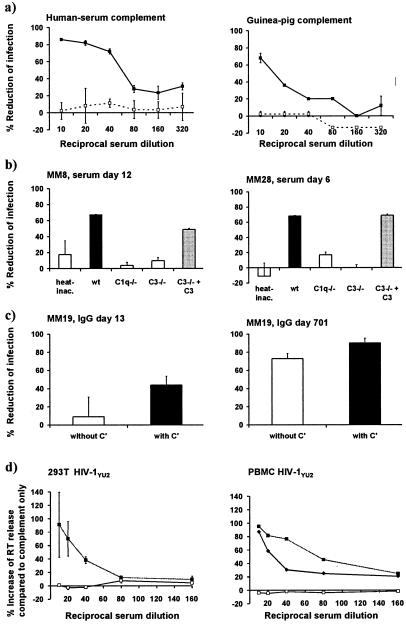
Characterization of the anti-HIV activity in patient sera. (a) Guinea pig complement can substitute for human complement in CMI assays with day 49 serum from patient MM8 (closed squares). CMI activity is lost following heat inactivation (open squares). (b) Serum from C1q- or C3-deficient individuals cannot mediate the antiviral activity observed with normal human serum as a complement source. Reconstitution of C3 restores the antiviral activity. (c) Affinity-purified IgG antibodies mediate the complement-dependent virus inactivation. Black and white bars represent activity in the presence of complement and in the presence of heat-inactivated complement, respectively. (d) Release of RT from virions was measured by the Lenti-RT activity assay (Cavidi Tech AB) under nonlysing detergent-free conditions after treatment with serum and complement. HIV-1YU2 derived from either 293T cells or PBMC was assayed for susceptibility to complement-mediated lysis. Nonimmune serum had no effect on RT release compared to complement alone (open squares). Immune serum, however, resulted in a 100% increase in RT activity (closed symbols). The data presented show the activity of MM28 sera from day 20 for the 293T-produced HIV-1YU2 and from day 34 (squares) and day 93 (diamonds) for PBMC-produced HIV-1YU2.

References

    1. Aasa-Chapman, M. M. I., A. Hayman, P. Newton, D. Cornforth, I. Williams, P. Borrow, P. Balfe, and A. McKnight. 2004. Development of the antibody response in acute HIV-1 infection. AIDS 18:371-381. - PubMed
    1. Albert, J., B. Abrahamsson, K. Nagy, E. Aurelius, H. Gaines, G. Nystrom, and E. M. Fenyo. 1990. Rapid development of isolate-specific neutralizing antibodies after primary HIV-1 infection and consequent emergence of virus variants which resist neutralization by autologous sera. AIDS 4:107-112. - PubMed
    1. Bajtay, Z., C. Speth, A. Erdei, and M. P. Dierich. 2004. Cutting edge: productive HIV-1 infection of dendritic cells via complement receptor type 3 (CR3, CD11b/CD18). J. Immunol. 173:4775-4778. - PubMed
    1. Blue, C. E., O. B. Spiller, and D. J. Blackbourn. 2004. The relevance of complement to virus biology. Virology 319:176-184. - PMC - PubMed
    1. Borrow, P., H. Lewicki, B. H. Hahn, G. M. Shaw, and M. B. Oldstone. 1994. Virus-specific CD8+ cytotoxic T-lymphocyte activity associated with control of viremia in primary human immunodeficiency virus type 1 infection. J. Virol. 68:6103-6110. - PMC - PubMed

Publication types