Prognostic factors for survival in patients with early-intermediate hepatocellular carcinoma undergoing non-surgical therapy: comparison of Okuda, CLIP, and BCLC staging systems in a single Italian centre
- PMID: 15710992
- PMCID: PMC1774422
- DOI: 10.1136/gut.2004.048124
Prognostic factors for survival in patients with early-intermediate hepatocellular carcinoma undergoing non-surgical therapy: comparison of Okuda, CLIP, and BCLC staging systems in a single Italian centre
Abstract
Background: Several prognostic models have been developed to stage hepatocellular carcinoma (HCC) but there is no general consensus on which is the most reliable. We compared three prognostic indices (Okuda, CLIP, and BCLC scoring systems) in a large series of cirrhotic patients with HCC undergoing non-surgical treatment in terms of their ability to classify patients into different risk groups
Methods: We retrospectively studied 268 Italian patients with HCC. A total of 146 patients were treated with ablation, 132 with percutaneous ethanol injection, and 14 with radiofrequency ablation; 103 underwent transcatheter arterial chemoembolisation and 19 had supportive care alone. Factors determining survival were analysed by univariate and multivariate analysis using the Kaplan-Meier method and Cox proportional hazard regression models. Okuda, CLIP, and BCLC scores evaluated before treatment were applied.
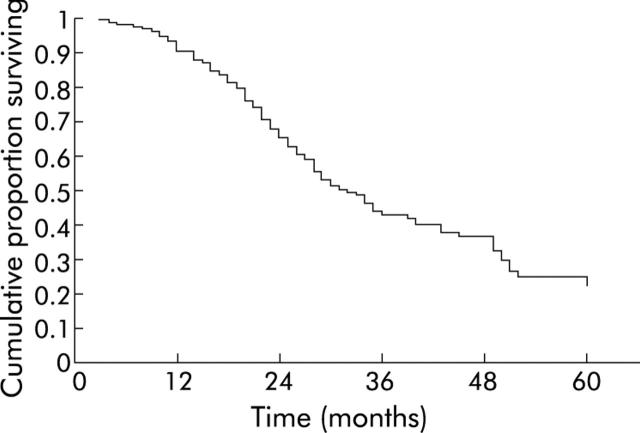
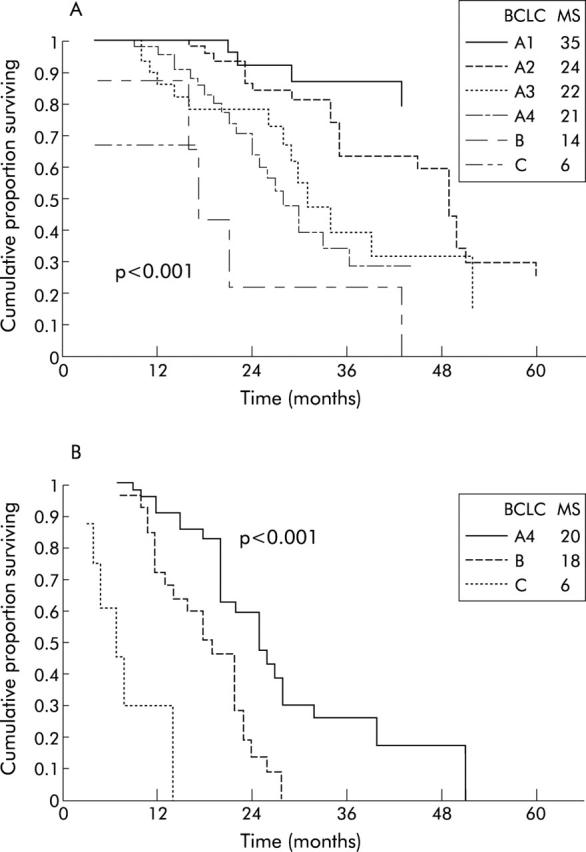
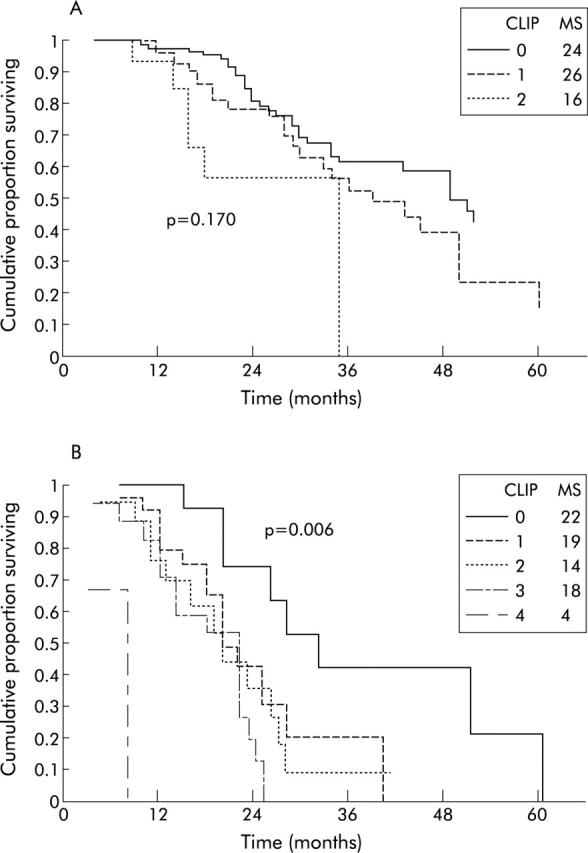
Results: Median survival was 25.7 months. In a multivariate analysis, portal vein thrombosis, alpha fetoprotein, total bilirubin, and tumour size were significant predictors of survival. Okuda, CLIP, and BCLC scores were all able to predict survival (p<0.001). They identified two, four, and six risk groups, respectively, with a median survival ranging from 27 to 19 months for Okuda, 30 to 5 months for CLIP, and 43 to 7 months for BCLC.
Conclusions: Both CLIP and BCLC scores were more effective than the Okuda score in stratifying patients into different risk groups with early-intermediate HCC. However, the BCLC scoring system gave a better prediction of prognosis in patients with disease diagnosis at a very early stage.
Figures
Comment in
-
Predicting survival in early hepatocellular carcinoma.Gut. 2005 Mar;54(3):328-9. doi: 10.1136/gut.2004.052092. Gut. 2005. PMID: 15710977 Free PMC article. Review. No abstract available.
-
Is there an ideal prognostic model for hepatocellular carcinoma?Gut. 2005 Sep;54(9):1348. doi: 10.1136/gut.2005.069468. Gut. 2005. PMID: 16099811 Free PMC article. No abstract available.
References
-
- Bosch FX. Global epidemiology of hepatocellular carcinoma. In: Okuda K, Tabor E, eds. Liver cancer. New York: Churchill Livingston, 1997:13–28.
-
- Poynard T, Bedossa P, Opolon P. Natural history of liver fibrosis progression in patients with chronic hepatitis C. The OBSVIRC, METAVIR, CLINIVIR, and DOSVIRC groups. Lancet 1997;349:825–32. - PubMed
-
- Trevisani F, D’Intino PE, Morselli-Labate AM, et al. M. Serum alpha-fetoprotein for diagnosis of hepatocellular carcinoma in patients with chronic liver disease: influence of HBsAg and anti-HCV status, J Hepatol 2001;34:570–5. - PubMed
-
- Tanaka S, Kitamura T, Nakanishi K, et al. Effectiveness of periodic checkup by ultrasonography for the early diagnosis of hepatocellular carcinoma. Cancer 1990;66:2210–14. - PubMed
Publication types
MeSH terms
Substances
LinkOut - more resources
Full Text Sources
Medical