doi: 10.1038/sj.embor.7400347.
crossveinless defines a new family of Twisted-gastrulation-like modulators of bone morphogenetic protein signalling
Affiliations
- PMID: 15711536
- PMCID: PMC1299258
- DOI: 10.1038/sj.embor.7400347
Item in Clipboard
crossveinless defines a new family of Twisted-gastrulation-like modulators of bone morphogenetic protein signalling
EMBO Rep.
2005 Mar.
Abstract
The Twisted gastrulation (Tsg) proteins are modulators of bone morphogenetic protein (BMP) activity in both vertebrates and insects. We find that the crossveinless (cv) gene of Drosophila encodes a new tsg-like gene. Genetic experiments show that cv, similarly to tsg, interacts with short gastrulation (sog) to modulate BMP signalling. Despite this common property, Cv shows a different BMP ligand specificity as compared with Tsg, and its expression is limited to the developing wing. These findings and the presence of two types of Tsg-like protein in several insects suggest that Cv represents a subgroup of the Tsg-like BMP-modulating proteins.
Figures
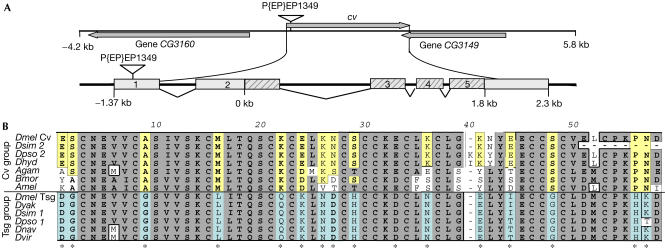
Organization of the cv gene region and alignment of the first cysteine-rich domain (CR1) of the tsg-related loci. (A) Arrows show the direction of transcription. Bottom: predicted exon–intron structure of cv. Striped boxes indicate protein-coding exons. (B) Sequences that distinguish Cv from Tsg-like proteins are indicated with an asterisk and highlighted in yellow and light blue, respectively (for alignment of the full proteins, see supplementary Fig S3 online). Agam, Anopheles gambiense; Amel, Apis mellifera; Bmor, Bombyx mori; Dhyd, Drosophila hydei; Dmel, Drosophila melanogaster; Dnav, Drosophila navajoa; Dpso, Drosophila pseudoobscura; Dsim, Drosophila simulans; Dvir; Drosophila virilis; Dyak, Drosophila yakuba.
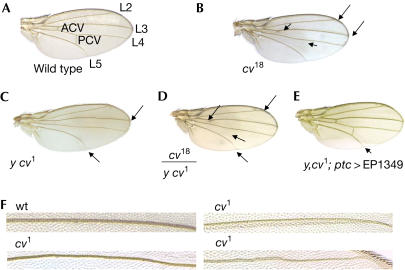
Characterization of cv. (A–E) Arrows indicate the delta tips of the longitudinal veins and loss of crossveins. (F) These high magnifications show examples of the meanderings and other vein abnormalities not previously described for cv.

Expression of crossveinless. (A–F) In situ hybridization to pupal wings. The timepoints indicate hours after pupariation (APF), and arrows indicate crossveins. Note that expression refines to two parallel stripes along the vein primordia (black arrowheads (F)). Elevated cv is also present (white arrowheads (F)) where deltas form at vein tips. (G) A leg disc with cv misexpressed under the control of the ptc promoter was used as a control for both the probe and background. (H) Diagram depicts the relative expression domains of genes involved in vein formation.

Misexpression experiments using the widely expressed A9 wing Gal4 driver and two restricted Gal4 drivers, ptc and en. (A) UAS>tsg driven by ptc>Gal4 does not restore the crossveins, the longitudinal veins or the L4 and L5 vein tips, typical of cv1 mutants. (B) Conversely, cv driven by the tsg promoter cannot rescue tsg mutants. Results of crossing males homozygous for the tsg>cv transgene on the second chromosome to tsgYN97/FM7 females are tabulated. Despite carrying the tsg>cv transgene, no hemizygous tsg males are viable. (C–J) Comparison of the activity of different combinations of cv and tsg with sog and cv-2 is shown. (K–R) BMP ligand specificity of Cv with or without Sog is shown. (S–V) Tsg shows different ligand specificity.
References
-
- Arora K, Levine MS, O'Connor MB (1994) The screw gene encodes a ubiquitously expressed member of the TGF-β family required for specification of dorsal cell fates in the Drosophila embryo. Genes Dev 8: 2588–2601 - PubMed
-
- Chang C, Holtzman DA, Chau S, Chickering T, Woolf EA, Holmgren LM, Bodorova J, Gearing DP, Holmes WE, Brivanlou AH (2001) Twisted gastrulation can function as a BMP antagonist. Nature 410: 483–487 - PubMed
-
- Conley CA, Silburn R, Singer MA, Ralston A, Rohwer-Nutter D, Olson DJ, Gelbart W, Blair SS (2000) Crossveinless 2 contains cysteine-rich domains and is required for high levels of BMP-like activity during the formation of the cross veins in Drosophila. Development 127: 3947–3959 - PubMed
-
- de Celis JF (1997) Expression and function of decapentaplegic and thick veins during the differentiation of the veins in the Drosophila wing. Development 124: 1007–1018 - PubMed
Publication types
MeSH terms
Substances
Grants and funding
LinkOut - more resources
Full Text Sources
Molecular Biology Databases
Miscellaneous