


Customized birth weight for gestational age standards: Perinatal mortality patterns are consistent with separate standards for males and females but not for blacks and whites
- PMID: 15720720
- PMCID: PMC551609
- DOI: 10.1186/1471-2393-5-3
Customized birth weight for gestational age standards: Perinatal mortality patterns are consistent with separate standards for males and females but not for blacks and whites
Abstract
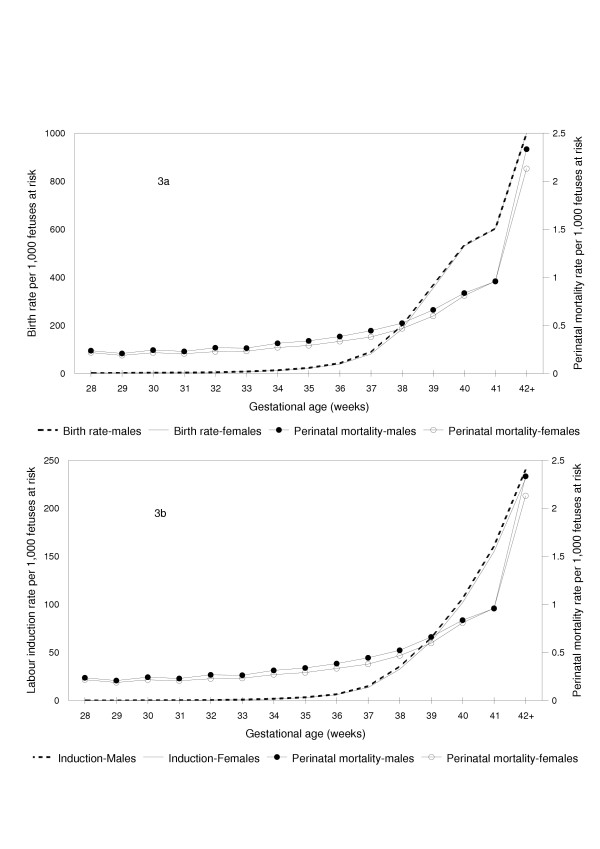
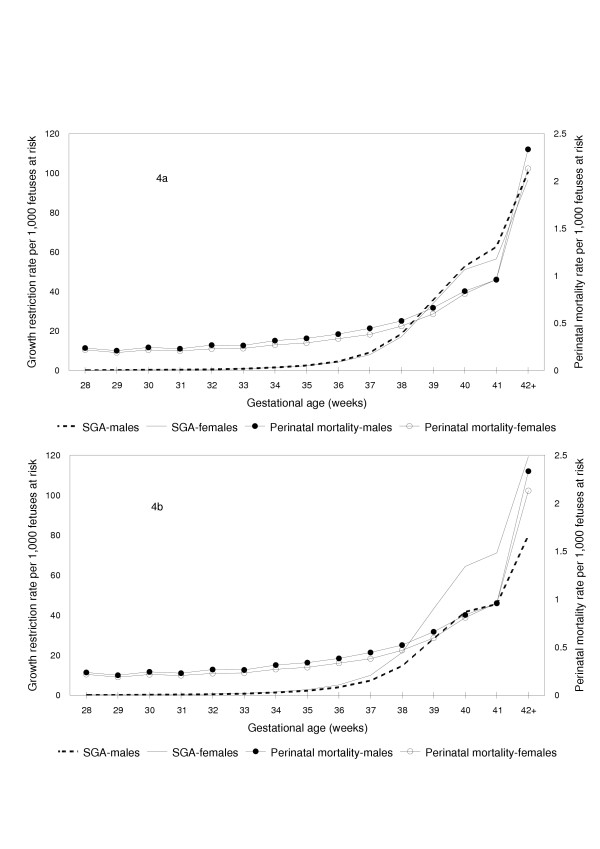
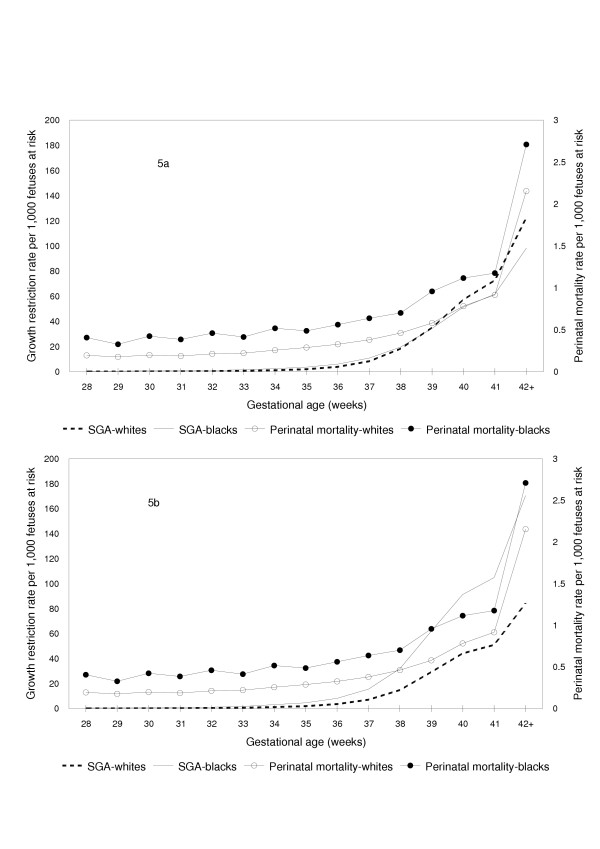
BACKGROUND: Some currently available birth weight for gestational age standards are customized but others are not. We carried out a study to provide empirical justification for customizing such standards by sex and for whites and blacks in the United States. METHODS: We studied all male and female singleton live births and stillbirths (22 or more weeks of gestation; 500 g birth weight or over) in the United States in 1997 and 1998. White and black singleton live births and stillbirths were also examined. Qualitative congruence between gestational age-specific growth restriction and perinatal mortality rates was used as the criterion for identifying the preferred standard. RESULTS: The fetuses at risk approach showed that males had higher perinatal mortality rates at all gestational ages compared with females. Gestational age-specific growth restriction rates based on a sex-specific standard were qualitatively consistent with gestational age-specific perinatal mortality rates among males and females. However, growth restriction patterns among males and females based on a unisex standard could not be reconciled with perinatal mortality patterns. Use of a single standard for whites and blacks resulted in gestational age-specific growth restriction rates that were qualitatively congruent with patterns of perinatal mortality, while use of separate race-specific standards led to growth restriction patterns that were incompatible with patterns of perinatal mortality. CONCLUSION: Qualitative congruence between growth restriction and perinatal mortality patterns provides an outcome-based justification for sex-specific birth weight for gestational age standards but not for the available race-specific standards for blacks and whites in the United States.
Figures
References
-
- Williams R, Creasy R, Cunningham G, Hawes W, Norris F, Tashiro M. Fetal growth and perinatal viability in California. Obstet Gynecol. 1982;59:624–632. - PubMed
-
- Yerushalmy J. The relationship of parents' cigarette smoking to outcome of pregnancy – implications as to the problem of inferring causation from observed associations. Am J Epidemiol. 1971;93:443–56. - PubMed
-
- Meyer MB, Comstock GW. Maternal cigarette smoking and perinatal mortality. Am J Epidemiol. 1972;96:1–10. - PubMed
-
- Wilcox AJ, Russell IT. Why small black infants have lower mortality than small white infants: the case for population-specific standards for birth weight. J Pediatr. 1990;116:7–10. - PubMed
-
- Wilcox AJ, Russell IT. Birthweight and perinatal mortality: III. Towards a new method of analysis. Int J Epidemiol. 1986;15:188–96. - PubMed
LinkOut - more resources
Full Text Sources
