. 2005 Mar 1;102(9):3383-8.
doi: 10.1073/pnas.0407488102. Epub 2005 Feb 18.

Modulation of CD1d-restricted NKT cell responses by using N-acyl variants of alpha-galactosylceramides

Affiliations

Modulation of CD1d-restricted NKT cell responses by using N-acyl variants of alpha-galactosylceramides

Karl O A Yu et al. Proc Natl Acad Sci U S A. .

Abstract

A form of alpha-galactosylceramide, KRN7000, activates CD1d-restricted Valpha14-invariant (Valpha14i) natural killer (NK) T cells and initiates multiple downstream immune reactions. We report that substituting the C26:0 N-acyl chain of KRN7000 with shorter, unsaturated fatty acids modifies the outcome of Valpha14i NKT cell activation. One analogue containing a diunsaturated C20 fatty acid (C20:2) potently induced a T helper type 2-biased cytokine response, with diminished IFN-gamma production and reduced Valpha14i NKT cell expansion. C20:2 also exhibited less stringent requirements for loading onto CD1d than KRN7000, suggesting a mechanism for the immunomodulatory properties of this lipid. The differential cellular response elicited by this class of Valpha14i NKT cell agonists may prove to be useful in immunotherapeutic applications.


Figures
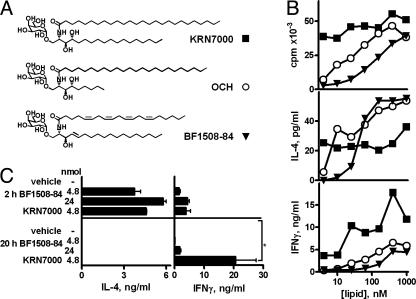
Fig. 1.
Fig. 1.
Induction of a TH2-polarized cytokine response by an unsaturated analogue of α-GalCer. (A) Glycolipid structures. (B) [3H]thymidine incorporation and supernatant IL-4 and IFN-γ levels in 72-h splenocyte cultures with graded amounts of glycolipid. Means from triplicate cultures are shown; SEMs were typically <10% of the mean. (C) Serum IL-4 and IFN-γ levels (at 2 and 20 h) of C57BL/6 mice injected i.p. with 4.8 or 24 nmol of glycolipid. KRN7000 was the only glycolipid that induced significant IFN-γ levels at 20 h (*, P < 0.05, Kruskall–Wallis test, Dunn's posttest). Means ± SD of two or three mice per group are shown.
Fig. 2.
Fig. 2.
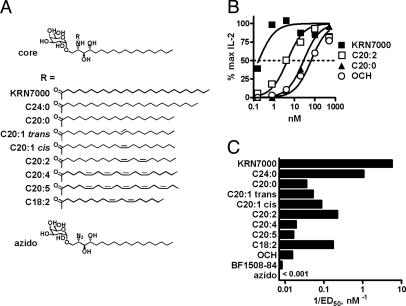
Recognition of a panel of unsaturated analogues of KRN7000 by a canonical Vα14i NKT hybridoma. (A) Analogue structures. (B) Dose–response curves showing IL-2 production by hybridoma DN3A4–1.2 after stimulation with RMA-S.mCD1d cells pulsed with various doses of glycolipid. Maximal IL-2 concentrations in each assay were designated as 100%. Four-parameter logistic equation dose–response curves are shown; the dotted line denotes the half-maximal dose. (C) Relative potencies of the analogue panel in Vα14i NKT cell recognition, plotted as the reciprocal of the effective dose required to elicit a half-maximal response (1/ED50). Similar results were obtained by using another Vα14i NKT hybridoma, DN32D3.
Fig. 3.
Fig. 3.
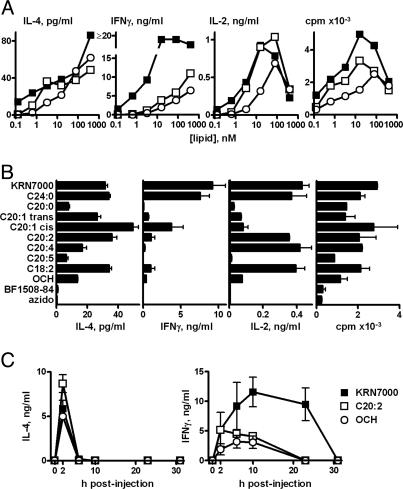
TH2-skewing of in vitro and in vivo cytokine responses to C20:2. (A) Dose–response curves reporting 48 h IL-4, IFN-γ, or IL-2 production, and cell proliferation of splenocytes in response to KRN7000, C20:2, and OCH. Means of duplicate cultures are shown; SEM were <10% of the means. (B) Cytokine and proliferation measurements on splenocytes exposed to a submaximal dose (3.2 nM) of the panel of α-GalCer analogues shown in Fig. 2. Mean ± SEM from duplicate cultures shown. (C) Serum IL-4 and IFN-γ levels in mice given 4.8 nmol of KRN7000, C20:2, or OCH. Mean ± SD of two or three mice are shown. Vehicle-treated mice had cytokine levels below limits of detection. The results shown are representative of two or more experiments.
Fig. 4.
Fig. 4.
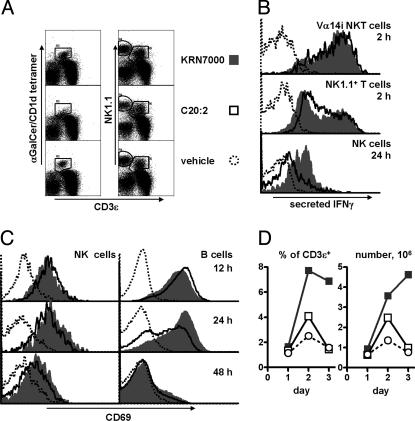
Sequelae of KRN7000 and C20:2-induced Vα14i NKT cell activation. (A)Vα14i NKT cell (tetramer+ CD3εint), NK cell (NK1.1+ CD3ε-), and NK1.1+ T cell (NK1.1int CD3εint) identification by FACS in splenocytes from mice given KRN7000, C20:2, or vehicle i.p. 2 h earlier. Lymphocytes gated as negative for B220 and propidium iodide are shown. (B) Histogram profiles for IFN-γ secretion of splenic Vα14i NKT, NK1.1+ T, or NK cells from mice 2 or 24 h after treatment with glycolipid. IFN-γ-staining in C24:0-stimulated samples was identical to that of KRN7000-stimulated samples. (C) CD69 levels of splenic NK cells (gated as CD3ε- NK1.1+) or B cells (CD3ε- NK1.1- B220+) at 12, 24, or 48 h after injection of glycolipid. (D) Splenic Vα14i NKT cell (B220- CD3εint tetramer+) frequency, measured as either percentages of T cells or as total NKT cell number, in mice 1, 2, or 3 days after glycolipid administration. The results shown are representative of three independent experiments.
Fig. 5.
Fig. 5.
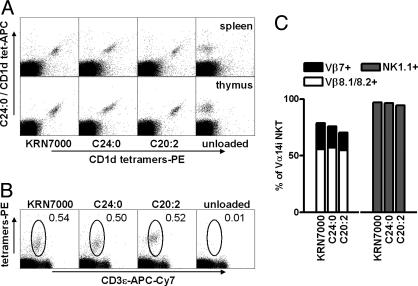
Recognition of KRN7000, C24:0, and C20:2 by the same population of Vα14i NKT cells. (A) Costaining of C57BL/6 splenocytes or thymocytes with allophycocyanin-conjugated CD1d tetramers assembled with C24:0, and phycoerythrin-labeled CD1d tetramers assembled with various analogues. (B) Thymocytes were stained with C24:0, C20:2, KRN7000, or vehicle-loaded CD1d tetramers–phycoerythrin, and with antibodies to B220, CD3ε,Vβ7, Vβ8.1/8.2, or NK1.1. Dot plots show gating for tetramer+ T cells, after exclusion of B lymphocytes, and dead cells. (C) TCR Vβ and NK1.1 phenotype of tetramer+ CD3εint thymocytes. Analogous results were obtained with splenocytes. The results shown are representative of three or more experiments.
Fig. 6.
Fig. 6.
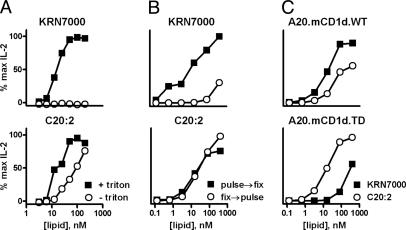
Differential requirements for CD1d loading with KRN7000 and C20:2. IL-2 response of hybridoma DN3A4–1.2 to glycolipid presentation in three in vitro CD1d presentation systems: platebound CD1d loaded with varying amounts of KRN7000 or C20:2 in the presence or absence of the detergent Triton X-100 (A), RMA-S.CD1d cells pulsed with glycolipid before or after glutaraldehyde fixation (B), or WT or cytoplasmic tail-deleted (TD) CD1d-transfected A20 cells, loaded with either KRN7000 or C20:2 (C).

References

    1. Lantz, O. & Bendelac, A. (1994) J. Exp. Med. 180, 1097-1106. - PMC - PubMed
    1. Brossay, L. & Kronenberg, M. (1999) Immunogenetics 50, 146-151. - PubMed
    1. Godfrey, D. I., Hammond, K. J., Poulton, L. D., Smyth, M. J. & Baxter, A. G. (2000) Immunol. Today 21, 573-583. - PubMed
    1. Wilson, S. B. & Delovitch, T. L. (2003) Nat. Rev. Immunol. 3, 211-222. - PubMed
    1. Poulton, L. D., Smyth, M. J., Hawke, C. G., Silveira, P., Shepherd, D., Naidenko, O. V., Godfrey, D. I. & Baxter, A. G. (2001) Int. Immunol. 13, 887-896. - PubMed

Publication types