. 2005 Mar;137(3):1160-8.
doi: 10.1104/pp.104.054460. Epub 2005 Feb 22.

Effects of feeding Spodoptera littoralis on lima bean leaves. II. Continuous mechanical wounding resembling insect feeding is sufficient to elicit herbivory-related volatile emission

Affiliations

Effects of feeding Spodoptera littoralis on lima bean leaves. II. Continuous mechanical wounding resembling insect feeding is sufficient to elicit herbivory-related volatile emission

Axel Mithöfer et al. Plant Physiol. 2005 Mar.

Abstract

Herbivore feeding elicits defense responses in infested plants, including the emission of volatile organic compounds that can serve as indirect defense signals. Until now, the contribution of plant tissue wounding during the feeding process in the elicitation of defense responses has not been clear. For example, in lima bean (Phaseolus lunatus), the composition of the volatiles induced by both the insect caterpillar Spodoptera littoralis and the snail Cepaea hortensis is very similar. Thus, a mechanical caterpillar, MecWorm, has been designed and used in this study, which very closely resembles the herbivore-caused tissue damage in terms of similar physical appearance and long-lasting wounding period on defined leaf areas. This mode of treatment was sufficient to induce the emission of a volatile organic compound blend qualitatively similar to that as known from real herbivore feeding, although there were significant quantitative differences for a number of compounds. Moreover, both the duration and the area that has been mechanically damaged contribute to the induction of the whole volatile response. Based on those two parameters, time and area, which can replace each other to some extent, a damage level can be defined. That damage level exhibits a close linear relationship with the accumulation of fatty acid-derived volatiles and monoterpenes, while other terpenoid volatiles and methyl salicylate respond in a nonlinear manner. The results strongly suggest that the impact of mechanical wounding on the induction of defense responses during herbivore feeding was until now underestimated. Controlled and reproducible mechanical damage that strongly resembles the insect's feeding process represents a valuable tool for analyzing the role of the various signals involved in the induction of plant defense reactions against herbivory.


Figures

Figure 1.
Figure 1.
GC profiles of induced VOCs emitted from lima bean leaves upon feeding of different herbivores. Headspace volatiles were collected for 24 h during the whole treatment. A, Feeding by S. littoralis larvae. B, Control without any feeding. C, Feeding by C. hortensis. Identification of compounds was performed by MS: (1) octen-3-ol; (2) Hex-Ac; (3) β-ocimene; (4) linalool; (5) DMNT; (6) C10H14; (7) MeSA; (8) C10H16O; (9) indole; (10) β-caryophyllene; (11) nerolidol; (12) TMTT. IS, Internal standard (1-bromodecane, 0.9 mm). All experiments have been conducted at least six times with similar results.
Figure 2.
Figure 2.
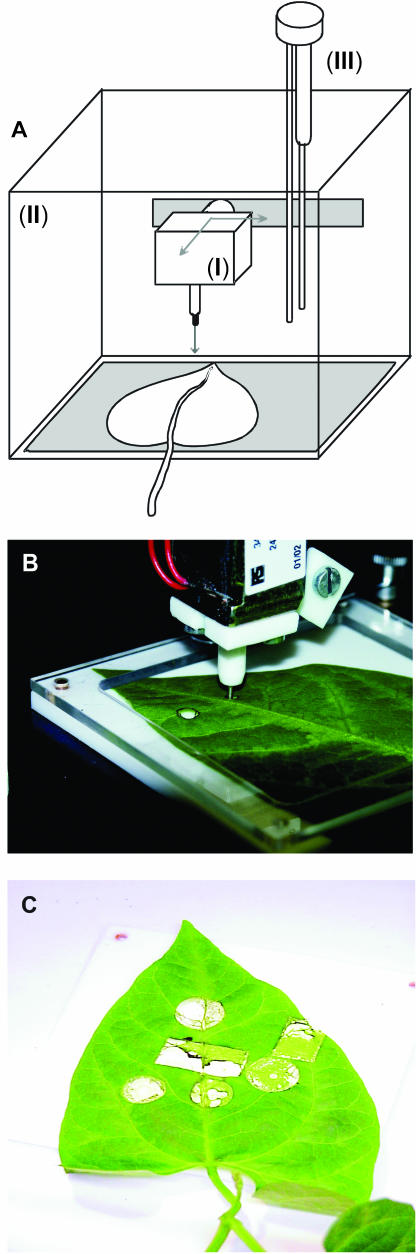
MecWorm, the mechanical caterpillar. A, Design of MecWorm. I, Punching unit; II, plexiglass cabinet; III, volatile collection unit. B, Section of the punching unit of MecWorm, including the aglet treating a lima bean leaf. C, Lima bean leaf damaged by MecWorm.
Figure 3.
Figure 3.
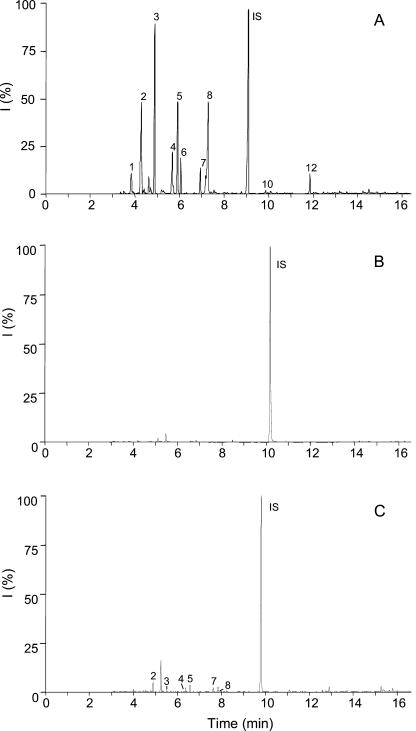
GC profile of induced VOCs emitted from lima bean leaves upon mechanical damage. A, Treatment with MecWorm. Headspace volatiles were collected for 24 h during the whole treatment (time = 17 h, 7 min; area = 733 mm2). B, Treatment with a pattern wheel. C, Collection of volatiles emitted from the nontreated opposite leaf. Identification of compounds was performed by MS (see Fig. 1). Experiments have been repeated nine (A), four (B), and eight times, respectively, with similar results.
Figure 4.
Figure 4.
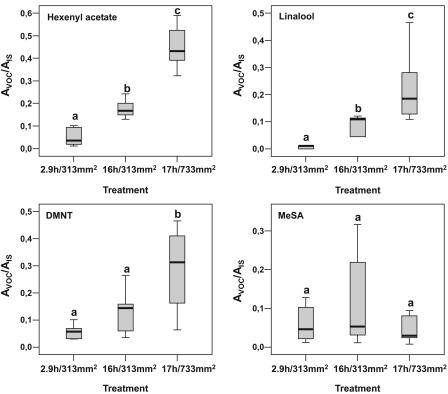
Relative amounts of various emitted VOCs in relation to time and extent of mechanical treatments in lima bean leaves. Volatiles have been induced by either mechanical damage of a fixed area at various or similar lengths of time combined with various areas. The relative increase or decrease in the amount of volatiles was determined by the ratio of the peak area of the particular compound (AVOC) to the peak area of the internal standard (AIS). Statistical evaluations were done with SPSS (version 11.5). Different letters indicate significant differences between treatments (P < 0.05) according to one-way ANOVA on rank-transformed data. The Student-Newman-Keuls test was used to determine post hoc differences. Sample sizes are n = 5 (2.9 h, 313 mm2), n = 6 (16 h, 313 mm2), and n = 10 (17 h, 733 mm2).
Figure 5.
Figure 5.
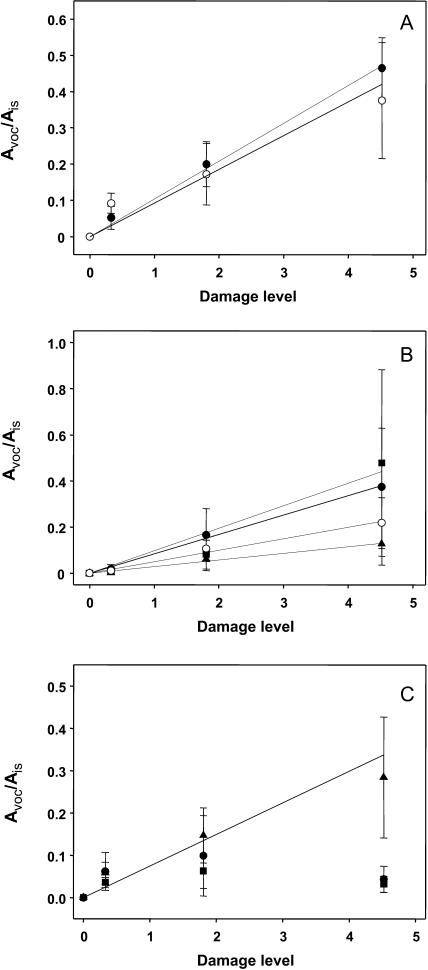
Correlation of the relative amounts of volatiles with the damage levels of mechanical wounding in lima bean leaves. The relative amount of the volatiles was determined by the ratio of the peak area of the particular compound (AVOC) to the peak area of the internal standard (AIS). The damage levels have been determined with 0 (no treatment), 0.33 (2.9 h, 313 mm2), 1.80 (6.85 h, 733 mm2; 16 h, 313 mm2), and 4.52 (17 h, 733 mm2), respectively. A, Octen-3-ol (○) and Hex-Ac (•). B, Ocimene (▪), C10H16O (•), linalool (○), and C10H14 (▴). C, DMNT (▴), MeSA (•), and TMTT (▪). MeSA and TMTT did not show linear correlations. The results are the mean ± sd (n = 5–10).
Figure 6.
Figure 6.
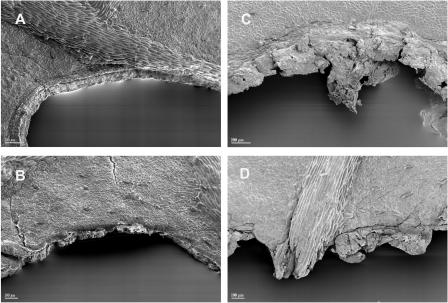
Scanning electron micrographs of lima bean leaf damage zones after feeding of S. littoralis larvae (A and B) and after treatment with the mechanical caterpillar (C and D).

References

    1. Alborn HT, Turlings TCJ, Jones TH, Stenhagen G, Loughrin JH, Tumlinson JH (1997) An elicitor of plant volatiles from beet armyworm oral secretion. Science 276: 945–949
    1. Bergomaz R, Boppré M (1986) A simple insect diet for rearing Arctiidae and other moths. J Lepid Soc 40: 131–137
    1. De Boer JG, Dicke M (2004) The role of methyl salicylate in prey searching behavior of the predatory mite Phytoseiulus persimilis. J Chem Ecol 30: 255–271 - PubMed
    1. De Moraes CM, Lewis WJ, Paré WB, Alborn HT, Tumlinson JH (1998) Herbivore-infested plants selectively attract parasitoids. Nature 393: 570–574
    1. De Moraes CM, Mescher MC (2004) Biochemical crypsis in the avoidance of natural enemies by an insect herbivore. Proc Natl Acad Sci USA 101: 8993–8997 - PMC - PubMed