


Anti-endothelial cell antibodies (AECA) in patients with propylthiouracil (PTU)-induced ANCA positive vasculitis are associated with disease activity
- PMID: 15730404
- PMCID: PMC1809319
- DOI: 10.1111/j.1365-2249.2005.02725.x
Anti-endothelial cell antibodies (AECA) in patients with propylthiouracil (PTU)-induced ANCA positive vasculitis are associated with disease activity
Abstract
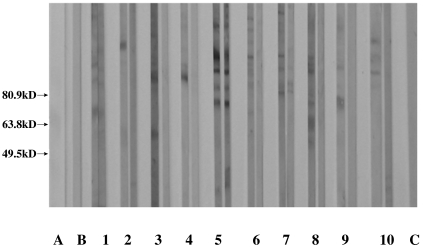
Increasing evidence has demonstrated that propylthiouracil (PTU) could induce ANCA positive vasculitis. However, our previous work has suggested that only one-fifth of the PTU-induced ANCA positive patients had clinical vasculitis and so the mechanism is not clear. Anti-endothelial cell antibodies (AECA) have been implicated in the pathogenesis of various vasculitides, including primary ANCA positive systemic vasculitis. The purpose of this study is to investigate the prevalence of AECA and their possible role in the pathogenesis of patients with PTU-induced ANCA positive vasculitis. Sera from 11 patients with PTU-induced ANCA positive vasculitis at both active and quiescent phases, and sera from 10 patients with PTU-induced ANCA but without clinical vasculitis, were studied. Sera from 30 healthy blood donors were collected as normal controls. Soluble proteins from 1% Triton-100 extracted in vitro cultured human umbilical vein endothelial cells were used as antigens and an immunoblotting technique was performed to determine the presence of AECA, and their specific target antigens were identified. In patients with PTU-induced ANCA positive vasculitis, 10 of the 11 patients in an active phase of disease were serum IgG-AECA positive and six protein bands of endothelial antigens could be blotted (61 kD, 69 kD, 77 kD, 85 kD, 91 kD and 97 kD). However, in the quiescent phase, seven of the 10 positive sera turned negative. None of the ANCA positive but vasculitis negative patients or normal controls were AECA positive. In conclusion, AECA could be found in sera from patients with PTU-induced ANCA positive vasculitis and were associated more closely with vasculitic disease activity.
Figures
References
-
- Dolman KM, Gans RO, Vervaat TJ, et al. Vasculitis and antineutrophil cytoplasmic autoantibodies associated with propylthiouracil therapy. Lancet. 1993;342:651–2. - PubMed
-
- Xu XD, Zhao MH, Zhang YK, Guo XH, Wang HY. Clinicopathological characteristics of propylthiouracil-induced antineutrophil cytoplasmic antibody-positive vasculitis and their target antigens: a report of 4 cases and literature review. Zhonghua Nei Ke Za Zhi. 2002;41:404–7. - PubMed
-
- Choi HK, Merkel P, Walker AM, Niles JL. Drug-associated antineutrophil cytoplasmic antibody-positive vasculitis: prevalence among patients with high titers of antimyeloperoxidase antibodies. Arthritis Rheum. 2000;43:405–13. - PubMed
-
- Sato H, Hattori M, Fujieda M, et al. High prevalence of antineutrophil cytoplasmic antibody positivity in childhood onset Graves’ disease treated with propylthiouracil. J Clin Endocrinol Metab. 2000;85:4270–3. - PubMed
-
- Yamauchi K, Sata M, Machiya J, et al. Antineutrophil cytoplasmic antibody positive alveolar haemorrhage during propylthiouracil therapy for hyperthyroidism. Respirology. 2003;8:532–5. - PubMed
MeSH terms
Substances
LinkOut - more resources
Full Text Sources
Medical
