. 2005 Mar;3(3):e64.
doi: 10.1371/journal.pbio.0030064. Epub 2005 Feb 22.

Engineering gene networks to emulate Drosophila embryonic pattern formation

Affiliations

Engineering gene networks to emulate Drosophila embryonic pattern formation

Mark Isalan et al. PLoS Biol. 2005 Mar.

Abstract

Pattern formation is essential in the development of higher eukaryotes. For example, in the Drosophila embryo, maternal morphogen gradients establish gap gene expression domain patterning along the anterior-posterior axis, through linkage with an elaborate gene network. To understand the evolution and behaviour of such systems better, it is important to establish the minimal determinants required for patterning. We have therefore engineered artificial transcription-translation networks that generate simple patterns, crudely analogous to the Drosophila gap gene system. The Drosophila syncytium was modelled using DNA-coated paramagnetic beads fixed by magnets in an artificial chamber, forming a gene expression network. Transient expression domain patterns were generated using various levels of network connectivity. Generally, adding more transcription repression interactions increased the "sharpness" of the pattern while reducing overall expression levels. An accompanying computer model for our system allowed us to search for parameter sets compatible with patterning. While it is clear that the Drosophila embryo is far more complex than our simplified model, several features of interest emerge. For example, the model suggests that simple diffusion may be too rapid for Drosophila-scale patterning, implying that sublocalisation, or "trapping," is required. Second, we find that for pattern formation to occur under the conditions of our in vitro reaction-diffusion system, the activator molecules must propagate faster than the inhibitors. Third, adding controlled protease degradation to the system stabilizes pattern formation over time. We have reconstituted transcriptional pattern formation from purified substances, including phage RNA polymerases, ribonucleotides, and an eukaryotic translation extract. We anticipate that the system described here will be generally applicable to the study of any biological network with a spatial component.


Figures
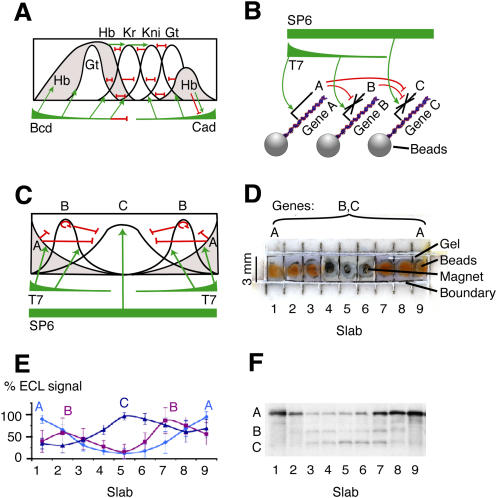
Figure 1
Figure 1. Gene Circuits and Chambers
(A) Principal interactions in the Drosophila gap gene network, modelled after [37]. Relative levels and distributions of Hunchback (Hb), Giant (Gt), Krüppel (Kr), Knirps (Kni), Bicoid (Bcd), and Caudal (Cad) shown from anterior (left) to posterior (right). Green arrows indicate activation, red T-bars repression. (B) Artificial gene network design, with transcription activators T7 and SP6 polymerases, and zinc finger repressors A, B, and C. Genes are immobilised on paramagnetic beads, and T7 forms a directional concentration gradient. (C) Principal interactions in a simple designed network. (D) Transcription-translation chamber. Genes for repressor A are localised at the “poles,” whereas B and C are ubiquitous. Gel slabs 4–6 have been excised, exposing the magnets below, illustrating gel dissection for Western blot analysis. (E) Normalised Western data for four replicate chambers, showing mean levels of A, B, and C after 20 min (± One standard deviation). (F) Sample Western blot from the four-replicate experiment.
Figure 2
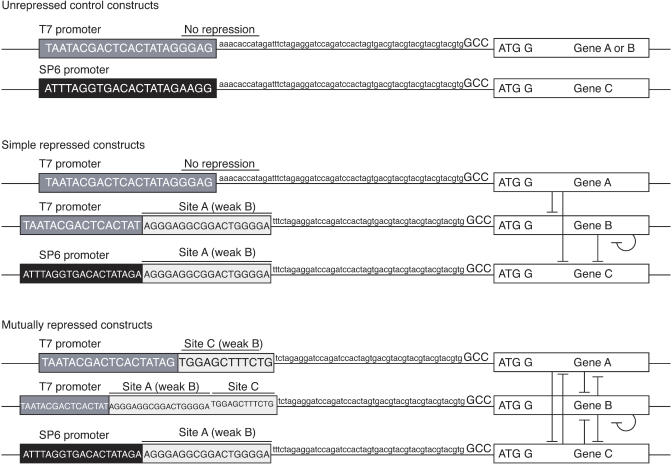
Figure 2. Map of the Constructs Used in This Study
The repressor binding sites overlap with T7 or SP6 promoters and vary between constructs. In this way, it is possible to alter the connectivity of the repressive interactions by the products of genes A, B, and C. Repressive interactions are denoted by T-bars. The start codon of each gene is in Kozak context and is denoted by “GCC ATG G.”
Figure 3
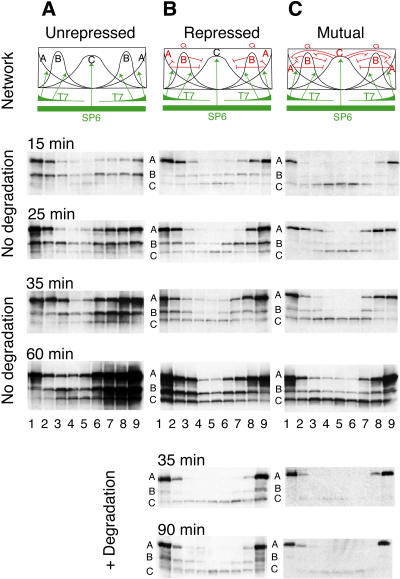
Figure 3. Alternative Gene Networks
At five set time points (15, 25, 35, 60, and 90 min), transcription-translation chambers were dissected into nine slabs for Western blot analysis. (A) Control network with no repression sites between genes A, B, and C. (B) Minimally repressed network (compare Figure 1). (C) Mutual repression network with extensive negative interactions between species. Adding protease (“+ Degradation”) creates weak but time-stable patterns for both the “Repressed” and “Mutual” networks (35 versus 90 min). Quantitated graphs for the above data are available in Protocol S1.
Figure 4
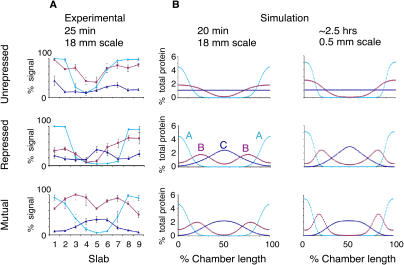
Figure 4. Comparison of Experimental Data and Computer Simulations
Data are shown for the three gene networks described in Figure 3, showing outputs for proteins A (cyan), B (magenta) and C (dark blue). (A) Quantitated Western blot data from Figure 3, after 25 min. (B) Simulation data plotted as percentage of total output protein against chamber length, at the chamber (18-mm) or Drosophila (0.5-mm) scale. The model is described in full in Protocol S1.
Figure 5
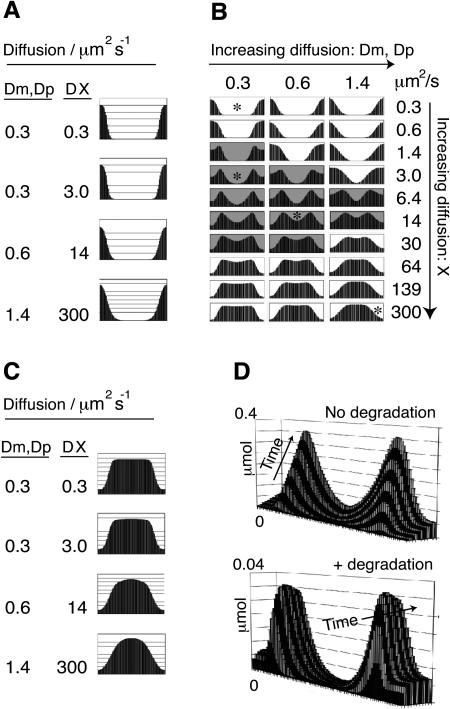
Figure 5. Varying Diffusion and Degradation Parameters
Computer model of gene network, scaled to Drosophila length (0.5 mm). Diffusion parameters are varied for mRNA (Dm), protein (Dp), and T7 activator (DX). Data are plotted as percentage of total output protein (y-axes) against chamber position (x-axes), for 10-min simulations. (A) Outputs for protein A. (B) Output for protein B. Graphs with “target behaviour” are shaded grey, and the four asterisks mark the parameter sets used to generate outputs for proteins A and C. (C) Outputs for protein C. (D) Effect of adding protease degradation to B-output, shown at 15-min intervals, over a 2.5-h time course (parameters: DX = 0.43 μm2s−1; Dm = Dp = 0.02 μm2s−1; t1/2 = 770 s).

References

    1. Elowitz MB, Leibler S. A synthetic oscillatory network of transcriptional regulators. Nature. 2000;403:335–338. - PubMed
    1. Gardner TS, Cantor CR, Collins JJ. Construction of a genetic toggle switch in Escherichia coli . Nature. 2000;403:339–342. - PubMed
    1. Becskei A, Serrano L. Engineering stability in gene networks by autoregulation. Nature. 2000;405:590–593. - PubMed
    1. Guet CC, Elowitz MB, Hsing W, Leibler S. Combinatorial synthesis of genetic networks. Science. 2002;296:1466–1470. - PubMed
    1. Hasty J, McMillen D, Collins JJ. Engineered gene circuits. Nature. 2002;420:224–230. - PubMed

Publication types