Review
doi: 10.1503/cmaj.1031920.
Tips for learners of evidence-based medicine: 4. Assessing heterogeneity of primary studies in systematic reviews and whether to combine their results
Affiliations
- PMID: 15738493
- PMCID: PMC550638
- DOI: 10.1503/cmaj.1031920
Item in Clipboard
Review
Tips for learners of evidence-based medicine: 4. Assessing heterogeneity of primary studies in systematic reviews and whether to combine their results
CMAJ.
.
No abstract available
Figures

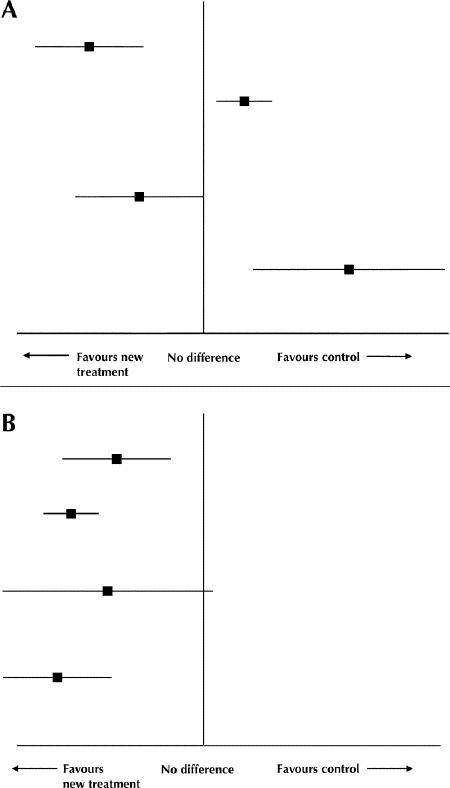
Fig. 1: Results of the studies in 2 hypothetical systematic reviews. The central vertical line represents a treatment effect of 0. Values to the left of this line indicate that the treatment is superior to the control, whereas those to the right of the line indicate that the control is superior to the treatment. For each of the 4 studies in each figure, the dot represents the point estimate of the treatment effect (the value observed in the study), and the horizontal line represents the confidence interval around that observed effect.
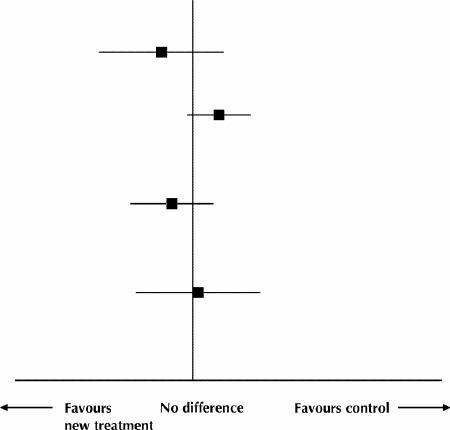
Fig. 2: Point estimates and confidence intervals for 4 studies. Two of the point estimates favour the new treatment, and the other 2 point estimates favour the control. Investigators doing a systematic review with these 4 studies would be satisfied that it is appropriate to pool the results.
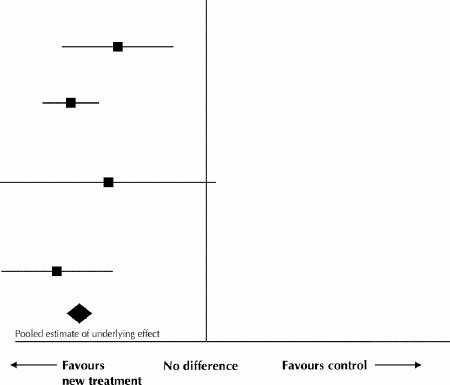
Fig. 3: Results of the hypothetical systematic review presented in Fig. 1B. The pooled estimate at the bottom of the chart (large diamond) provides the best guess as to the underlying treatment effect. It is centred on the midpoint of the area of overlap of the confidence intervals around the estimates of the individual trials.

References
-
- Oxman A, Guyatt G, Cook D, Montori V. Summarizing the evidence. In: Guyatt G, Rennie D, editors. Users' guides to the medical literature: a manual for evidence-based clinical practice. Chicago: AMA Press; 2002. p. 155-73.
-
- Guyatt G, Cook D, Devereaux PJ, Meade M, Straus S. Therapy. In: Guyatt G, Rennie D, editors. Users' guides to the medical literature: a manual for evidence-based clinical practice. Chicago: AMA Press; 2002. p. 55-79.
Publication types
MeSH terms
LinkOut - more resources
Full Text Sources