


Claudin-1, -3 and -4 proteins and mRNA expression in benign and malignant breast lesions: a research study
- PMID: 15743508
- PMCID: PMC1064136
- DOI: 10.1186/bcr983
Claudin-1, -3 and -4 proteins and mRNA expression in benign and malignant breast lesions: a research study
Abstract
Introduction: We compared levels of protein and mRNA expression of three members of the claudin (CLDN) family in malignant breast tumours and benign lesions.
Methods: Altogether, 56 sections from 52 surgically resected breast specimens were analyzed for CLDN1, CLDN3 and CLDN4 expression by immunohistochemistry. mRNA was also analyzed using real-time PCR in 17 of the 52 cases.
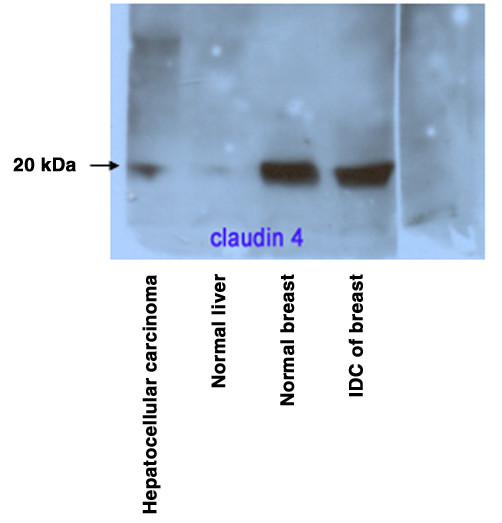
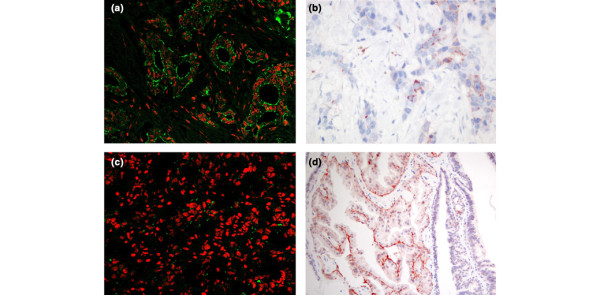
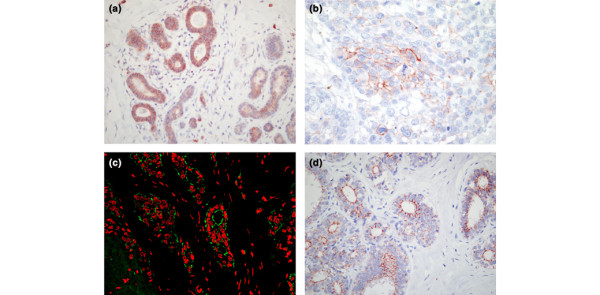
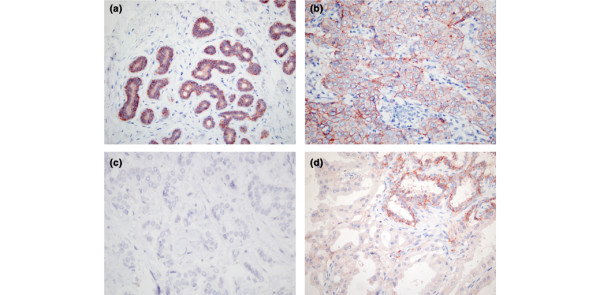
Results: CLDNs were rarely observed exclusively at tight junction structures. CLDN1 was present in the membrane of normal duct cells and in some of the cell membranes from ductal carcinoma in situ, and was frequently observed in eight out of nine areas of apocrine metaplasia, whereas invasive tumours were negative for CLDN1 or it was present in a scattered distribution among such tumour cells (in 36/39 malignant tumours). CLDN3 was present in 49 of the 56 sections and CLDN4 was present in all 56 tissue sections. However, CLDN4 was highly positive in normal epithelial cells and was decreased or absent in 17 out of 21 ductal carcinoma grade 1, in special types of breast carcinoma (mucinous, papillary, tubular) and in areas of apocrine metaplasia. CLDN1 mRNA was downregulated by 12-fold in the sample (tumour) group as compared with the control group using GAPDH as the reference gene. CLDN3 and CLDN4 mRNA exhibited no difference in expression between invasive tumours and surrounding tissue.
Conclusions: The significant loss of CLDN1 protein in breast cancer cells suggests that CLDN1 may play a role in invasion and metastasis. The loss of CLDN4 expression in areas of apocrine metaplasia and in the majority of grade 1 invasive carcinomas also suggests a particular role for this protein in mammary glandular cell differentiation and carcinogenesis.
Figures
References
-
- Gonzalez-Mariscal L, Avila Flores A, Betanzos A. The relationship between structure and function of tight junctions. In: Cereijido M, Anderson JM, editor. Tight Junctions. 2. Boca Raton, FL: CRC Press; 2001. pp. 89–119.
-
- Katoh M, Katoh M. CLDN23 gene, frequently down-regulated in intestinal-type gastric cancer, is a novel member of CLAUDIN family. Int J Mol Med. 2003;11:683–689. - PubMed
Publication types
MeSH terms
Substances
LinkOut - more resources
Full Text Sources
Other Literature Sources
Medical
Research Materials
