


Regulation of motoneuron excitability via motor endplate acetylcholine receptor activation
- PMID: 15745948
- PMCID: PMC6726080
- DOI: 10.1523/JNEUROSCI.5065-04.2005
Regulation of motoneuron excitability via motor endplate acetylcholine receptor activation
Abstract
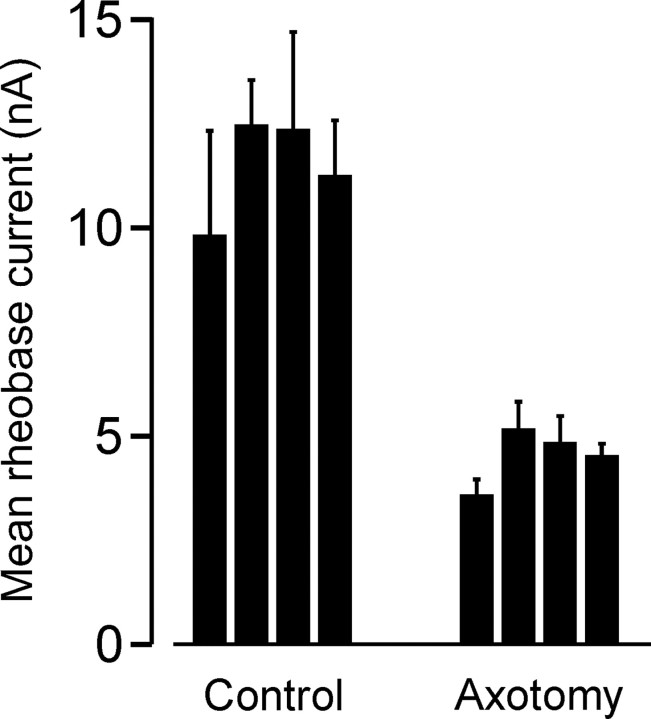
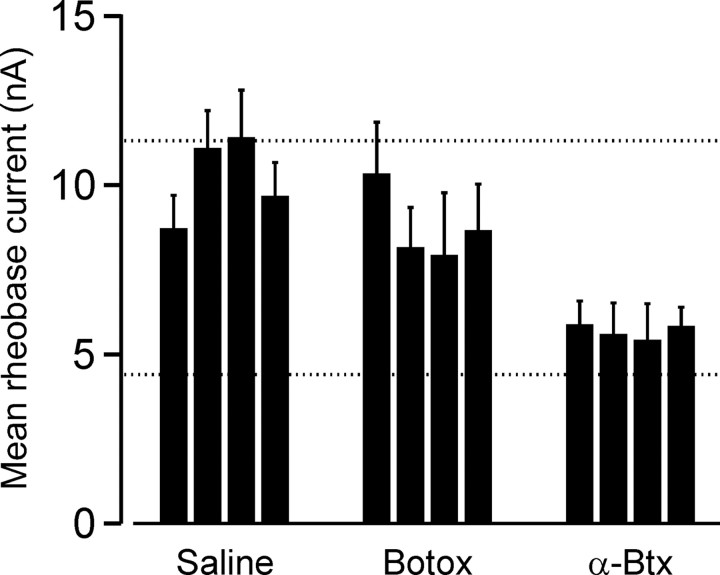
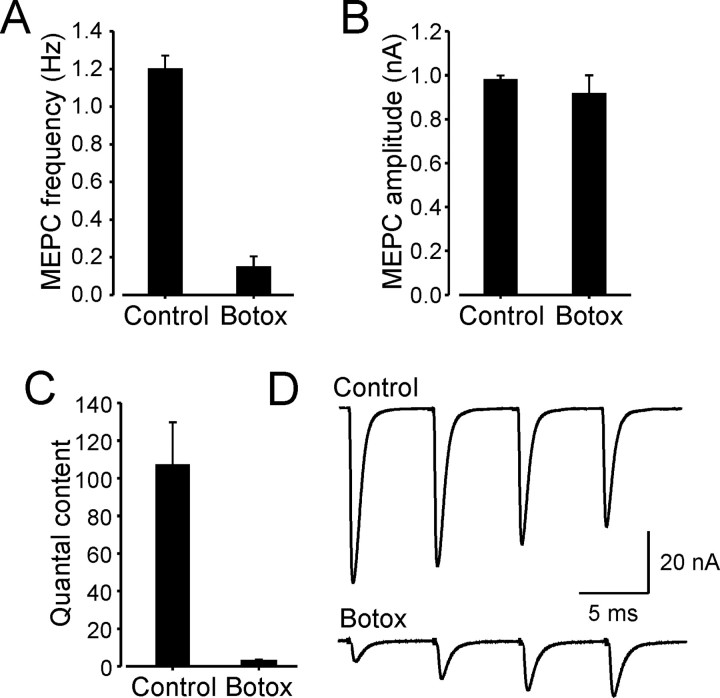
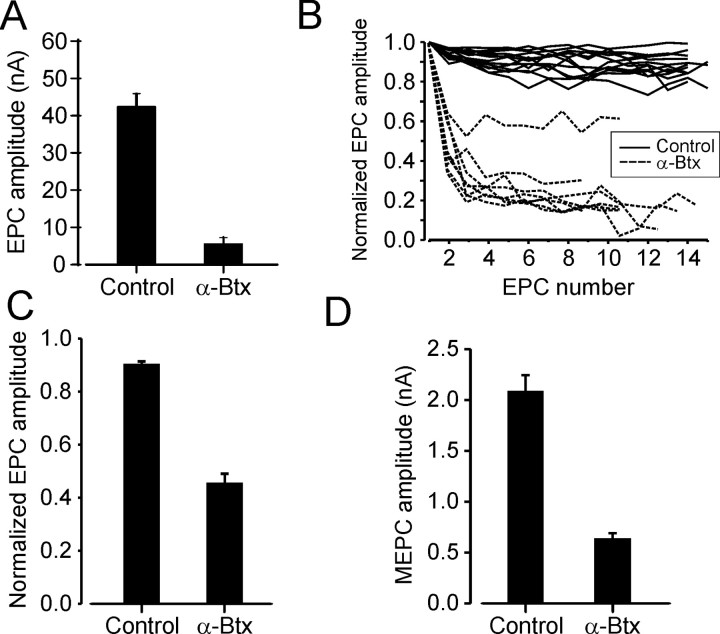
Motoneuron populations possess a range of intrinsic excitability that plays an important role in establishing how motor units are recruited. The fact that this range collapses after axotomy and does not recover completely until after reinnervation occurs suggests that muscle innervation is needed to maintain or regulate adult motoneuron excitability, but the nature and identity of underlying mechanisms remain poorly understood. Here, we report the results of experiments in which we studied the effects on rat motoneuron excitability produced by manipulations of neuromuscular transmission and compared these with the effects of peripheral nerve axotomy. Inhibition of acetylcholine release from motor terminals for 5-6 d with botulinum toxin produced relatively minor changes in motoneuron excitability compared with the effect of axotomy. In contrast, the blockade of acetylcholine receptors with alpha-bungarotoxin over the same time interval produced changes in motoneuron excitability that were statistically equivalent to axotomy. Muscle fiber recordings showed that low levels of acetylcholine release persisted at motor terminals after botulinum toxin, but endplate currents were completely blocked for at least several hours after daily intramuscular injections of alpha-bungarotoxin. We conclude that the complete but transient blockade of endplate currents underlies the robust axotomy-like effects of alpha-bungarotoxin on motoneuron excitability, and the low level of acetylcholine release that remains after injections of botulinum toxin inhibits axotomy-like changes in motoneurons. The results suggest the existence of a retrograde signaling mechanism located at the motor endplate that enables expression of adult motoneuron excitability and depends on acetylcholine receptor activation for its normal operation.
Figures
References
-
- Binder MD, Powers RK (2001) Relationship between simulated common synaptic input and discharge synchrony in cat spinal motoneurons. J Neurophysiol 86: 2266-2275. - PubMed
-
- Burgess RW, Nguyen QT, Son YJ, Lichtman JW, Sanes JR (1999) Alternatively spliced isoforms of nerve- and muscle-derived agrin: their roles at the neuromuscular junction. Neuron 23: 33-44. - PubMed
-
- Cope T, Pinter MJ (1995) The size principle: still working after all these years? News Physiol Sci 10: 280-286.
Publication types
MeSH terms
Substances
Grants and funding
LinkOut - more resources
Full Text Sources
