. 2005 Jun 1;565(Pt 2):349-70.
doi: 10.1113/jphysiol.2004.081422. Epub 2005 Mar 3.

Modulation of skeletal and cardiac voltage-gated sodium channels by calmodulin

Affiliations

Modulation of skeletal and cardiac voltage-gated sodium channels by calmodulin

Katharine A Young et al. J Physiol. .

Abstract

Calmodulin (CaM) has been shown to modulate different ion channels, including voltage-gated sodium channels (NaChs). Using the yeast two-hybrid assay, we found an interaction between CaM and the C-terminal domains of adult skeletal (NaV1.4) and cardiac (NaV1.5) muscle NaChs. Effects of CaM were studied using sodium channels transiently expressed in CHO cells. Wild type CaM (CaM(WT)) caused a hyperpolarizing shift in the voltage dependence of activation and inactivation for NaV1.4 and activation for NaV1.5. Intracellular application of CaM caused hyperpolarizing shifts equivalent to those seen with CaM(WT) coexpression with NaV1.4. Elevated Ca2+ and CaM-binding peptides caused depolarizing shifts in the inactivation curves seen with CaM(WT) coexpression with NaV1.4. KN93, a CaM-kinase II inhibitor, had no effect on NaV1.4, suggesting that CaM acts directly on NaV1.4 and not through activation of CaM-kinase II. Coexpression of hemi-mutant CaMs showed that an intact N-terminal lobe of CaM is required for effects of CaM upon NaV1.4. Mutations in the sodium channel IQ domain disrupted the effects of CaM on NaV1.4: the I1727E mutation completely blocked all calmodulin effects, while the L1736R mutation disrupted the effects of Ca2+-calmodulin on inactivation. Chimeric channels of NaV1.4 and NaV1.5 also indicated that the C-terminal domain is largely responsible for CaM effects on inactivation. CaM had little effect on NaV1.4 expressed in HEK cells, possibly due to large differences in the endogenous expression of beta-subunits between CHO and HEK cells. These results in heterologous cells suggest that Ca2+ released during muscle contraction rapidly modulates NaCh availability via CaM.


Figures

Figure 1
Figure 1. Effect of CaM and modulators of CaM on Na+ currents in CHO cells transiently transfected with NaV1.4
A and B, increased Ca2+ and CIP had no effect on currents. A, normalized peak current–voltage (I–V) relationships, elicited by 30 ms voltage-clamp steps from –90 to +100 mV in 10 mV increments (mean ± s.e.m.). NaV1.4 whole-cell currents (▪, n = 21) were unchanged with increased Ca2+ (▵, n = 13) or CIP (⋄, n = 6) included in the pipette. Inset shows one example of current traces used to generate the I–V curve. B, voltage dependence of steady-state activation and inactivation. Steady-state inactivation was measured by a two-pulse protocol with 100 ms conditioning pulses from −150 to +20 mV followed by a 30 ms test pulse to −10 mV. The data were fitted using a Boltzmann distribution. There was no shift in either activation or inactivation with 10 μm Ca2+ (▵) or 75 pm CIP (⋄). C and D, inclusion of CaM in the recording pipette caused hyperpolarizing shifts in the current. C, normalized I–V relationships for NaV1.4 alone (▪, n = 21) and with 10 μm CaM (◃, n = 11), 30 μm CaM (▹, n = 4), or 50 μm CaM (⋄, n = 6) included in the pipette (mean ± s.e.m.). D, activation and steady-state inactivation shifted with CaM included in the pipette. NaV1.4 alone (▪); +10 μm CaM (◃); +30 μm CaM (▹); +50 μm CaM (⋄). E and F, shifts in the V1/2 of activation (E) and steady-state inactivation (F) of NaV1.4 relative to the values for NaV1.4 alone from Fig. 1B and D.
Figure 2
Figure 2. Coexpression of NaV1.4 with CaMWT or CaM1234
A, normalized representative sodium currents through NaV1.4 in the absence (continuous line) and presence of coexpressed CaMWT (dashed line) or Ca2+-binding deficient mutant CaM1234 (dotted line). Currents were elicited by a 30 ms step to −10 mV from a holding potential of −120 mV. Time constants for inactivation (control = 0.67 ± 0.02 ms; + CaMWT= 0.59 ± 0.03 ms; + CaM1234= 0.61 ± 0.04 ms) were not significantly different. CaMWT is designated by WT in all panels. B, normalized I–V relationships for NaV1.4 (▪, n = 21) coexpressed with CaMWT (□, n = 13) or CaM1234 (▵, n = 8), as described in Fig. 1A. C, the voltage dependence of both activation and inactivation for NaV1.4 shifted significantly with coexpression of CaMWT (−14.9 mV and −11.3 mV, respectively). CaM1234 caused a significant shift in activation (−11.1 mV), but had no significant effect on inactivation. NaV1.4 alone (▪); + CaMWT (□); + CaM1234 (▵). D, modulators of CaM (10 μm Ca2+, 25 μm CBP or 75 pm CIP) caused a depolarizing shift in V1/2 for steady-state inactivation. + CaMWT+10 μm Ca2+ (▵, n = 16); + CaMWT+ 25 μm CBP (◃, n = 14); + CaMWT+ 75 pm CIP (⋄, n = 9). E, shifts in the V1/2 of activation relative to the values for NaV1.4 coexpressed with CaMWT (filled bars) or CaM1234 (open bars). Ca2+, CBP and CIP included in the pipette were not significantly different from CaMWT alone. Likewise, the addition of these modulators of CaM to cells expressing CaM1234 did not produce any changes in V1/2 of activation. CIPc (75 pm; a non-functional peptide analogue of CIP) and 10 μm KN93 (a blocker of CaM activation of CKII) had no effect. F, shifts in the V1/2 of steady-state inactivation relative to the values for NaV1.4 coexpressed with CaMWT (filled bars) or CaM1234 (open bars). Ca2+, CBP and CIP caused significant shifts from CaMWT alone (*). 75 pm CIPc and 10 μm KN93 had no effect. CaM modulators had no effect on the voltage dependence of inactivation of currents with CaM1234 coexpression.
Figure 3
Figure 3. Coexpression of NaV1.4 with mutant CaMs lacking Ca+ binding in either the N-terminal (CaM12) or C-terminal (CaM34) lobes
A, currents from cells with coexpression of CaM12 with NaV1.4 were unchanged from NaV1.4 expressed alone. CaMWT coexpression is shown for comparison: + CaMWT (▪, n = 13); + CaM12 (▵, n = 10). Addition of Ca2+ (10 μm, ▵, n = 8) or CIP (75 pm, ⋄, n = 9) was not different from CaM12. Cartoons depict mutations in the Ca2+-binding sites of CaM (N-terminal for panel A and C-terminal for panel B). B, coexpression of CaM34 caused a hyperpolarizing shift in the voltage dependence of both activation and inactivation, similar to CaMWT. + CaMWT (▪); + CaM34 (▵, n = 9); + CaM34+ 10 μm Ca2+ (▵, n = 10); + CaM34+ 75 pm CIP (⋄, n = 8). C, shifts in the V1/2 of activation and inactivation of NaV1.4 coexpressed with CaM12 or CaM34 relative to coexpression with CaMWT. Coexpression of CaM12 (filled bars) was significantly different from CaMWT, and not significantly different from NaV1.4 expressed alone. The shifts in both activation and inactivation with CaM34 (open bars) were not significantly different compared with CaMWT. D, Ca2+ or CIP induced shifts in the V1/2 of activation relative to coexpression with either CaM12 (filled bars) or CaM34 (open bars). Ca2+ and CIP had no effect on currents with CaM12. The depolarizing shifts with 10 μm Ca2+ and 75 pm CIP were significant compared with CaM34 alone. E, Ca2+ or CIP induced shifts in the V1/2 of steady-state inactivation relative to coexpression with either CaM12 or CaM34. Ca2+ and CIP had no effect on currents with CaM12. The depolarizing shifts seen with Ca2+ and CIP were significant compared with CaM34 alone.
Figure 4
Figure 4. Coexpression of NaV1.4 IQ-domain mutants with CaMWT
A, normalized I–V relationships (mean ± s.e.m.). I1727E whole-cell currents (▪, n = 5) were unchanged by coexpression with CaMWT (○, n = 9). Whole-cell currents from I1727E were not significantly different from native NaV1.4 (data not shown). CaMWT is designated WT in all panels. B, the I1727E mutation blocked all shifts in V1/2 of activation or inactivation seen with coexpression of CaMWT. Curves for I1727E were not significantly different compared with native NaV1.4 (data not shown). I1727E (▪); I1727E + CaMWT (○); I1727E + CaMWT+ 10 μm Ca2+ (▵, n = 8); I1727E + CaMWT+ 75 pm CIP (⋄, n = 9). C, normalized I–V relationships for L1736R (mean ± s.e.m.). L1736R whole-cell currents (▪, n = 5) were shifted by coexpression with CaMWT (○, n = 10). Whole-cell currents from L1736R were not significantly different from native NaV1.4 (data not shown). D, the L1736R mutated channel retained its responsiveness to CaMWT coexpression but activation and inactivation were no longer affected by Ca2+ and CIP with CaMWT coexpression. The V1/2 of activation and inactivation for L1736R was not significantly different compared with native NaV1.4 (data not shown). L1736R (▪); L1736R + CaMWT (○); L1736R + CaMWT+ 10 μm Ca2+ (▵, n = 8); L1736R + CaMWT+ 75 pm CIP (⋄, n = 9). E, shifts in the V1/2 of activation for I1727E (filled bars) and L1736R (open bars) coexpressed with CaMWT, relative to NaV1.4. Data for coexpression of native NaV1.4 coexpressed with CaMWT (cross-hatched bar) were replotted from Fig. 2 for comparison. The I1727E mutation abolished the effects of CaMWT coexpression (ϕ). For the L1736R mutation, V1/2 of activation with CaMWT was significantly shifted compared with L1736R alone, but not different from native NaV1.4 coexpressed with CaMWT. Ca2+ and CIP caused no significant shift compared with L1736R + CaMWT. F, shifts in the V1/2 of steady-state inactivation for I1727E and L1736R coexpressed with CaMWT, relative to NaV1.4. Data for coexpression of native NaV1.4 coexpressed with CaMWT were replotted from Fig. 2 for comparison. The I1727E mutation abolished the effects of CaMWT coexpression (ϕ; P < 0.05). For the L1736R mutation, activation with CaMWT coexpression was significantly shifted compared with L1736R alone. Addition of Ca2+ and CIP caused no significant shift compared with L1736R + CaMWT.
Figure 5
Figure 5. Coexpression of NaV1.5 with CaMWT or CaM1234
A, normalized I–V relationships for NaV1.5 (▪, n = 19) coexpressed with CaMWT (○, n = 20) or CaM1234 (▵, n = 11) (mean ± s.e.m.). Inset shows one example of current traces used to generate the I–V curve. CaMWT is designated WT in all panels. B, coexpression of CaMWT with NaV1.5 caused a significant hyperpolarizing shift in the voltage dependence of activation, but not inactivation. CaM1234 had no significant effect on currents. NaV1.5 (▪); + CaMWT (○); + CaM1234 (▵). C, modulators of CaM (10 μm Ca2+, 25 μm CBP or 75 pm CIP) had no significant effect on activation or steady-state inactivation of NaV1.5 compared with CaMWT coexpression. + CaMWT+ 10 μm Ca2+ (▵, n = 17); + CaMWT+ 25 μm CBP (◃, n = 9); + CaMWT+ 75 pm CIP (⋄, n = 15). D, blocking CKII with KN93 caused a shift in activation, but had no effect on inactivation of NaV1.5: + 10 μm KN93 (▵, n = 16); + 10 μm KN92 (*, n = 5). KN92 was unchanged from CaMWT alone. E, shifts in the V1/2 of activation for NaV1.5 relative to CaMWT coexpression. Coexpression with CaMWT caused a significant hyperpolarizing shift. Ca2+, CBP and CIP had no significant effect compared with CaMWT alone. 10 μm KN93 caused a further hyperpolarizing shift compared with CaMWT (σ). F, shifts in the V1/2 of steady-state inactivation for NaV1.5 relative to CaMWT coexpression. Coexpression with CaMWT had no significant effect on NaV1.5. CaM modulators had no significant effect compared with CaMWT alone. KN93 (10 μm) caused a hyperpolarizing shift compared with CaMWT coexpression alone (Θ).
Figure 6
Figure 6. Coexpression of C-terminal chimeric sodium channels with CaMWT
A, coexpression of NaV1.4/CT1.5 with CaMWT caused a hyperpolarizing shift in the voltage dependence of activation and inactivation. V1/2 of inactivation was not shifted by 10 μm Ca2+ or 75 pm CIP. Activation was shifted by these CaM modulators. Chimera (▪, n = 6); chimera + CaMWT (○, n = 16); chimera + CaMWT+ 10 μm Ca2+ (▵, n = 8); chimera + CaMWT+ 75 pm CIP (⋄, n = 10). Inset shows cartoon of chimeric channels, with portions contributed by NaV1.4 depicted by thin lines and by NaV1.5 by thick lines. CaMWT is designated WT in all panels. B, coexpression of NaV1.5/CT1.4 with CaMWT caused a hyperpolarizing shift in the voltage dependence of activation and steady-state inactivation. V1/2 of activation was not shifted by 10 μm Ca2+ or 75 pm CIP. Steady-state inactivation was shifted by these CaM modulators. Chimera (▪, n = 21); chimera + CaMWT (○, n = 19); chimera + CaMWT+ 10 μm Ca2+ (▵, n = 14); chimera + CaMWT+ 75 pm CIP (⋄, n = 11). C, shifts in the V1/2 of activation of chimeric channels compared with native NaV1.4 + CaMWT (filled bars) and NaV1.5 + CaMWT (cross-hatched bars). The depolarizing shifts seen with the addition of Ca2+ and CIP were significantly different for NaV1.4/CT1.5+ CaMWT (open bars), similar to the activation properties of NaV1.4 (filled bars). Ca2+ or CIP had no effect on NaV1.5/CT1.4. Chimeric channels behaved like the parent channel. Lettering at the top of the panel indicates the chimeric constructs. D, shifts in the V1/2 of steady-state inactivation of chimeric channels compared with native NaV1.4 (filled bars) and NaV1.5 (cross-hatched bars). Ca2+ and CIP had no effect on inactivation in NaV1.4/CT1.5. Ca2+ and CIP produced significant depolarizing shifts of V1/2 compared with NaV1.5/CT1.4+ CaMWT (striped bars), similar to the effects of Ca2+ and CIP on the inactivation properties of native NaV1.4 (filled bars). Chimeric channels behaved like the channel contributing the carboxyl tail. Lettering at the top of the panel indicates the chimeric constructs.
Figure 7
Figure 7. CaM effects and β-subunit mRNA expression in HEK and CHO cells
A, coexpression of CaM with Nav1.4 did not shift the voltage dependence of activation or inactivation in HEK cells. Nav1.4 (▪, n = 12); Nav1.4 + CaM (○, n = 7). B and C, relative abundance of mRNA of each of the four NaCh β-subunits, expressed as the number of copies relative to 1000 copies of HPRT (an internal control) in HEK and CHO cells, respectively. Note the logarithmic scale.
Figure 8
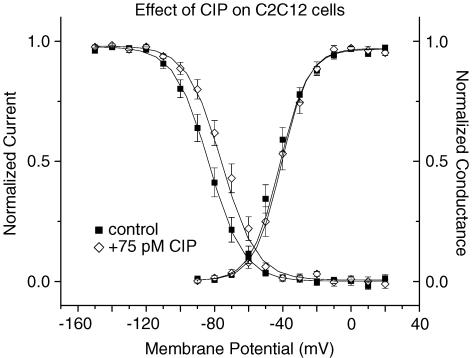
Figure 8. Voltage dependence of steady-state activation and inactivation in C2C12 cells
There was a shift in steady-state inactivation with 75 pm CIP (⋄, n = 9, V1/2=−75.8 ± 1.1 mV) compared with control (▪, n = 10, V1/2=−83.2 ± 1.2 mV) (P = 0.009). CIP had no effect on activation (control: ▪, n = 11, Va=−41.8 ± 1.0 mV; + 75 pm CIP: ⋄, n = 9, Va=−40.8 ± 1.2 mV).
Figure 9
Figure 9. Model of CaM interactions with the IQ domain
CaM is in an extended conformation with the C lobe bound to the proximal IQ region under low Ca2+ conditions (apoCaM). The sequence of the sodium channel IQ domain is similar to that of myosin IQ domains that crystallize with myosin light chain (a protein similar to CaM) in an extended conformation (Terrak et al. 2003). The N lobe interacts with another region of the carboxyl-terminal (or alternatively, other domains of the sodium channel or its subunits) termed the NLBD (N-lobe binding domain). When Ca2+ is elevated or CaM-binding peptides are added, the N lobe of CaM is released from the NLBD and, in the case of increased Ca2+, binds to the distal IQ domain (since mutation of the second leucine of RYLL abolished the Ca2+ effects).

References

    1. Bennett ES. Channel cytoplasmic loops alter voltage-dependent sodium channel activation in an isoform-specific manner. J Physiol. 2001;535:371–381. - PMC - PubMed
    1. Bennett ES, Urcan MS, Tinkle SS, Koszowski AG, Levinson SR. Contribution of sialic acid to the voltage dependence of sodium channel gating. A possible electrostatic mechanism. J General Physiol. 1997;109:327–343. - PMC - PubMed
    1. Carlier E, Dargent B, De Waard M, Couraud F. Na+ channel regulation by calmodulin kinase II in rat cerebellar granule cells. Biochem Biophys Res Commun. 2000;274:394–399. - PubMed
    1. Chou JJ, Li S, Klee CB, Bax A. Solution structure of Ca2+-calmodulin reveals flexible hand-like properties of its domains. Nature Struc Biol. 2001;8:990–996. - PubMed
    1. Colbert CM, Pan E. Ion channel properties underlying axonal action potential initiation in pyramidal neurons. Nat Neurosci. 2002;5:533–538. - PubMed

Publication types

MeSH terms

LinkOut - more resources