Comparative Study
. 2005 May 1;564(Pt 3):671-82.
doi: 10.1113/jphysiol.2004.079046. Epub 2005 Mar 3.

CFTR fails to inhibit the epithelial sodium channel ENaC expressed in Xenopus laevis oocytes

Affiliations
Comparative Study

CFTR fails to inhibit the epithelial sodium channel ENaC expressed in Xenopus laevis oocytes

G Nagel et al. J Physiol. .

Abstract

The cystic fibrosis transmembrane conductance regulator (CFTR) plays a crucial role in regulating fluid secretion by the airways, intestines, sweat glands and other epithelial tissues. It is well established that the CFTR is a cAMP-activated, nucleotide-dependent anion channel, but additional functions are often attributed to it, including regulation of the epithelial sodium channel (ENaC). The absence of CFTR-dependent ENaC inhibition and the resulting sodium hyperabsorption were postulated to be a major electrolyte transport abnormality in cystic fibrosis (CF)-affected epithelia. Several ex vivo studies, including those that used the Xenopus oocyte expression system, have reported ENaC inhibition by activated CFTR, but contradictory results have also been obtained. Because CFTR-ENaC interactions have important implications in the pathogenesis of CF, the present investigation was undertaken by our three independent laboratories to resolve whether CFTR regulates ENaC in oocytes and to clarify potential sources of previously reported dissimilar observations. Using different experimental protocols and a wide range of channel expression levels, we found no evidence that activated CFTR regulates ENaC when oocyte membrane potential was carefully clamped. We determined that an apparent CFTR-dependent ENaC inhibition could be observed when resistance in series with the oocyte membrane was not low enough or the feedback voltage gain was not high enough. We suggest that the inhibitory effect of CFTR on ENaC reported in some earlier oocyte studies could be attributed to problems arising from high levels of channel expression and suboptimal recording conditions, that is, large series resistance and/or insufficient feedback voltage gain.


Figures
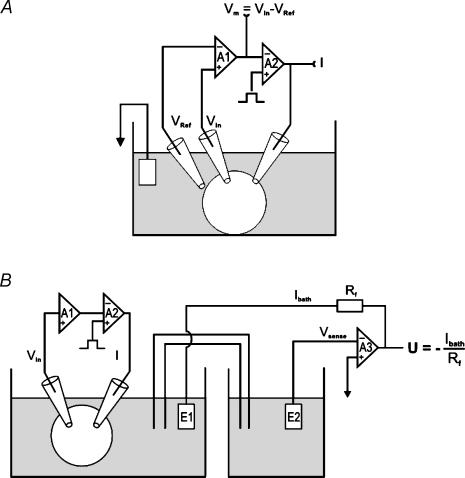
Figure 1
Figure 1. Schematic representation of different voltage-clamp configurations
Voltage-clamp arrangement as used with the Turbo-Tec (A) and the GeneClamp-500 (B) amplifier. See Methods for details.
Figure 2
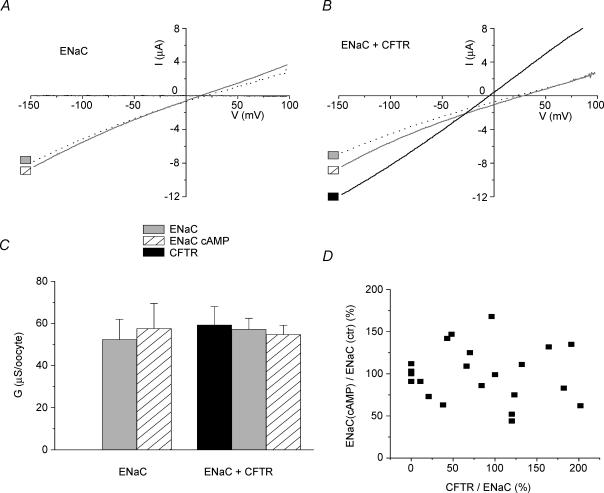
Figure 2. Human ENaC is not regulated by the human CFTR co-expressed in Xenopus oocytes
A, representative current–voltage (I–V) relationships obtained with an oocyte expressing human α-,β-and γ-ENaC only. Specific amiloride-sensitive (10 μm), ENaC-mediated current is shown in response to a voltage ramp (see Methods). The two lines represent the I–V relationship before (dotted line), and after application of cAMP-elevating cocktail (see Methods, continuous grey line). Note the lack of effect of cAMP elevation on ENaC-mediated current. B, representative I–V relationships obtained with an oocyte co-expressing hENaC and hCFTR. The graph shows specific amiloride-sensitive, ENaC-mediated current before and after the application of a cAMP-elevating cocktail, dotted and continous grey lines, respectively. The continuous black line represents cAMP-stimulated, CFTR-mediated current measured in the presence of amiloride. Note that in the presence of the CFTR, elevation of cAMP had no significant (NS) effect on the slope of ENaC-mediated current, although its reversal potential was slightly, but statistically significantly, increased (change in Vr= 13 mV, P < 0.001). C, summary of results: conductances GCFTR, GENaC and GENaC(cAMP) were calculated from the slopes of the I–V relationships such as those shown in A and B. The difference between the number of oocytes measured in the presence of the CFTR (n = 19) and the number of oocytes measured in the absence of the CFTR (n = 4) is due to the fact that only oocytes exhibiting similar levels of ENaC conductance were presented here (four oocytes), but cAMP insensitivity was also noticed in oocytes exhibiting higher levels of conductance (see D below). D, effect of CFTR activation on ENaC-mediated conductance in oocytes expressing different GCFTR/GENaC ratios. The graph shows relative change of ENaC-mediated conductance GENaC(cAMP)/GENaC in each individual oocyte measured before and after CFTR activation. The figure illustrates that CFTR activation had no effect on the hENaC at GCFTR/GENaC ratios up to 2.
Figure 3
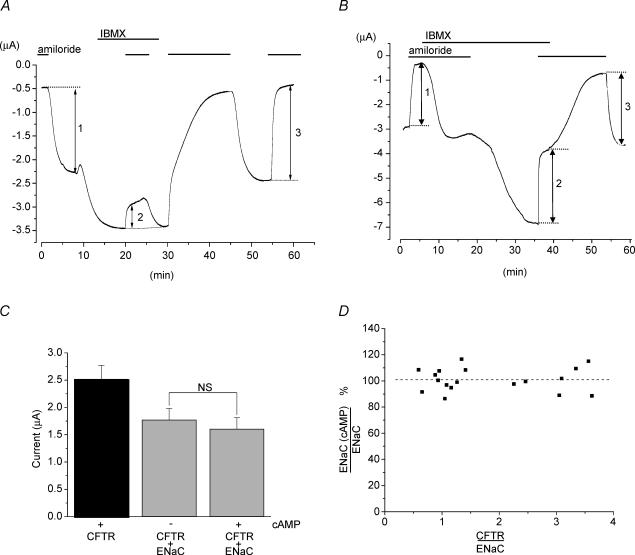
Figure 3. Rat ENaC is not regulated by the human CFTR co-expressed in Xenopus oocytes
A, example of a current trace recorded at −60 mV from an oocyte co-expressing α-, β-and γ-rENaC and hCFTR recorded with a single bath electrode (see Fig. 1; i.e. relatively large Rs of about 6 kΩ; see below). Horizontal lines indicate the application of 10 μm amiloride to block the ENaC or 1 mm IBMX to stimulate the CFTR. Vertical arrows indicate the amplitudes of ENaC-mediated, amiloride-sensitive Na+ current (IENaC) observed before, during and after IBMX stimulation, arrows 1, 2 and 3, respectively. Note that CFTR stimulation, seen as increased inward current during IBMX application, resulted in apparent inhibition of amiloride-sensitive current (compare vertical arrow 2 with 1 or 3). The bath-fluid resistance of the experimental chamber (RC-10, Warner Instruments Co) filled with ND96 solution was ∼4.5 kΩ, the combined resistance of the reference bath electrode and the agar bridge was ∼1.5 kΩ. B, an example of an experiment similar to A, but performed with the virtual ground amplifier connected with two electrodes to the bath to reduce Rs (cf. Fig. 1). No reduction of ENaC current by the CFTR was observed under these conditions; compare the inhibition of ENaC by amiloride in the presence of activated CFTR (arrow 2) with that before (arrow 1) and after CFTR deactivation (arrow 3). C, summary of ENaC-mediated and CFTR-mediated currents measured with low Rs as in B, filled bar, ICFTR; grey bars, IENaC without (left) and with (right) stimulation of the CFTR by IBMX. Oocytes were clamped at the holding potential of −60 mV. The data are means ±s.e.m, n = 23. The observed ENaC current amplitudes were not statistically significantly different (NS) before and after CFTR stimulation. D, effect of activated CFTR on IENaC observed in oocytes expressing different ratios of ICFTR/IENaC. Oocytes were voltage-clamped at −60 mV and stimulated with 1 mm IBMX. The slope of the linear regression fitted to the data points was not significantly different from 0 (P= 0.99, n = 18 oocytes from seven different frogs).
Figure 4
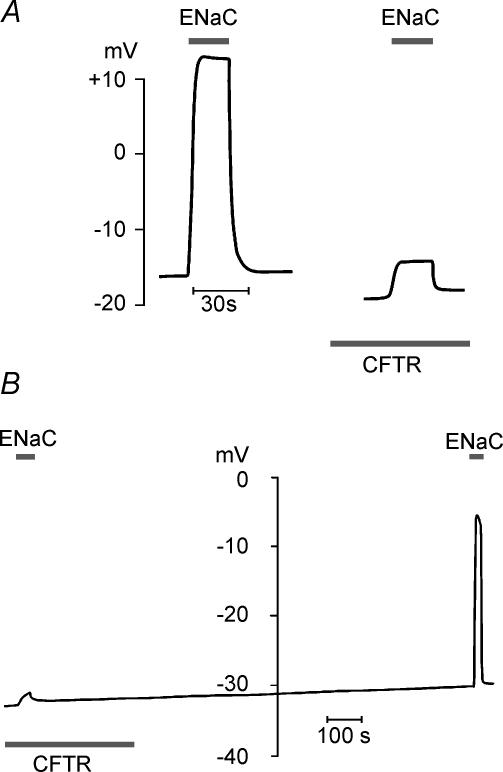
Figure 4. Amiloride-induced voltage shift is modulated by membrane conductance changes
A, when the hCFTR is inactive, rENaC activation by removal of amiloride (indicated by the bar labelled ENaC) depolarizes an oocyte in this example from −16 mV to +13 mV. Activation of the CFTR (by 0.5 mm IBMX + 10 μm forskolin, indicated by the bar labelled CFTR) yields slight hyperpolarization (to −19 mV), and subsequent activation of ENaC depolarizes the oocyte to only −14 mV. The trace shown is representative of seven similar experiments in which voltage-clamp measurements showed that ENaC conductance is not affected by CFTR activation. B, continuous voltage recording from another hCFTR/rENaC-co-expressing oocyte, where CFTR and ENaC were activated in a reversed order compared to A (i.e. CFTR was activated first, at the beginning of the experiment, and then inactivated). The data show increase of ENaC-related, amiloride-induced voltage shift after inactivating CFTR (washout of IBMX/forskolin), demonstrating reversibility of the effect.
Figure 5
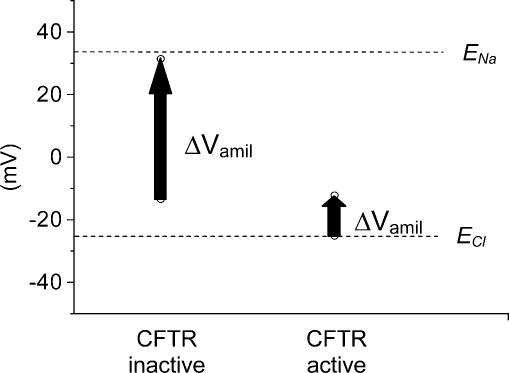
Figure 5. Amiloride-induced voltage shifts in oocytes expressing ENaC and CFTR
The diagram shows predicted membrane voltage shifts induced by amiloride removal (ΔVamil, vertical arrows) for oocytes under current-clamp condition with CFTR inactive or after CFTR activation. ΔVamil was calculated as described in the Discussion. ENa and ECl (dashed lines) represent Nernst potentials for Na+ and Cl, respectively.

References

    1. Akabas MH. Cystic fibrosis transmembrane conductance regulator. Structure and function of an epithelial chloride channel. J Biol Chem. 2000;275:3729–3732. 10.1074/jbc.275.6.3729. - DOI - PubMed
    1. Anderson MP, Berger HA, Rich DP, Gregory RJ, Smith AE, Welsh MJ. Nucleoside triphosphates are required to open the CFTR chloride channel. Cell. 1991;67:775–784. - PubMed
    1. Armstrong CM, Gilly WF. Access resistance and space clamp problems associated with whole-cell patch clamping. Methods Enzymol. 1992;207:100–122. - PubMed
    1. Axon Instruments. The Axon Guide. Foster City CA: Axon Instruments Inc; 1993. pp. 1–282.
    1. Barasch J, Kiss B, Prince A, Saiman L, Gruenert D, al Awqati Q. Defective acidification of intracellular organelles in cystic fibrosis. Nature. 1991;352:70–73. - PubMed

MeSH terms

LinkOut - more resources