. 2005 Mar;71(3):1155-62.
doi: 10.1128/AEM.71.3.1155-1162.2005.

Induction of Shiga toxin-converting prophage in Escherichia coli by high hydrostatic pressure

Affiliations

Induction of Shiga toxin-converting prophage in Escherichia coli by high hydrostatic pressure

Abram Aertsen et al. Appl Environ Microbiol. 2005 Mar.

Abstract

Since high hydrostatic pressure is becoming increasingly important in modern food preservation, its potential effects on microorganisms need to be thoroughly investigated. In this context, mild pressures (<200 MPa) have recently been shown to induce an SOS response in Escherichia coli MG1655. Due to this response, we observed a RecA- and LexA-dependent induction of lambda prophage upon treating E. coli lysogens with sublethal pressures. In this report, we extend this observation to lambdoid Shiga toxin (Stx)-converting bacteriophages in MG1655, which constitute an important virulence trait in Stx-producing E. coli strains (STEC). The window of pressures capable of inducing Stx phages correlated well with the window of bacterial survival. When pressure treatments were conducted in whole milk, which is known to promote bacterial survival, Stx phage induction could be observed at up to 250 MPa in E. coli MG1655 and at up to 300 MPa in a pressure-resistant mutant of this strain. In addition, we found that the intrinsic pressure resistance of two types of Stx phages was very different, with one type surviving relatively well treatments of up to 400 MPa for 15 min at 20 degrees C. Interestingly, and in contrast to UV irradiation or mitomycin C treatment, pressure was not able to induce Stx prophage or an SOS response in several natural Stx-producing STEC isolates.


Figures
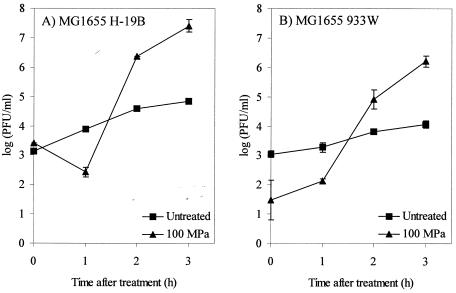
FIG. 1.
FIG. 1.
Induction of H-19B (A) and 933W (B) lysogens of MG1655 by HHP treatment (100 MPa, 15 min, 20°C). The evolution of phage particle count [log(PFU/milliliter)] in untreated (▪) and high-pressure-treated (▴) cell suspensions of MG1655 is shown. The results are expressed as the means ± standard deviations of three experiments.
FIG. 2.
FIG. 2.
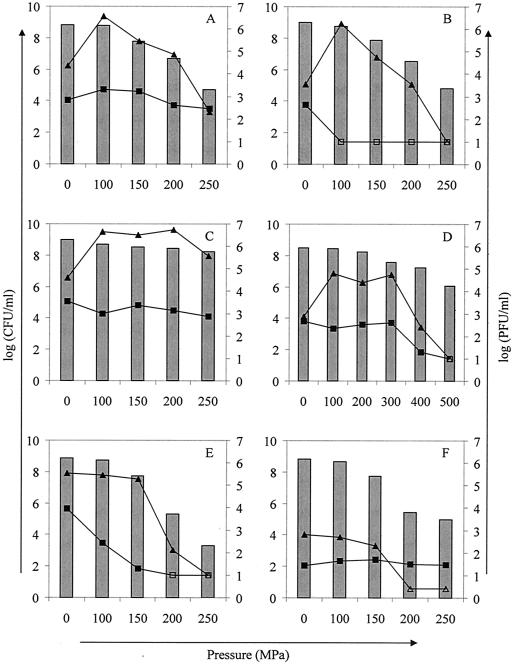
Phage counts [log(PFU/milliliter), plotted on the right y axis] immediately (▪) and 3 h (▴) after induction at different pressures (15 min, 20°C) of MG1655 H-19B in LB (A), MG1655 933W in LB (B), MG1655 H-19B in whole milk (C), LMM1010 H-19B in whole milk (D), EDL 933 (O157:H7) in LB (E), and H19 (O26:H11) in LB (F). Open symbols represent counts below the detection limit. Bars represent bacterial survival after pressure treatment [log(CFU/milliliter), plotted on the left y axis]. Representative results of at least three experiments are shown.
FIG. 3.
FIG. 3.
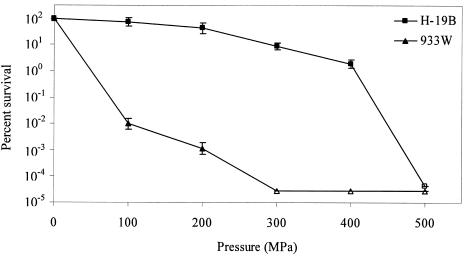
Inactivation of isolated H-19B (▪) and 933W (▴) phage particles by pressure treatment (0 to 500 MPa, 15 min, 20°C), as determined by infectivity upon plating on C600. Untreated (0-MPa) phage titers correspond to ca. 2.3 × 10⁷ and 3.8 × 10⁷ PFU/ml for H-19B and 933W, respectively. Open symbols represent counts below the detection limit. The results are expressed as means ± the standard deviations of three experiments.
FIG. 4.
FIG. 4.
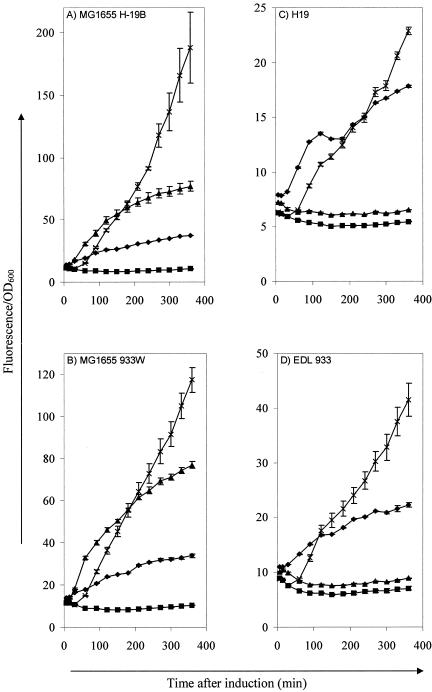
Determination of SOS promoter activity in MG1655 H-19B (A), MG1655 933W (B), H19 (O26:H11) (C), and EDL 933 (O157:H7) (D) after treatment with pressure (▴; 100 MPa, 15 min, 20°C), UV (♦; 0.2 kJ/m2), or mitomycin C (×; 0.5 μg/ml) compared to untreated cells (▪). SOS promoter activity was measured with a recA promoter transcription fusion to gfp and is expressed as fluorescence per unit of OD600. The results are expressed as means ± the standard deviations.

References

    1. Acheson, D. W., J. Reidl, X. Zhang, G. T. Keusch, J. J. Mekalanos, and M. K. Waldor. 1998. In vivo transduction with Shiga toxin 1-encoding phage. Infect. Immun. 66:4496-4498. - PMC - PubMed
    1. Aertsen, A., K. Vanoirbeek, P. De Spiegeleer, J. Sermon, K. Hauben, A. Farewell, T. Nyström, and C. W. Michiels. 2004. Heat shock protein mediated resistance toward high hydrostatic pressure in Escherichia coli. Appl. Environ. Microbiol. 70:2660-2666. - PMC - PubMed
    1. Aertsen, A., R. Van Houdt, K. Vanoirbeek, and C. W. Michiels. 2004. An SOS response induced by high pressure in Escherichia coli. J. Bacteriol. 186:6133-6141. - PMC - PubMed
    1. Alpas, H., N. Kalchayanand, F. Bozoglu, A. Sikes, C. P. Dunne, and B. Ray. 1999. Variation in resistance to hydrostatic pressure among strains of food-borne pathogens. Appl. Environ. Microbiol. 65:4248-4251. - PMC - PubMed
    1. Beaber, J. W., B. Hochhut, and M. K. Waldor. 2004. SOS response promotes horizontal dissemination of antibiotic resistance genes. Nature 427:72-74. - PubMed

Publication types

LinkOut - more resources