. 2005 Mar;71(3):1267-75.
doi: 10.1128/AEM.71.3.1267-1275.2005.

Poly(A) polymerase modification and reverse transcriptase PCR amplification of environmental RNA

Affiliations

Poly(A) polymerase modification and reverse transcriptase PCR amplification of environmental RNA

Lina M Botero et al. Appl Environ Microbiol. 2005 Mar.

Abstract

We describe a combination of two established techniques for a novel application for constructing full-length cDNA clone libraries from environmental RNA. The cDNA was cloned without the use of prescribed primers that target specific genes, and the procedure did not involve random priming. Purified RNA was first modified by addition of a poly(A) tail and then was amplified by using a commercially available reverse transcriptase PCR (RT-PCR) cDNA synthesis kit. To demonstrate the feasibility of this approach, a cDNA clone library was constructed from size-fractionated RNA (targeting 16S rRNA) purified from a geothermally heated soil in Yellowstone National Park in Wyoming. The resulting cDNA library contained clones representing Bacteria and Eukarya taxa and several mRNAs. There was no exact clone match between this library and a separate cDNA library generated from an RT-PCR performed with unmodified rRNA and Bacteria-specific forward and universal reverse primers that were designed from cultivated organisms; however, both libraries contained representatives of the Firmicutes and the alpha-Proteobacteria. Unexpectedly, there were no Archaea clones in the library generated from poly(A)-modified RNA. Additional RT-PCRs performed with universal and Archaea-biased primers and unmodified RNA demonstrated the presence of novel Archaea in the soil. Experiments with pure cultures of Sulfolobus solfataricus and Halobacterium halobium revealed that some Archaea rRNA may not be a suitable substrate for the poly(A) tail modification step. The protocol described here demonstrates the feasibility of directly accessing prokaryote RNA (rRNA and/or mRNA) in environmental samples, but the results also illustrate potentially important problems.


Figures
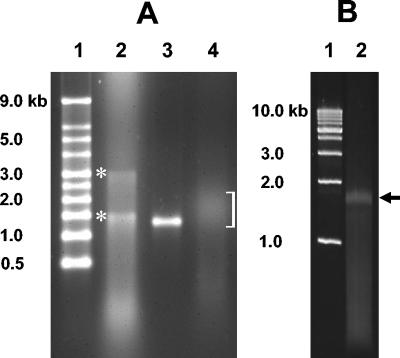
FIG. 1.
FIG. 1.
Demonstration of RNA purification, poly(A) tail modification, and RT-PCR amplification of environmental RNA. (A) Denaturing agarose (1%) gel containing electrophoresed samples resulting from RNA extraction, purification, and modification with poly(A)polymerase. Lane 1, molecular weight markers; lane 2, RNA extracted from soil and purified; lane 3, DNase-treated and gel-purified RNA; lane 4, soil RNA after poly(A) tailing reaction. The bracket indicates the position of the various tailed RNA molecules. The locations of 23S and 16S RNAs are indicated by asterisks and were determined by examining numerous reproducible gels in which these bands were aligned with the corresponding bands of RNA purified from E. coli (data not shown) and by molecular weight, as shown. (B) Final PCR product electrophoresed in a 1% agarose gel. Lane 1, molecular weight markers; lane 2, cDNA product from PCR amplification. The arrow indicates the position of the PCR product. In both panels, the sizes of all molecular weight markers are indicated on the left.
FIG. 2.
FIG. 2.
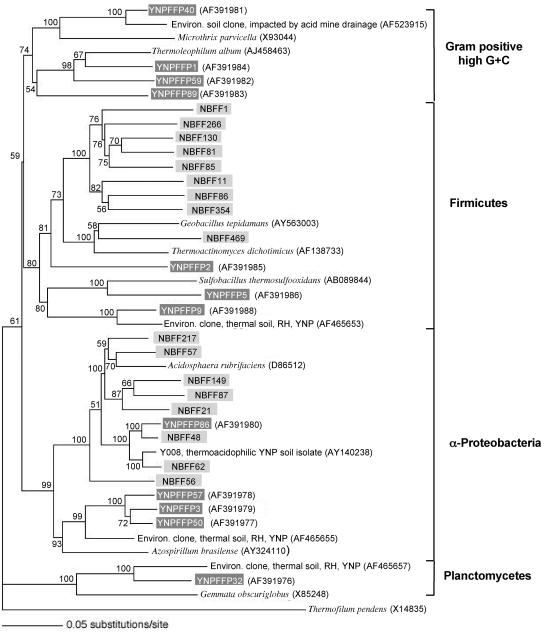
Inferred evolutionary relationships of Bacteria sequences RT-PCR amplified from RNA purified from the same Yellowstone National Park geothermal soil. All clones obtained from unmodified rRNA (amplified by using the 8F [Bacteria-specific] and 1510R [universal] primers) are indicated by dark gray boxes and are compared to taxonomically relevant clones derived from rRNAs with poly(A) tails, which are indicated by light gray boxes. Phyla are indicated by brackets on the right. The tree was constructed by maximum-likelihood analysis, and the cloned sequences (approximately 1,400 nucleotides) were aligned with and compared to the most similar (closest BLAST matches) 16S rRNA gene sequences of cultured and characterized bacteria and, where informative, to the most similar environmental (Environ.) clones (RH, Ragged Hills; YNP, Yellowstone National Park). Bootstrap values resulting from analysis of 100 pseudoreplicates are indicated at the nodes, and a nucleotide substitution scale bar is below the tree. The archaeon Thermofilum pendens was used as an outgroup.
FIG. 3.
FIG. 3.
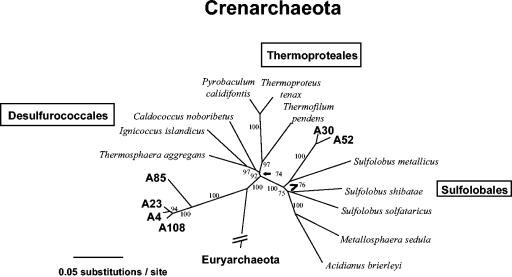
Inferred evolutionary relationships of Archaea sequences RT-PCR amplified from Yellowstone National Park geothermal soil total RNA (unmodified) by using the 2F (Archaea-biased) and 1510R (universal) primers. The tree was constructed by using distance analysis (parsimony analysis yielded a very similar tree), and the cloned archaeal sequences (at approximately 1,400 positions) were compared to 16S rRNA gene sequences of cultured and characterized archaea representing separate lines of decent within the Crenarchaeota division. The taxonomic orders within the Crenarchaeota are enclosed in boxes. Cloned sequences are indicated by boldface type. The bootstrap value resulting from 500 pseudoreplicates is shown for each branch, and a nucleotide substitution scale bar is below the tree. Clones A4, A23, A30, A52, A85, and A108 correspond to GenBank accession numbers AF391990, AF391991, AF391995, AF391996, AF391992, and AF391993, respectively.
FIG. 4.
FIG. 4.
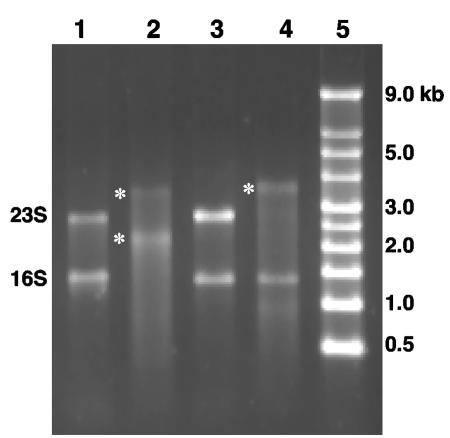
Variation in poly(A) tailing of purified RNA from S. solfataricus and H. halobium. Lane 1, S. solfataricus untreated RNA; lane 2, S. solfataricus RNA treated with poly(A) polymerase; lane 3, H. halobium untreated RNA; lane 4, H. halobium RNA treated with poly(A) polymerase; lane 5, nucleic acid fragment length standards. The positions of size standards are indicated on the right. The positions of 16S and 23S rRNAs are indicated on the left, and asterisks indicated the positions of poly(A)-modified RNA.

References

    1. Altschul, S. F., T. L. Madden, A. A. Schaffer, J. Zhang, Z. Zhang, W. Miller, and D. L. Lipman. 1997. Gapped BLAST and PSI-BLAST: a new generation of protein database search programs. Nucleic Acids Res. 25:3389-3402. - PMC - PubMed
    1. Amann, R. I., W. Ludwig, and K.-H. Schleifer. 1995. Phylogenetic identification and in situ detection of individual microbial cells without cultivation. Microbiol. Rev. 59:143-169. - PMC - PubMed
    1. Boucher, Y., and W. F. Doolittle. 2002. Something new under the sea. Nature 417:27-28. - PubMed
    1. Brofft, J. E., J. V. McArthur, and L. J. Shimkets. 2002. Recovery of novel bacterial diversity from a forested wetland impacted by reject coal. Environ. Microbiol. 4:764-769. - PubMed
    1. Cole, J. R., B. Chai, T. L. Marsh, R. J. Farris, Q. Wang, S. A. Kulam, S. Chandra, D. M. McGarrell, T. M. Schmidt, G. M. Garrity, and J. M. Tiedje. 2003. The Ribosomal Database Project (RDP-II): previewing a new autoaligner that allows regular updates and the new prokaryotic taxonomy. Nucleic Acids Res. 31:442-443. - PMC - PubMed

Publication types

MeSH terms

LinkOut - more resources