


Human cytomegalovirus reactivation during lactation and mother-to-child transmission in preterm infants
- PMID: 15750102
- PMCID: PMC1081237
- DOI: 10.1128/JCM.43.3.1318-1324.2005
Human cytomegalovirus reactivation during lactation and mother-to-child transmission in preterm infants
Abstract
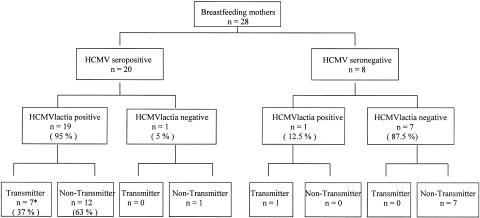
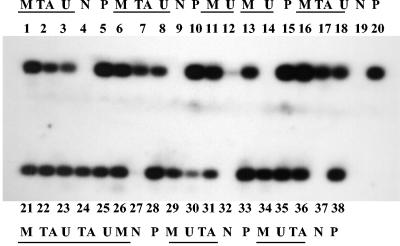
In a clinical trial, the incidence of cytomegalovirus reactivation in breastfeeding mothers and transmission to their preterm infants were studied. Breast milk from 73 mothers as well as urine and tracheal and pharyngeal aspirates from their 89 infants were screened weekly for human cytomegalovirus (HCMV) DNA during the first 2 months after delivery. Of the 73 mothers, 48 (66%) were positive for HCMV DNA in the lactating breast. HCMV reactivation could be confirmed for 19 of 20 (95%) immunoglobulin G-positive mothers. Of the eight immunoglobulin G-negative mothers one was positive for HCMV DNA in breast milk. In only 2 out of 13 seropositive mothers with HCMV DNA in breast milk could viral DNA be detected in the peripheral blood. HCMV mother-to-child transmission was concluded for 20 of the 48 (42%) mothers positive for DNA or 7 of 19 (37%) seropositive for HCMV and positive for HCMV DNA in breast milk and one of one mother seronegative for HCMV but positive for HCMV DNA in breast milk. One mother transmitted the virus to her twins. In addition, one infant acquired postnatal HCMV infection despite the mother's being negative for HCMV DNA in breast milk; altogether, we found 22 infants with HCMV infection. In 13 of these 22 infants, virus infection occurred definitively postnatally; two of them developed severe symptomatic HCMV infection. HCMV-infected infants demonstrated higher incidences of amniotic infection, respiratory distress syndrome, bronchopulmonary dysplasia, and retinopathia praenatalis than noninfected infants, however, the differences were not statistically significant. In summary, our study confirmed a very high incidence of HCMV reactivation in mothers during lactation and a significant risk of transmission to preterm infants with the possibility of severe disease in these babies.
Figures
References
-
- Alford, C. A., S. Stagno, R. F. Pass, and W. J. Britt. 1990. Congenital and perinatal cytomegalovirus infections. Rev. Infect. Dis. 12:S745-S753. - PubMed
-
- Asanuma, H., K. Numazaki, N. Nagata, T. Hotsubo, K. Horino, and S. Chiba. 1996. Role of milk whey in the transmission of human cytomegalovirus infection by breast milk. Microbiol. Immunol. 40:201-204. - PubMed
-
- Ballard, R. A., W. L. Drew, K. G. Hufnagle, and P. A. Riedel. 1979. Acquired cytomegalovirus infection in preterm infants. Am. J. Dis. Child. 133:482-485. - PubMed
-
- Bauer, H., Y. Ting, C. E. Greer, J. C. Chambers, C. J. Tashino, J. Chimera, A. Reingold, and M. M. Manos. 1991. Genital human papilloma virus infection in female university students as determined by a PCR-based method. JAMA 265:472-477. - PubMed
-
- Beutler, T., C. Höflich, S. A. Stevens, D. H. Krüger, and S. Prösch. 2003. Downregulation of the epidermal growth factor receptor by human cytomegalovirus infection in human fetal lung fibroblasts. Am. J. Respir. Cell. Mol. Biol. 28:86-94. - PubMed
Publication types
MeSH terms
Substances
LinkOut - more resources
Full Text Sources
Other Literature Sources
Medical
