. 2005 Mar 22;102(12):4637-42.
doi: 10.1073/pnas.0407655101. Epub 2005 Mar 8.

Role of Toll-like receptors 2 and 4 in the induction of cyclooxygenase-2 in vascular smooth muscle

Affiliations

Role of Toll-like receptors 2 and 4 in the induction of cyclooxygenase-2 in vascular smooth muscle

Rosario Jimenez et al. Proc Natl Acad Sci U S A. .

Abstract

Bacteria stimulate macrophages as part of normal host defense. However, when this response is not limited, vascular smooth muscle may also be activated to express "vasoactive" genes (e.g., cyclooxygenase), leading to vascular collapse and septic shock. In macrophages, Toll-like receptors (TLRs) 4 and 2 transduce responses to Gram-negative and Gram-positive bacteria, respectively. However, the role of these TLRs in sensing bacteria in vascular smooth muscle is unclear. To address this question, we have cultured vascular smooth muscle cells from mice deficient in TLR4 (TLR4(-/-) mice), mice deficient in TLR2 (TLR2(-/-) mice), or control mice. Cells cultured from control or TLR2(-/-) mice, but not from TLR4(-/-) mice, expressed cyclooxygenase-2 and released increasing levels of prostaglandin E(2) after stimulation with whole Escherichia coli bacteria; the combination of IL-1beta plus TNF-alpha induced cyclooxygenase-2 in cells cultured from all three groups of animals. By contrast, Staphylococcus aureus affected cyclooxygenase-2 expression in two distinct ways. First, S. aureus induced a transient inhibition of cyclooxygenase-2 expression, which was overcome with time, and increased protein expression was noted. The effects of S. aureus on cyclooxygenase-2 expression were TLR2- and not TLR4-dependent. Thus, we show that Gram-positive and Gram-negative bacteria induce cyclooxygenase-2 in vascular smooth muscle with differing temporal profiles but with appropriate TLR2-versus-TLR4 signaling. These data have important implications for our understanding of the innate immune response in vascular cells and how it may impact vascular disease.


Figures
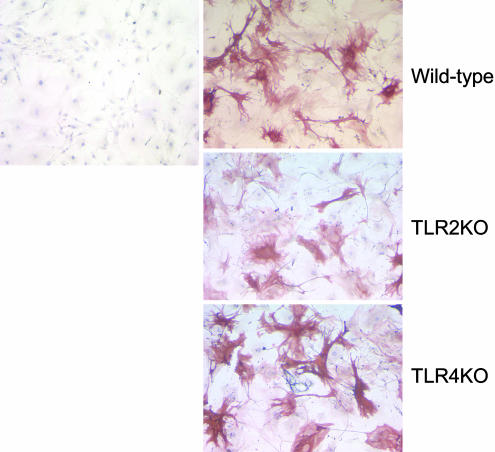
Fig. 1.
Fig. 1.
Morphology of mouse aortic smooth muscle cells. Primary cultures from control, TLR2–/–, and TLR4–/– mice exhibited the characteristic hill-and-valley morphology of vascular smooth muscle cells. Immunostaining shows smooth muscle α-actin with counterstaining for the nuclei. Staining in the absence of primary antibodies is shown in Left.
Fig. 2.
Fig. 2.
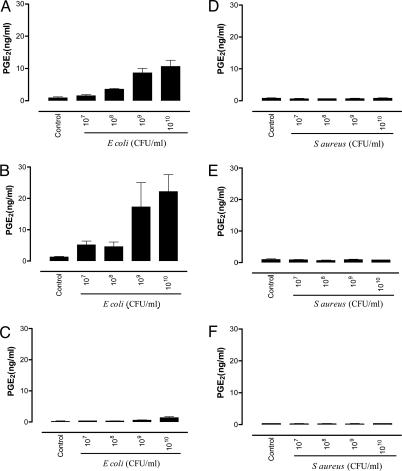
Effect of Gram-negative and Gram-positive bacteria on cyclooxygenase activity in murine smooth muscle cells from wild-type, TLR2–/–, and TLR4–/– mice. (A and B) E. coli (107 to 1010 CFU/ml) induced a concentration-dependent increase in the activity of cyclooxygenase in vascular smooth muscle cells derived from the aortae of control (A) or TLR2–/– (B) animals. (C) However, E. coli had a little or no effect on the production of PGE2 in vascular smooth muscle cells cultured from TLR4–/– mice. (DF) S. aureus (107 to 1010 CFU/ml) had no effect on cyclooxygenase activity in cells cultured from control (D), TLR2–/– (E), or TLR4–/– (F) mice. Data shown are mean ± SEM for three separate wells of cells. Similar observations (using bacteria at 109 CFU/ml) were made in two other experiments.
Fig. 3.
Fig. 3.
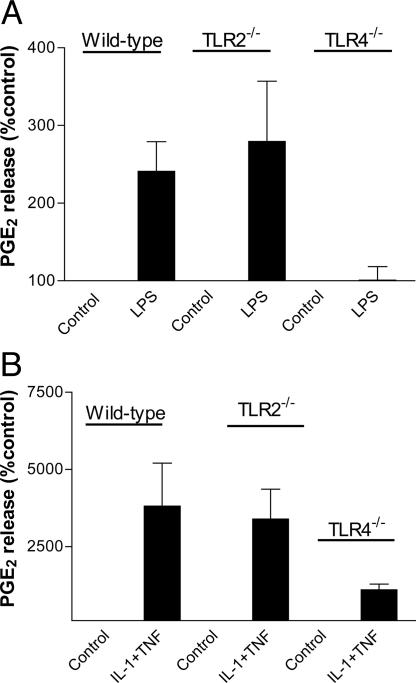
Effect of LPS (10 μg/ml) (A) or the combination of the cytokines TNF-α and IL-1β (both at 10 ng/ml) (B) on PGE2 production in primary cultures of murine smooth muscle cells from control, TLR2–/–, and TLR4–/– mice, respectively. The release of PGE2 is calculated as percentage of control. Data are means ± SEM for 5–11 determinations with cells from three separate aortae.
Fig. 4.
Fig. 4.
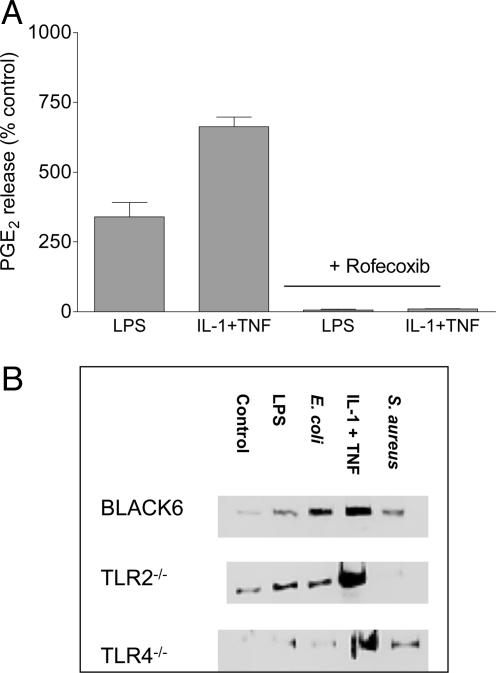
Characterization of cyclooxygenase-2 activity in primary cultures of murine smooth muscle cells from control, TLR4–/–, and TLR2–/– mice. (A) Inhibition by rofecoxib (100 nM) of the increase in PGE2 production induced by LPS (10 μg/ml) or the combination of TNF-α plus IL-1β (10 ng/ml each) for 48 h. Data are means ± SEM for three experiments. (B) Western blot analysis of cyclooxygenase-2 protein expression in whole cell extracts from wild-type control, TLR2–/–, and TLR4–/– mice. Lanes contain samples of unstimulated cells from control, TLR2–/–, and TLR4–/– mice and cells stimulated with LPS (10 μg/ml), E. coli (109 CFU/ml), the combination of TNF-α and IL-1β (10 ng/ml each), or S. aureus (109 CFU/ml) for 48h. Similar results were obtained by using cells cultured from three separate aortae.
Fig. 5.
Fig. 5.
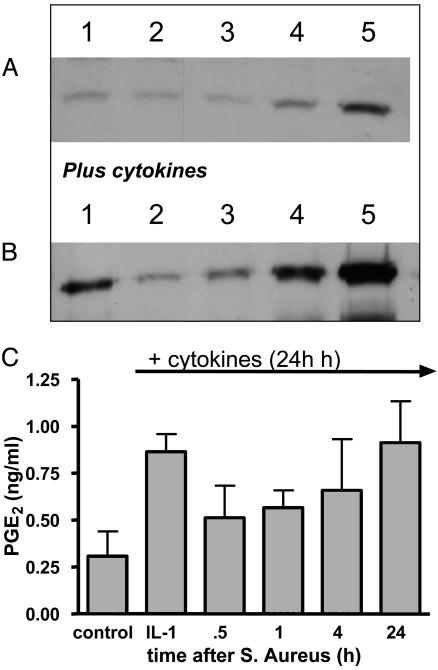
Temporal effects of S. aureus (108 CFU/ml) on cyclooxygenase-2 expression in wild-type cells. (A) A representative Western blot for cyclooxygenase-2 with samples from control cells (lane 1) or cells treated with S. aureus for 30 min (lane 2), 1 h (lane 3), 4 h (lane 4), or 24 h (lane 5). (B) A representative blot in which cells were treated with cytokines alone for 24 h (lane 1) or with cytokines plus S. aureus for 30 min (lane 2), 60 min (lane 3), 4 h (lane 4), or 24 h (lane 5). Twenty-five micrograms of protein was loaded in each well. Similar data were obtained by using three other separate cell cultures. In each experiment, the inhibitory effects of S. aureus on expression were significant. It should be noted, however, that the duration of inhibition of cyclooxygenase induction varied in time from between 4 and 24 h. (C) The inhibitory effects of S. aureus on cyclooxygenase activity [measured as PGE2 for 30 min after treatments in the presence of substrate (30 μM)].

References

    1. Jourdan, K. B., Mitchell, J. A. & Evans, T. W. (1997) Biochem. Biophys. Res. Commun. 233, 668–672. - PubMed
    1. Bishop-Bailey, D., Pepper, J. R., Larkin, S. W. & Mitchell, J. A. (1998) Arterioscler. Thromb. Vasc. Biol. 18, 1655–1661. - PubMed
    1. Bishop-Bailey, D., Larkin, S. W., Warner, T. D., Chen, G. & Mitchell, J.A. (1997) Br. J. Pharmacol. 121, 125–133. - PMC - PubMed
    1. Busse, R. & Mulsch A. (1990) FEBS Lett. 275, 87–90. - PubMed
    1. Woods, M., Bishop-Bailey, D., Pepper, J. R., Evans, T. W., Mitchell, J. A. & Warner, T. D. (1998) J. Cardiovasc. Pharmacol. 31, S348–S350. - PubMed

Publication types

MeSH terms

LinkOut - more resources