


Use of glycosylated recombinant human G-CSF (lenograstim) during and/or after induction chemotherapy in patients 61 years of age and older with acute myeloid leukemia: final results of AML-13, a randomized phase-3 study
- PMID: 15761020
- PMCID: PMC1895135
- DOI: 10.1182/blood-2004-09-3728
Use of glycosylated recombinant human G-CSF (lenograstim) during and/or after induction chemotherapy in patients 61 years of age and older with acute myeloid leukemia: final results of AML-13, a randomized phase-3 study
Abstract
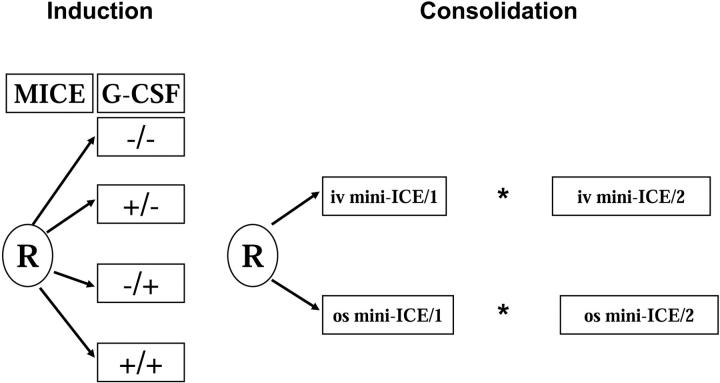
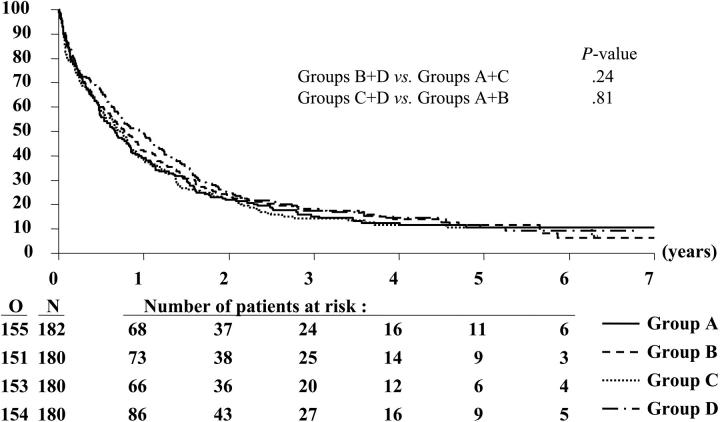
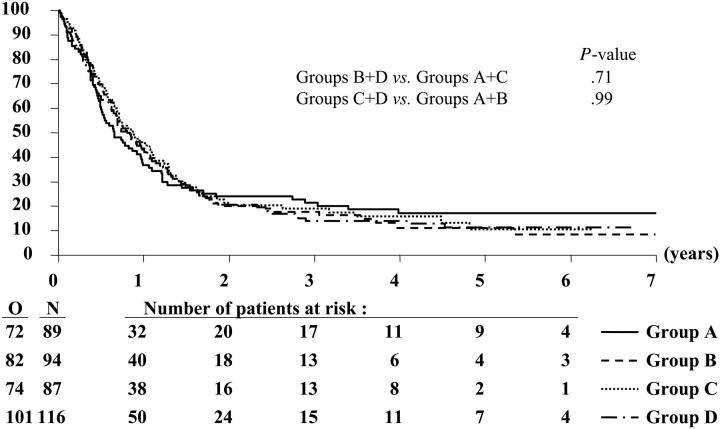
The role of glycosylated recombinant human granulocyte colony-stimulating factor (G-CSF) in the induction treatment of older adults with acute myeloid leukemia (AML) is still uncertain. In this trial, a total of 722 patients with newly diagnosed AML, median age 68 years, were randomized into 4 treatment arms: (A) no G-CSF; (B) G-CSF during chemotherapy; (C) G-CSF after chemotherapy until day 28 or recovery of polymorphonuclear leukocytes; and (D) G-CSF during and after chemotherapy. The complete remission (CR) rate was 48.9% in group A, 52.2% in group B, 48.3% in group C, and 64.4% in group D. Analysis according to the 2 x 2 factorial design indicated that the CR rate was significantly higher in patients who received G-CSF during chemotherapy (58.3% for groups B + D vs 48.6% for groups A + C; P = .009), whereas no significant difference was observed between groups A + B and C + D (50.6% vs 56.4%, P = .12). In terms of overall survival, no significant differences were observed between the various groups. Patients who received G-CSF after chemotherapy had a shorter time to neutrophil recovery (median, 20 vs 25 days; P < .001) and a shorter hospitalization (mean, 27.2 vs 29.7 days; P < .001). We conclude that although priming with G-CSF can improve the CR rate, the use of G-CSF during and/or after chemotherapy has no effect on the long-term outcome of AML in older patients.
Figures

References
-
- Stone RM. The difficult problem of acute myeloid leukemia in the older adult. CA Cancer J Clin. 2002;52: 363-371. - PubMed
-
- Stasi R, Venditti A, Del Poeta G, et al. Intensive treatment of patients age 60 years and older with de novo acute myeloid leukemia: analysis of prognostic factors. Cancer. 1996;77: 2476-2488. - PubMed
-
- Leith CP, Kopecky KJ, Godwin J, et al. Acute myeloid leukemia in the elderly: assessment of multidrug resistance (MDR1) and cytogenetics distinguishes biologic subgroups with remarkably distinct responses to standard chemotherapy: A Southwest Oncology Group study. Blood. 1997; 89: 3323-3329. - PubMed
-
- Grimwade D, Walker H, Harrison G, et al. The predictive value of hierarchical cytogenetic classification in older adults with acute myeloid leukemia (AML): analysis of 1065 patients entered into the United Kingdom Medical Research Council AML11 trial. Blood. 2001;98: 1312-1320. - PubMed
-
- Hiddemann W, Kern W, Schoch C, et al. Management of acute myeloid leukemia in elderly patients. J Clin Oncol. 1999;17: 3569-3576. - PubMed
