


Review
doi: 10.1172/JCI24408.
Oxygen, oxidative stress, hypoxia, and heart failure
Affiliations
- PMID: 15765131
- PMCID: PMC1052012
- DOI: 10.1172/JCI24408
Item in Clipboard
Review
Oxygen, oxidative stress, hypoxia, and heart failure
J Clin Invest.
2005 Mar.
Abstract
A constant supply of oxygen is indispensable for cardiac viability and function. However, the role of oxygen and oxygen-associated processes in the heart is complex, and they and can be either beneficial or contribute to cardiac dysfunction and death. As oxygen is a major determinant of cardiac gene expression, and a critical participant in the formation of ROS and numerous other cellular processes, consideration of its role in the heart is essential in understanding the pathogenesis of cardiac dysfunction.
Figures
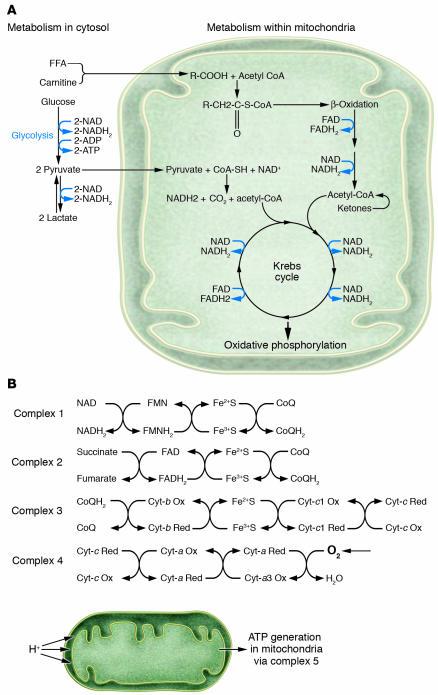
Role of oxygen in myocardial metabolism. (A) Schematic depiction of the pathways by which cardiac muscle utilizes various fuels, including fatty acids, glucose, lactate, and ketones. Glycolysis occurs in the cytosol and does not require oxygen. β-Oxidation of fatty acids, ketone metabolism, and the metabolism of glucose-derived intermediates all generate reduced flavoproteins (NADH2 and FADH2). (B) Schematic depiction of the process of oxidative phosphorylation in the mitochondria. Complexes 1_4 refer to specific electron transfer steps that occur in the mitochondria. A series of electron transfers among the flavoproteins (FMNH2, NADH2, FADH2), iron-sulfur, coenzyme Q, and the cytochromes a_c1, results in accumulation of protons in the space between the inner and outer mitochondrial membranes. This proton gradient provides the energy for ATP production via complex 5. Sustaining this crucial process requires the continuous availability of oxygen as the terminal electron acceptor in the chain. Fe2+S, reduced iron-sulfur; Fe3+S, oxidized iron-sulfur; FMN, flavin mononucleotide; cyt, cytochrome; CoQ, coenzyme Q.
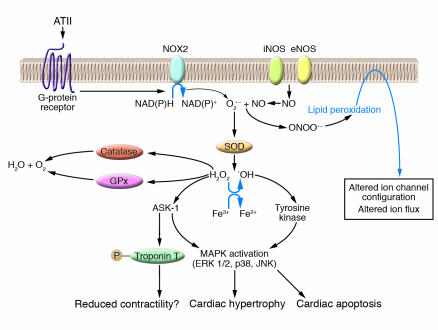
Mechanisms by which ROS can alter the structure and function of cardiac muscle. ATII binds a G-protein_associated receptor, initiating a cascade of events that involves activation of O2–– production by the NAD(P)H oxidase NOX2. O2–– is converted by SOD into H2O2 and –OH that mediates activation of MAPKs via a tyrosine kinase. MAPK activation can lead to cardiac hypertrophy or to apoptosis. The ROS that is generated can also signal through ASK-1 to induce cardiac hypertrophy, apoptosis, or phosphorylate troponin T, an event that reduces myofilament sensitivity and cardiac contractility. NO production by the NO synthases iNOS and eNOS can interact with O2–– to form ONOO––. ONOO–– can cause lipid peroxidation, an event that can alter ion channel and ion pump function. Catalase and glutathione reductase (GPx) are shown as enzymatic pathways to produce water and oxygen from H2O2.
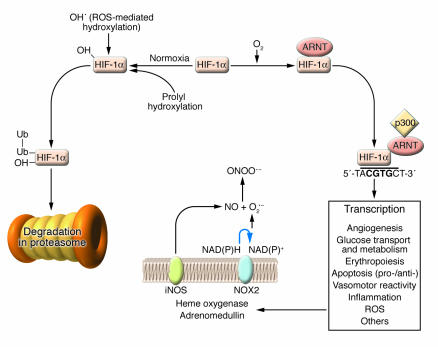
Transcriptional gene regulation by the hypoxia-inducible factor HIF-1α. HIF-1α protein undergoes rapid prolyl hydroxylation under normoxic conditions by specific cellular prolyl hydroxylases. Direct hydroxylation by ROS is a purported alternative pathway. Hydroxylated HIF interacts with the VHL, a critical member of an E3 ubiquitin ligase complex that polyubiquitylates HIF (Ub, ubiquitin). Polyubiquitylation targets HIF-1α for destruction by the proteosome. Under hypoxia (¬O2) hydroxylation does not occur and HIF-1α is stabilized. Heterodimerization with ARNT forms the active HIF complex that binds to a core hypoxia response element in a wide array of genes involved in a diversity of biological processes germane to cardiovascular function. Transcriptional activation of iNOS expression is shown as an example of how HIF-mediated gene expression can affect ROS generation by generating NO that interacts with O2–– to form ONOO––. NOX2 is shown as a cellular source of O2––.
References
-
- West, J.B. 1991. Cardiac energetics and myocardial oxygen consumption. Physiologic basis of medical practice. Williams and Wilkins. Baltimore, Maryland, USA. 250–260.
-
- Braunwald, E. 2001. Coronary blood flow and myocardial ischemia. Heart disease: a textbook of cardiovascular medicine. W.B. Saunders Company. Philadelphia, Pennsylvania, USA. 1161–1183.
-
- Huang Y, et al. Cardiac myocyte-specific HIF-1alpha deletion alters vascularization, energy availability, calcium flux, and contractility in the normoxic heart. FASEB J. 2004;18:1138–1140. - PubMed
-
- Davies KJ. Oxidative stress: the paradox of aerobic life. Biochem. Soc. Symp. 1995;61:1–31. - PubMed
-
- Jafri MS, Dudycha SJ, O’Rourke B. Cardiac energy metabolism: models of cellular respiration. Annu. Rev. Biomed. Eng. 2001;3:57–81. - PubMed
Publication types
MeSH terms
Substances
LinkOut - more resources
Full Text Sources
Other Literature Sources
Research Materials
