


Comment
doi: 10.1172/JCI24507.
Licking latency with licorice
Affiliations
- PMID: 15765143
- PMCID: PMC1052015
- DOI: 10.1172/JCI24507
Item in Clipboard
Comment
Licking latency with licorice
J Clin Invest.
2005 Mar.
Abstract
Numerous viruses cause latent infections in humans, and reactivation often results in pain and suffering. While vaccines for several of these viruses are available or currently being studied in clinical trials, and antiviral therapies have been successful in preventing or treating active infection, therapy to eradicate latent infection has lagged behind. A new study reported in this issue of the JCI shows that treatment of cells latently infected with Kaposi sarcoma-associated herpesvirus (KSHV) with glycyrrhizic acid, a component of licorice, reduces synthesis of a viral latency protein and induces apoptosis of infected cells. This finding suggests a novel way to interrupt latency.
Figures
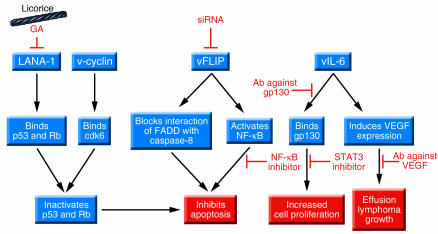
Mechanisms of action of KSHV latency proteins expressed in PEL cells and points of attack by inhibitor compounds. cdk6, cyclin-dependent kinase 6; FADD, Fas-associated death domain–containing protein; siRNA, small interfering RNA.
Comment on
-
Glycyrrhizic acid alters Kaposi sarcoma-associated herpesvirus latency, triggering p53-mediated apoptosis in transformed B lymphocytes.J Clin Invest. 2005 Mar;115(3):642-52. doi: 10.1172/JCI23334. J Clin Invest. 2005. PMID: 15765147 Free PMC article.
References
-
- Ploeger B, et al. The pharmacokinetics of glycyrrhizic acid evaluated by physiologically based pharmacokinetic modeling. Drug Metab. Rev. 2001;33:125–147. - PubMed
-
- Katano H, Sato Y, Kurata T, Mori S, Sata T. Expression and localization of human herpesvirus 8-encoded proteins in primary effusion lymphoma, Kaposi’s sarcoma, and multicentric Castleman’s disease. Virology. 2000;269:335–344. - PubMed
-
- Moore, P, and Chang, Y. 2001. Kaposi’s sarcoma-associated herpesvirus. In Fields virology. D.M. Knipe and P.M. Howley, editors. Lippincott Williams & Wilkins. Philadelphia, Pennsylvania, USA. 2803–2833.
Publication types
MeSH terms
Substances
LinkOut - more resources
Full Text Sources
Other Literature Sources
