. 2005 Apr;125(4):377-94.
doi: 10.1085/jgp.200409228. Epub 2005 Mar 14.

CFTR gating II: Effects of nucleotide binding on the stability of open states

Affiliations

CFTR gating II: Effects of nucleotide binding on the stability of open states

Silvia G Bompadre et al. J Gen Physiol. 2005 Apr.

Abstract

Previously, we demonstrated that ADP inhibits cystic fibrosis transmembrane conductance regulator (CFTR) opening by competing with ATP for a binding site presumably in the COOH-terminal nucleotide binding domain (NBD2). We also found that the open time of the channel is shortened in the presence of ADP. To further study this effect of ADP on the open state, we have used two CFTR mutants (D1370N and E1371S); both have longer open times because of impaired ATP hydrolysis at NBD2. Single-channel kinetic analysis of DeltaR/D1370N-CFTR shows unequivocally that the open time of this mutant channel is decreased by ADP. DeltaR/E1371S-CFTR channels can be locked open by millimolar ATP with a time constant of approximately 100 s, estimated from current relaxation upon nucleotide removal. ADP induces a shorter locked-open state, suggesting that binding of ADP at a second site decreases the locked-open time. To test the functional consequence of the occupancy of this second nucleotide binding site, we changed the [ATP] and performed similar relaxation analysis for E1371S-CFTR channels. Two locked-open time constants can be discerned and the relative distribution of each component is altered by changing [ATP] so that increasing [ATP] shifts the relative distribution to the longer locked-open state. Single-channel kinetic analysis for DeltaR/E1371S-CFTR confirms an [ATP]-dependent shift of the distribution of two locked-open time constants. These results support the idea that occupancy of a second ATP binding site stabilizes the locked-open state. This binding site likely resides in the NH2-terminal nucleotide binding domain (NBD1) because introducing the K464A mutation, which decreases ATP binding affinity at NBD1, into E1371S-CFTR shortens the relaxation time constant. These results suggest that the binding energy of nucleotide at NBD1 contributes to the overall energetics of the open channel conformation.


Figures
F<sc>igure</sc> 1.
Figure 1.
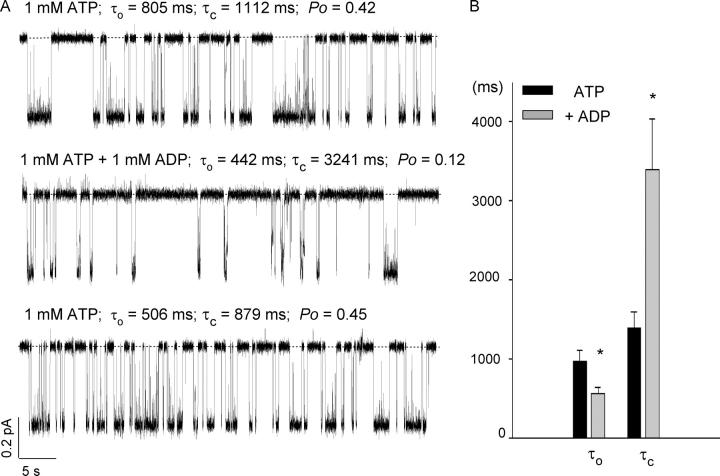
ADP shortens the open time of ΔR/D1370N-CFTR channels. (A) Single-channel current traces in the presence of 1 mM ATP, 1 mM ATP + 1 mM ADP, or 1 mM ATP again. (B) Effects of ADP on the mean open and closed times. Notice that ADP shortens the mean open time and increases the mean closed time (n = 5). Error bars represent SEM. * indicates P < 0.01.
F<sc>igure</sc> 2.
Figure 2.
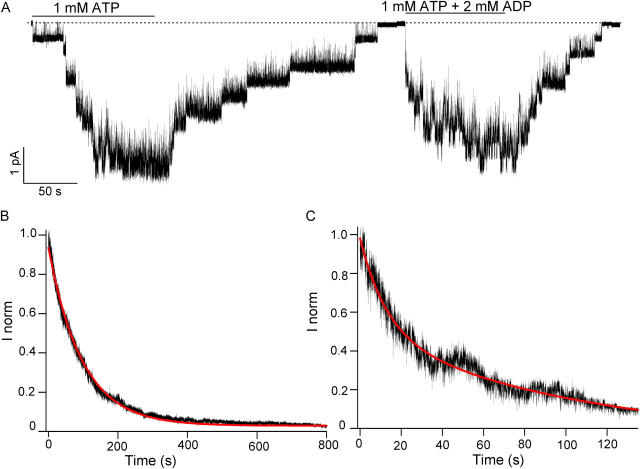
Macroscopic current relaxation for ΔR/E1371S-CFTR channels in the presence of ATP and ADP. (A) A sample trace of current relaxations for ΔR/E1371S-CFTR channels opened with 1 mM ATP, and subsequently with 1 mM ATP + 2 mM ADP. (B) The current decay upon removal of ATP can be fitted with a single exponential function with a time constant of 100.00 ± 0.02 s. (C) The current decay upon removal of ATP plus ADP is fitted with a double exponential function with time constants of 12.9 ± 0.1 and 105 ± 3 s.
F<sc>igure</sc> 3.
Figure 3.
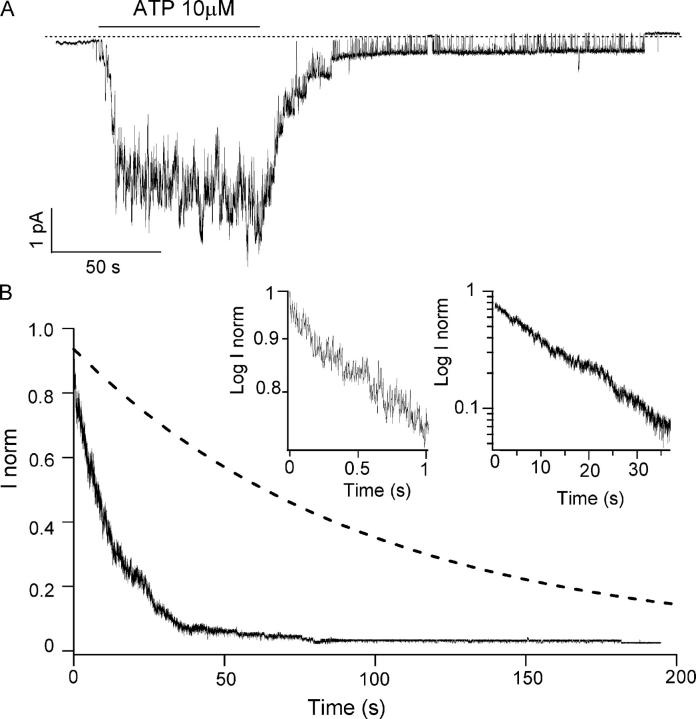
Macroscopic current relaxation for ΔR/E1371S-CFTR opened with 10 μM ATP. ΔR/E1371S-CFTR channels were activated with 10 μM ATP until the current reached a steady state. Then the nucleotide was washed out. (A) Sample trace. (B) Ensemble currents were generated by pooling data from 22 experiments. The insets show the first two components of the current relaxation. The dash line represents current relaxation of ΔR/E1371S-CFTR upon removal of 1 mM ATP (from Fig. 2 B).
F<sc>igure</sc> 4.
Figure 4.
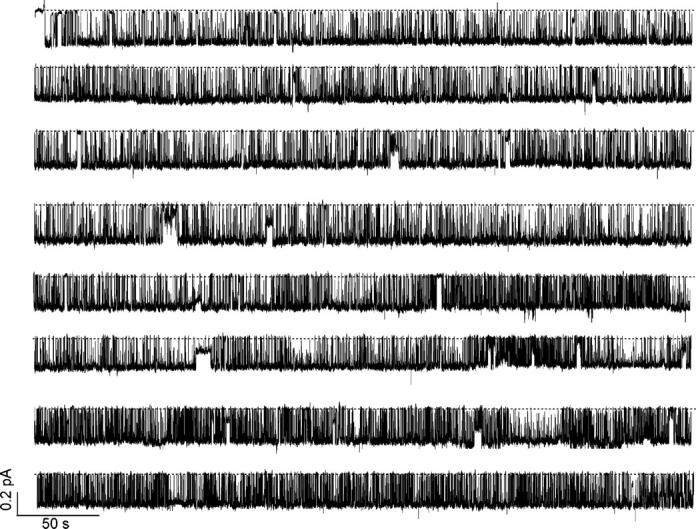
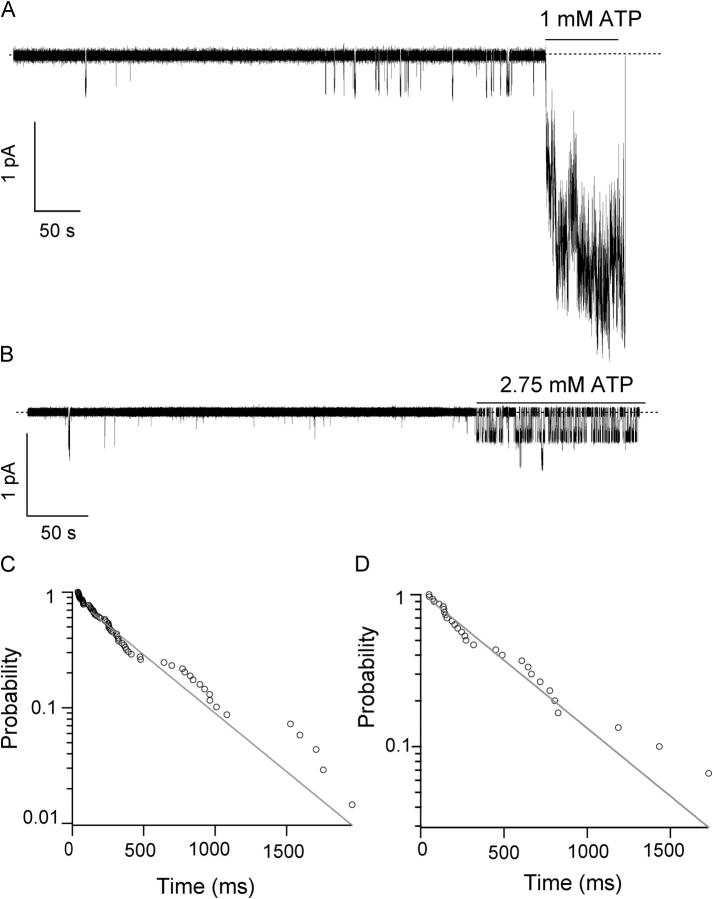
Single-channel recording of ΔR/E1371S-CFTR in the presence of 1 μM ATP. A continuous, 54-min single-channel trace in the presence of 1 mM ATP. Note that the channel is open most of the time. The Po is almost 1.
F<sc>igure</sc> 5.
Figure 5.
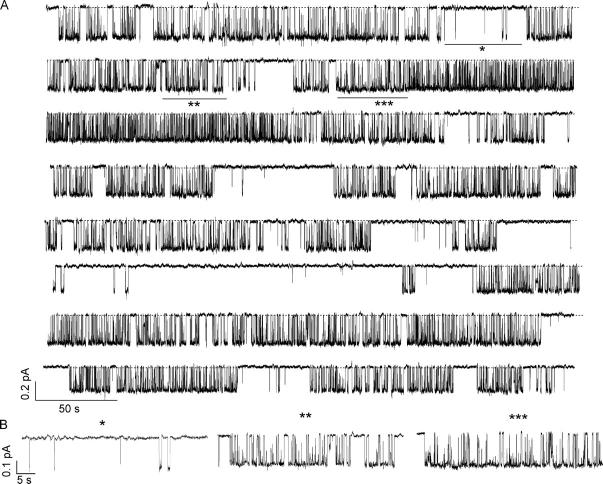
Single-channel recording of ΔR/E1371S-CFTR in the presence of 10 μM ATP. (A) A continuous 45-min single-channel trace in the presence of 10 μM ATP. Note that the channel remains closed for long periods, and presents opening bursts of different lengths. (B) Expanded traces of selected parts of the trace in A. Note the presence of very brief openings (*), and intermediate locked-open events (**), and rarely occurring long locked-open events (***).
F<sc>igure</sc> 6.
Figure 6.
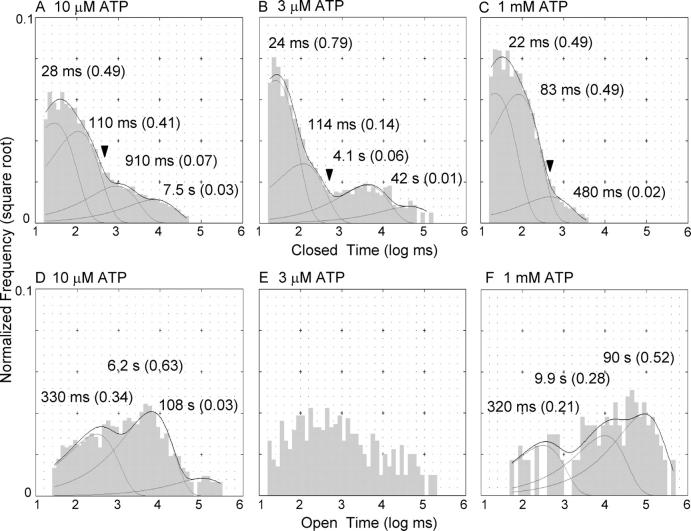
Single-channel dwell time analysis of ΔR/E1371S-CFTR. (A) Events from two single-channel recordings (∼50 min each) were pooled together to construct this closed time histogram. The closed time distribution for data obtained at 10 μM ATP can be fitted with a quadruple exponential function. No cutoff was used for the construction of this histogram. The arrow marks the cutoff (500 ms) used to define the minimum of the ATP-dependent closed times used for the open time analysis in D. (B) The closed time distribution for data obtained at 3 μM ATP and fitting parameters. (C) Events from two recordings of single channels in the presence of 1 mM ATP were pooled together to construct this closed time histogram (∼100 min of recording). The closed time distribution can be fitted with a triple exponential function. No cutoff was used for the construction of this histogram. The arrow marks the cutoff used to construct the open time histogram shown in F. (D) The open time histogram for data obtained at 10 μM ATP shows the presence of three distinct burst lengths: a brief opening of 330 ms, an intermediate burst of 6 s (most of the events), and very few lock-open bursts with a time constant of ∼100 s. (E) The open time histogram for the recording at 3 μM ATP. (F) The open time histogram shows that most of the events are long-lived locked-open bursts (>50%).
F<sc>igure</sc> 7.
Figure 7.
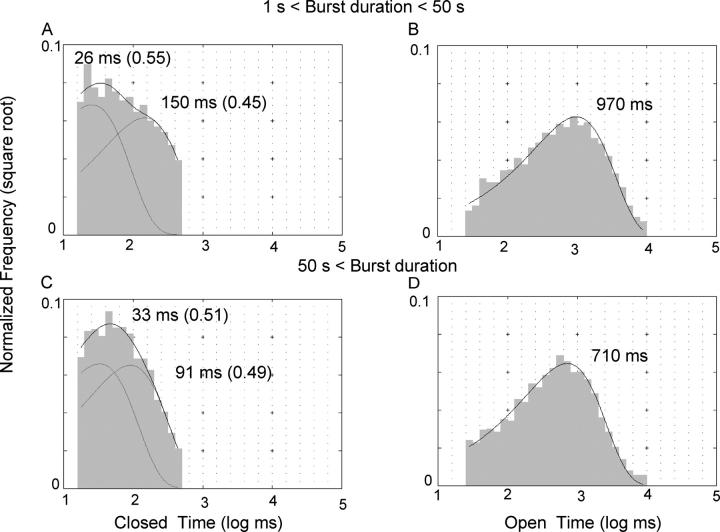
Intraburst kinetic analysis. Locked-open bursts were divided into two categories: short-lived locked-open events (1–50 s in length) and long-lived locked-open events (>50 s). Both types of bursts show similar characteristics. The closed dwell time histograms (A and C) show two components: the flickers (20–30 ms) and a relatively longer closing (∼100 ms). Once the flickering closures are removed by using a 50-ms cutoff, the open times within the locked-open bursts are very similar, irrespective of the locked-open duration (B and D).
F<sc>igure</sc> 8.
Figure 8.
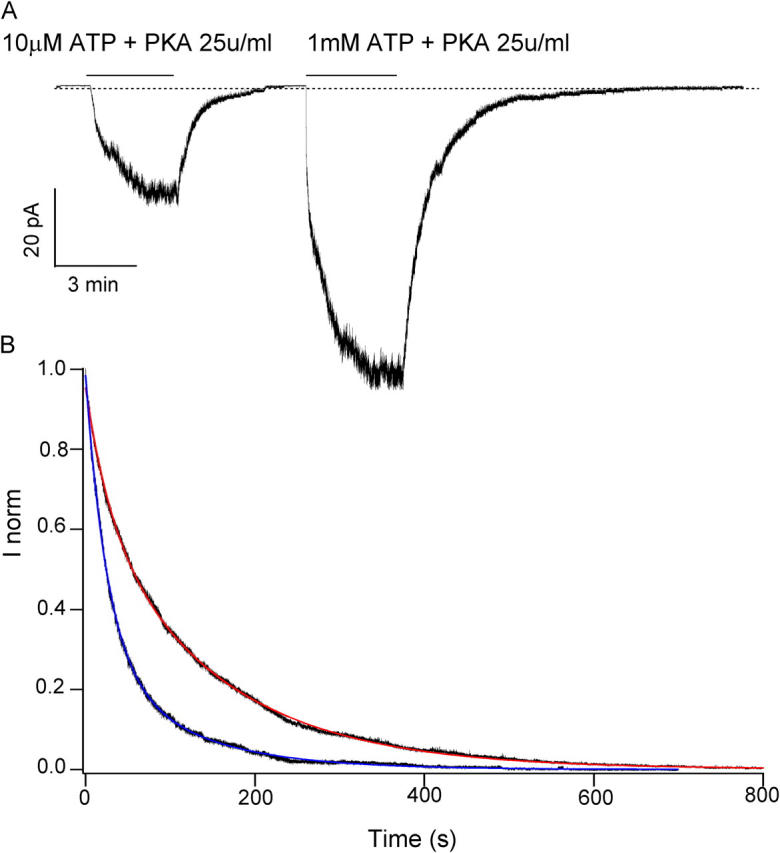
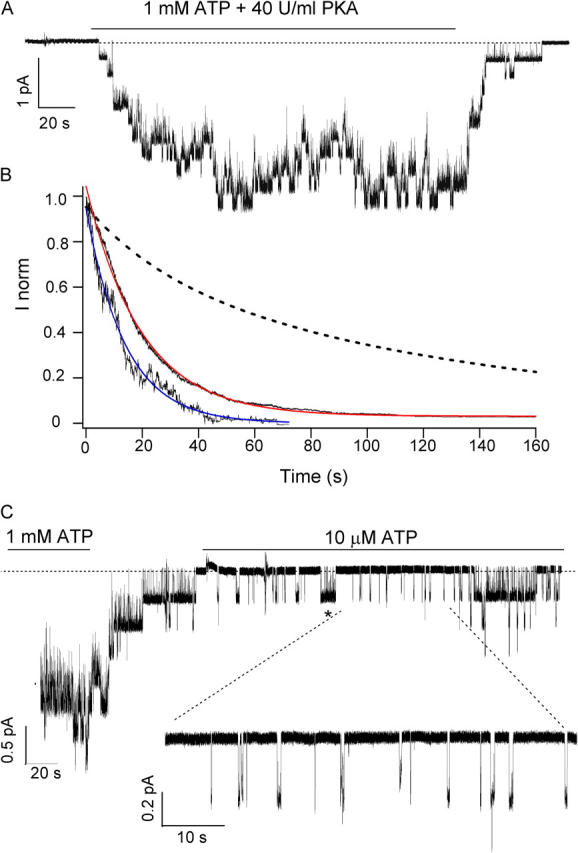
Macroscopic current relaxation of E1371S-CFTR currents. (A) Sample trace of current relaxations for E1371S-CFTR channels activated with 10 μM ATP + PKA, or with 1 mM ATP + PKA. (B) Normalized ensemble current relaxations upon removal of 1 mM ATP (from 12 patches) or 10 μM ATP (from 9 patches). The 1 mM ATP relaxation curve can be fitted with a double exponential function (red curve) with time constants of 149.3 ± 0.02 s (69%) and 29.59 ± 0.02 s (31%). The 10 μM ATP curve can be fitted also with a double exponential function (blue curve) with time constants of 107.53 ± 0.08 s (29%), and 26.32 ± 0.01 s (71%).
F<sc>igure</sc> 9.
Figure 9.
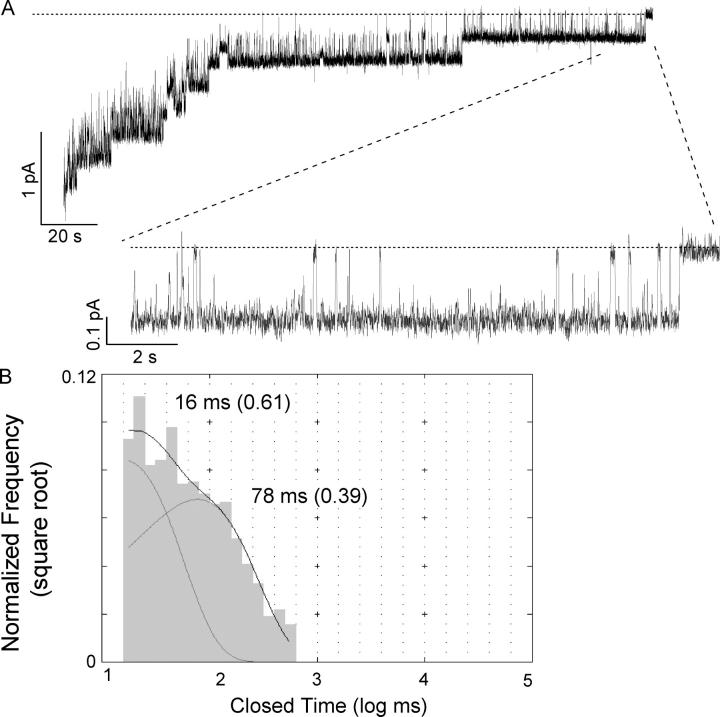
Kinetic analysis of the last E1371S-CFTR channel that remains open after removal of ATP. (A) Sample trace of the current relaxation of E1371S-CFTR channels upon ATP washout. The inset shows the expanded trace of the last channel that remains open. Note the presence of poorly resolved flickers and several long closings that last for hundreds of milliseconds. (B) Data from four patches were pooled together to construct the closed time histogram.
F<sc>igure</sc> 10.
Figure 10.
The K464A mutation shortens the locked-open time of E1371S-CFTR. (A) Sample trace of K464A/E1371S-CFTR channels in the presence of 1 mM ATP + PKA. Note that the relaxation upon nucleotide washout is very fast. (B) Ensemble macroscopic currents were generated from 18 patches. The macroscopic current has a relaxation time constant of 19.60 ± 0.01 s (red curve). (C) Sample trace of K464A/E1371S-CFTR channels in the presence of 10 μM ATP (blue curve). The inset shows the presence of numerous brief openings (from 42 to 650 ms). Note also the presence of longer openings (*, 9 s).
F<sc>igure</sc> 11.
Figure 11.
Kinetic analysis of the spontaneous openings in the absence of ATP. (A) A representative ΔR/E1371S-CFTR current trace from an excised inside-out patch exposed to ATP-free solution for several minutes before 1 mM ATP was applied. (B) Similar experiment as described in A, but with ΔR-CFTR channels. The open times of these spontaneous openings from several patches containing ΔR/E1371S-CFTR (C) or ΔR-CFTR (D) were pooled together to construct survivor plots.

References

    1. Ai, T., S.G. Bompadre, X. Wang, S. Hu, M. Li, and T.-C. Hwang. 2004. Capsaicin potentiates wild-type and mutant CFTR chloride channel currents. Mol. Pharmacol. 65:1415–1426. - PubMed
    1. Aleksandrov, A.A., and J.R. Riordan. 1998. Regulation of CFTR ion channel gating by Mg-ATP. FEBS Lett. 431:97–101. - PubMed

    1. Aleksandrov, A.A., X.B. Chang, L. Aleksandrov, and J.R. Riordan. 2000. The non-hydrolytic pathway of cystic fibrosis transmembrane conductance regulator ion channel gating. J. Physiol. 528:259–265. - PMC - PubMed
    1. Basso, C., P. Vergani, A.C. Nairn, and D.C. Gadsby. 2003. Prolonged nonhydrolytic interaction of nucleotide with CFTR's NH2-terminal nucleotide binding domain and its role in channel gating. J. Gen. Physiol. 122:333–348. - PMC - PubMed
    1. Bompadre S.G., T. Ai, J.H. Cho, X. Wang, Y. Sohma, M. Li, and T.-C. Hwang. 2005. CFTR gating I: characterization of the ATP-dependent gating of a phosphorylation-independent CFTR channel (ΔR-CFTR). J. Gen. Physiol. 125:361–375. - PMC - PubMed

Publication types

Substances