


Mechanism of the antiviral action of 1-beta-D-arabinofuranosylcytosine on Borna disease virus
- PMID: 15767452
- PMCID: PMC1061581
- DOI: 10.1128/JVI.79.7.4514-4518.2005
Mechanism of the antiviral action of 1-beta-D-arabinofuranosylcytosine on Borna disease virus
Abstract
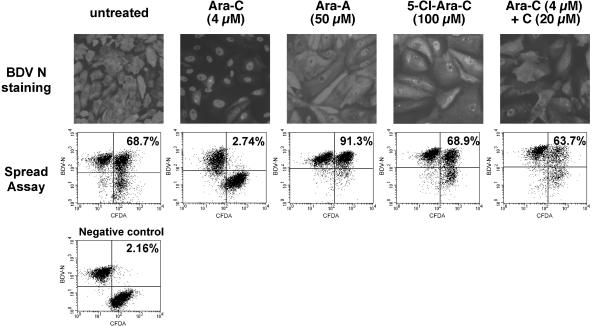
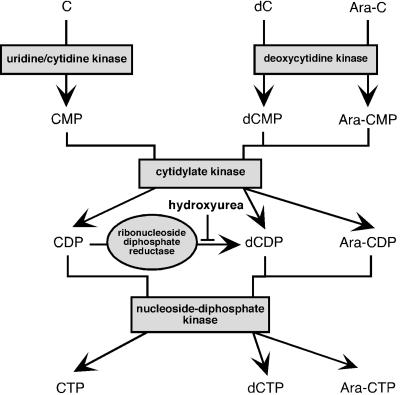
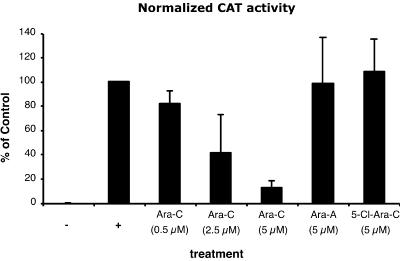
Borna disease virus (BDV) is a nonsegmented, negative-stranded RNA virus that causes neurological diseases in a variety of warm-blooded animal species. Recently, we showed that the nucleoside analog 1-beta-D-arabinofuranosylcytosine (Ara-C) was a potent inhibitor of BDV. This finding was surprising for an RNA virus, since Ara-C is a DNA polymerase inhibitor. Thus, we sought to better define the mechanism of action of Ara-C on BDV. Here, we show that (i) this effect is specific for an arabinoside ring carrying a cytosine base, (ii) it requires phosphorylation of the nucleotide, and (iii) it can be reversed by an excess of cytidine. Using the recently described minigenome assay for BDV, we provide evidence suggesting that Ara-C may act as a competitive inhibitor of the BDV replication complex.
Figures
References
-
- Bhalla, K., P. Swerdlow, and S. Grant. 1991. Effects of thymidine and hydroxyurea on the metabolism and cytotoxicity of 1-β-d arabinofuranosylcytosine in highly resistant human leukemia cells. Blood 78:2937-2944. - PubMed
-
- Bode, L., D. E. Dietrich, R. Stoyloff, H. M. Emrich, and H. Ludwig. 1997. Amantadine and human Borna disease virus in vitro and in vivo in an infected patient with bipolar depression. Lancet 349:178-179. - PubMed
Publication types
MeSH terms
Substances
LinkOut - more resources
Full Text Sources
