


Uneven distribution of ventilation in acute respiratory distress syndrome
- PMID: 15774050
- PMCID: PMC1175934
- DOI: 10.1186/cc3058
Uneven distribution of ventilation in acute respiratory distress syndrome
Abstract
Introduction: The aim of this study was to assess the volume of gas being poorly ventilated or non-ventilated within the lungs of patients treated with mechanical ventilation and suffering from acute respiratory distress syndrome (ARDS).
Methods: A prospective, descriptive study was performed of 25 sedated and paralysed ARDS patients, mechanically ventilated with a positive end-expiratory pressure (PEEP) of 5 cmH2O in a multidisciplinary intensive care unit of a tertiary university hospital. The volume of poorly ventilated or non-ventilated gas was assumed to correspond to a difference between the ventilated gas volume, determined as the end-expiratory lung volume by rebreathing of sulphur hexafluoride (EELVSF6), and the total gas volume, calculated from computed tomography images in the end-expiratory position (EELVCT). The methods used were validated by similar measurements in 20 healthy subjects in whom no poorly ventilated or non-ventilated gas is expected to be found.
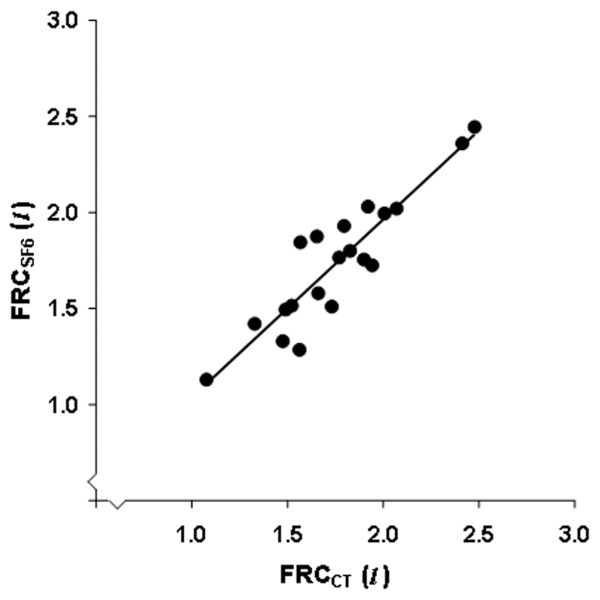
Results: EELVSF6 was 66% of EELVCT, corresponding to a mean difference of 0.71 litre. EELVSF6 and EELVCT were significantly correlated (r2 = 0.72; P < 0.001). In the healthy subjects, the two methods yielded almost identical results.
Conclusion: About one-third of the total pulmonary gas volume seems poorly ventilated or non-ventilated in sedated and paralysed ARDS patients when mechanically ventilated with a PEEP of 5 cmH2O. Uneven distribution of ventilation due to airway closure and/or obstruction is likely to be involved.
Figures



References
-
- Ramachandran PR, Fairley HB. Changes in functional residual capacity during respiratory failure. Can Anaesth Soc J. 1970;17:359–369. - PubMed
-
- Koutsoukou A, Armaganidis A, Stavrakaki-Kallergi C, Vassilakopoulos T, Lymberis A, Roussos C, Milic-Emili J. Expiratory flow limitation and intrinsic positive end-expiratory pressure at zero positive end-expiratory pressure in patients with adult respiratory distress syndrome. Am J Respir Crit Care Med. 2000;161:1590–1596. - PubMed
-
- Kendrick AH. Comparison of methods of measuring static lung volumes. Monaldi Arch Chest Dis. 1996;51:431–439. - PubMed
