. 2005 Mar 23;24(6):1202-10.
doi: 10.1038/sj.emboj.7600606. Epub 2005 Mar 10.

LdpA: a component of the circadian clock senses redox state of the cell

Affiliations

LdpA: a component of the circadian clock senses redox state of the cell

Natalia B Ivleva et al. EMBO J. .

Abstract

The endogenous 24-h (circadian) rhythms exhibited by the cyanobacterium Synechococcus elongatus PCC 7942 and other organisms are entrained by a variety of environmental factors. In cyanobacteria, the mechanism that transduces environmental input signals to the central oscillator of the clock is not known. An earlier study identified ldpA as a gene involved in light-dependent modulation of the circadian period, and a candidate member of a clock-entraining input pathway. Here, we report that the LdpA protein is sensitive to the redox state of the cell and exhibits electron paramagnetic resonance spectra consistent with the presence of two Fe4S4 clusters. Moreover, LdpA copurifies with proteins previously shown to be integral parts of the circadian mechanism. We also demonstrate that LdpA affects both the absolute level and light-dependent variation in abundance of CikA, a key input pathway component. The data suggest a novel input pathway to the circadian oscillator in which LdpA is a component of the clock protein complex that senses the redox state of a cell.


Figures
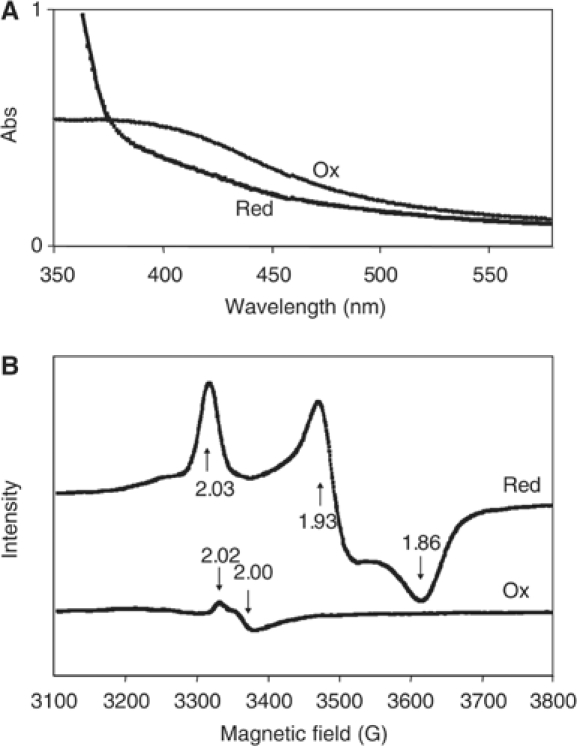
Figure 1
Figure 1
LdpA contains redox-active iron-sulfur clusters. (A) UV–visible absorption spectra of the purified recombinant protein. Ox, as-isolated reductant-free LdpA sample; Red, sample reduced with 2 mM dithionite. (B) 10 K X-band EPR spectra of the purified recombinant protein. Red, sample reduced with 2 mM dithionite; Ox, sample oxidized with thionin. Parameters are as described in Materials and methods.
Figure 2
Figure 2
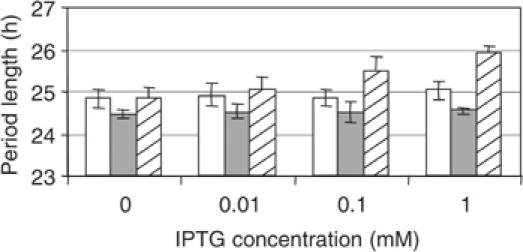
Disruption or overexpression of ldpA affects period length in a kaiBC reporter strain. Period length of the wild-type (AMC1004, open bars), ΩldpA (AMC1345, filled bars), and LdpA overexpression (AMC1347, hatched bars) reporter strains in the presence of the indicated concentrations of IPTG, as measured by bioluminescence assay (n=6, mean±SD).
Figure 3
Figure 3
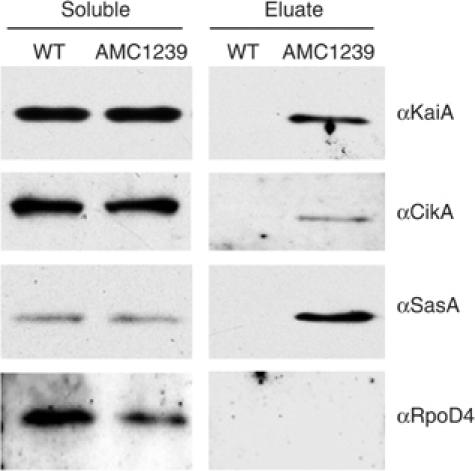
LdpA copurifies with circadian clock proteins. Immunoblot analysis of total soluble protein and affinity-purified fractions from wild-type (WT) and AMC1239 (His-tagged LdpA) strains. To induce LdpA production, 100 μM IPTG was added to unsynchronized cultures 24 h prior to collection. Cells were broken with glass beads, and the soluble fraction was purified. His-tagged LdpA was purified from the soluble fraction by affinity chromatography. Samples were subjected to SDS–PAGE and transferred to nitrocellulose membranes for immunoanalysis with the antisera indicated at the right of each panel. The immunoblots shown are from one of multiple independent experiments that gave essentially the same results. Because of differences in antisera sensitivities and film exposure times, the results are not quantitative among panels.
Figure 4
Figure 4
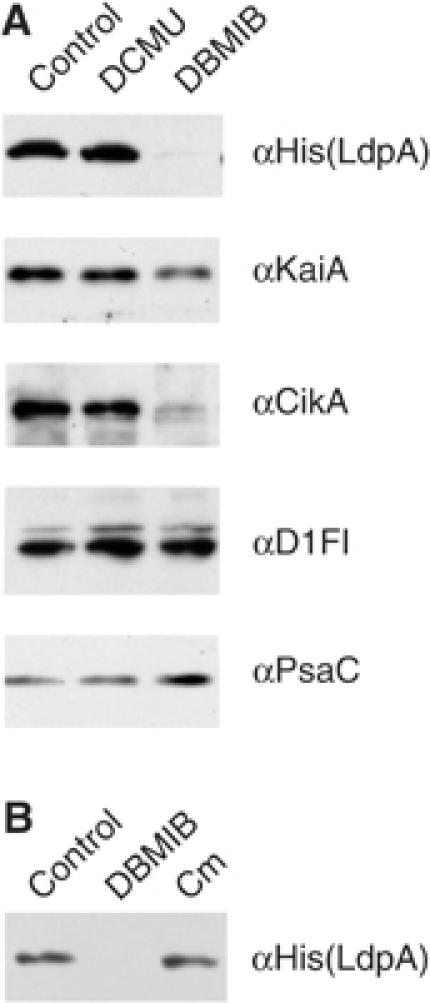
DBMIB affects stability of LdpA. Immunoblot analysis of whole-cell extract from AMC1239 (His-tagged LdpA). Antisera are indicated at the right of each panel. Whole-cell extract (10 μg) was loaded in each lane. (A) Cells were treated for 15 min with: ethanol (control, solvent used for inhibitors), DCMU (10 μM), or DBMIB (10 μM). (B) Cells were treated for 15 min with: ethanol (control, solvent used for inhibitors), DBMIB (10 μM), or chloramphenicol (Cm, 250 μg/ml).
Figure 5
Figure 5
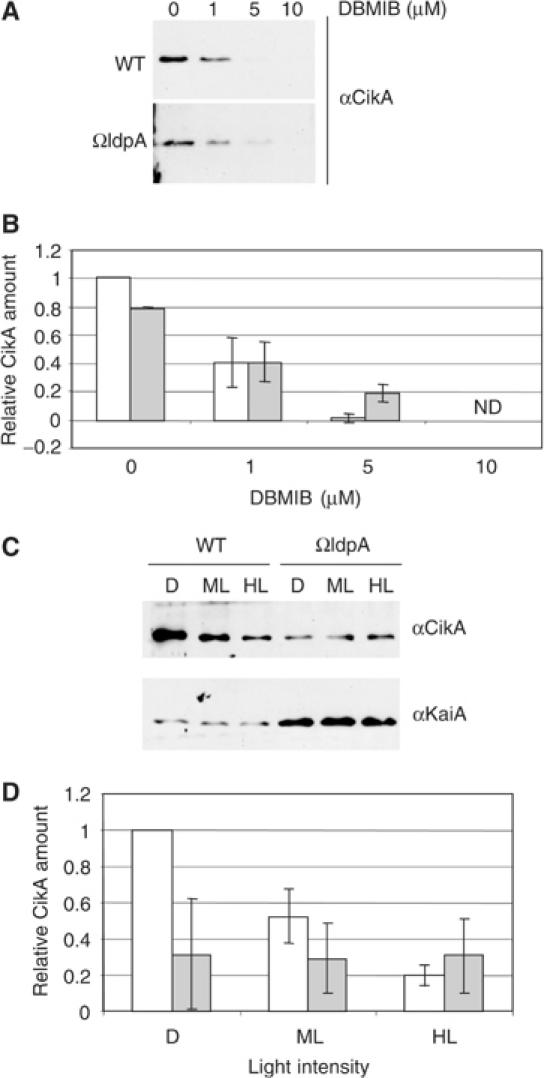
LdpA contributes to sensitivity of CikA to DBMIB, affects steady-state levels of both CikA and KaiA, and is necessary for light-dependent modulation of CikA abundance. (A, C) Immunoblot analysis of whole-cell extracts from the wild-type and ΩldpA (AMC1162) strains, prepared as described in Materials and methods. Antisera are indicated at the right of each panel. (A) Cultures were treated with DBMIB at the indicated concentrations for 15 min prior to harvesting. (C) Cultures were incubated for 6 h in darkness (D), or under medium (ML, 125 μE/m2 s) or high light intensity (HL, 250 μE/m2 s) prior to harvesting. (B, D) Quantification of data from experiments for which representative panels are shown in (A, C), respectively (n=3, mean±SD). Open bars, wild-type strain; filled bars, ΩldpA strain, ND, not detectable. The amount of CikA in the wild-type strain in the absence of DBMIB (B) or in the dark (D), to which other values are compared, is set at 1. The cultures for the upper panels (A, B) were grown under conditions different in aeration and light intensity from those for the lower panels (C, D); see Materials and methods for details.
Figure 6
Figure 6
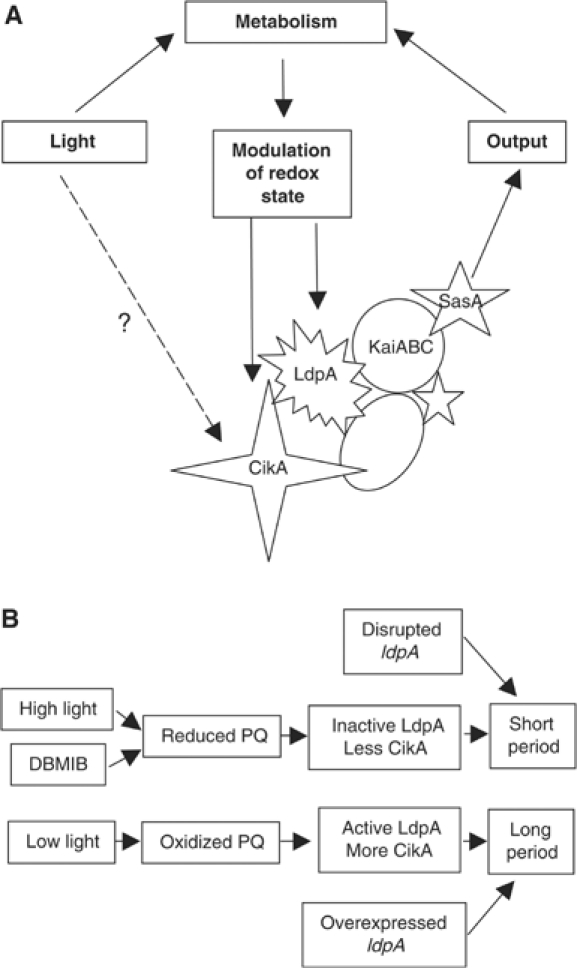
Proposed role of LdpA in the cyanobacterial clock. A detailed description is given in the text. (A) Possible role of LdpA in the periodosome, a protein complex that controls circadian rhythmicity. The specific placement of LdpA in the periodosome is preliminary and is based on data shown in Supplementary Figure S1. (B) Proposed mechanism of action of LdpA.

References

    1. Aoki S, Kondo T, Wada H, Ishiura M (1997) Circadian rhythm of the cyanobacterium Synechocystis sp. strain PCC 6803 in the dark. J Bacteriol 179: 5751–5755 - PMC - PubMed
    1. Aschoff J (1981) Freerunning and entrained circadian rhythms. In Handbook of Behavioral Neurobiology: Biological Rhythms, Aschoff J (ed) pp 81–93. NY: Plenum Press
    1. Barnes D, Mayfield SP (2003) Redox control of posttranscriptional processes in the chloroplast. Antioxid Redox Signal 5: 89–94 - PubMed
    1. Beaver LM, Gvakharia BO, Vollintine TS, Hege DM, Stanewsky R, Giebultowicz JM (2002) Loss of circadian clock function decreases reproductive fitness in males of Drosophila melanogaster. Proc Natl Acad Sci USA 99: 2134–2139 - PMC - PubMed
    1. Beinert H, Kiley PJ (1999) Fe-S proteins in sensing and regulatory functions. Curr Opin Chem Biol 3: 152–157 - PubMed

Publication types

MeSH terms

Substances