. 2005 Apr;73(4):2005-11.
doi: 10.1128/IAI.73.4.2005-2011.2005.

Antibiotic-free plasmid stabilization by operator-repressor titration for vaccine delivery by using live Salmonella enterica Serovar typhimurium

Affiliations

Antibiotic-free plasmid stabilization by operator-repressor titration for vaccine delivery by using live Salmonella enterica Serovar typhimurium

Helen S Garmory et al. Infect Immun. 2005 Apr.

Abstract

Live, attenuated bacteria are effective vectors for heterologous antigen delivery. However, loss of heterologous gene-bearing plasmids is problematic, and antibiotics and their resistance genes are not desirable for in vivo DNA vaccine delivery due to biosafety and regulatory concerns. To solve this problem, we engineered the first vaccine delivery strain that has no requirement for antibiotics or other selectable marker genes to maintain the recombinant plasmid. This model strain of Salmonella enterica serovar Typhimurium, SLDAPD, uses operator-repressor titration (ORT) technology, which requires only the short, nonexpressed lacO sequence for selection and maintenance. SLDAPD, recovered from the spleens and Peyer's patches of mice following oral inoculation, was shown to maintain a plasmid that, in contrast, was lost from parental strain SL3261. We also demonstrated successful application of this technology to vaccine development, since SLDAPD carrying a plasmid without an antibiotic resistance gene that expressed the Yersinia pestis F1 antigen was as efficacious in protecting vaccinated mice against plague as the parental SL3261 strain carrying an antibiotic-selected version of this plasmid. Protection of mice against plague by immunization with Salmonella expressing F1 has previously required two or more doses; here we demonstrated for the first time protective immunity after a single oral immunization. This technology can easily be used to convert any suitable attenuated strain to an antibiotic-free ORT strain for recombinant protein vaccine delivery in humans.


Figures
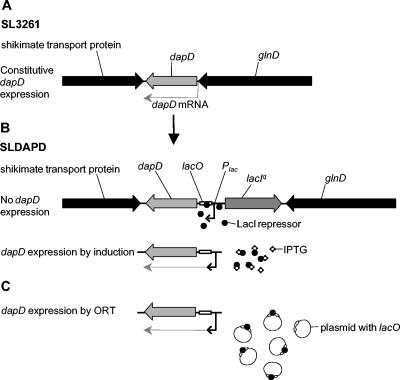
FIG. 1.
FIG. 1.
Conversion of SL3261 to SLDAPD and plasmid selection by ORT. (A) Wild-type dapD locus in SL3261. (B) Replacement of dapD with the lacO/P-dapD-lacIq cassette to create SLDAPD. Induction with IPTG is required for dapD expression in the absence of a plasmid. (C) When the organism is transformed with a plasmid containing a lacO sequence, the repressor is titrated and dapD is expressed.
FIG. 2.
FIG. 2.
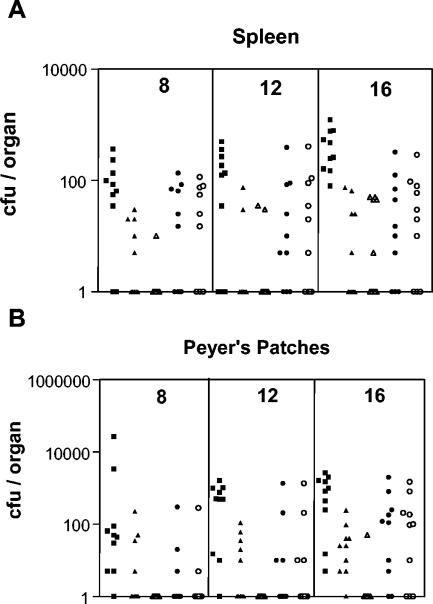
Colonization of spleens and Peyer's patches following oral inoculation of mice (n = 10) with SLDAPD or SL3261 carrying plasmid pUC18I. Mice were inoculated with 5 × 10⁹ CFU of SLDAPD/pUC18I (circles), SL3261/pUC18I (triangles), or control strain SL3261 (squares) by using a gavage needle. Spleens (A) and Peyer's patches (B) were removed 8, 12, or 16 days after inoculation and homogenized in PBS before preparations were plated onto LB agar (solid symbols) or LB agar containing ampicillin (open symbols) for enumeration of bacteria.
FIG. 3.
FIG. 3.
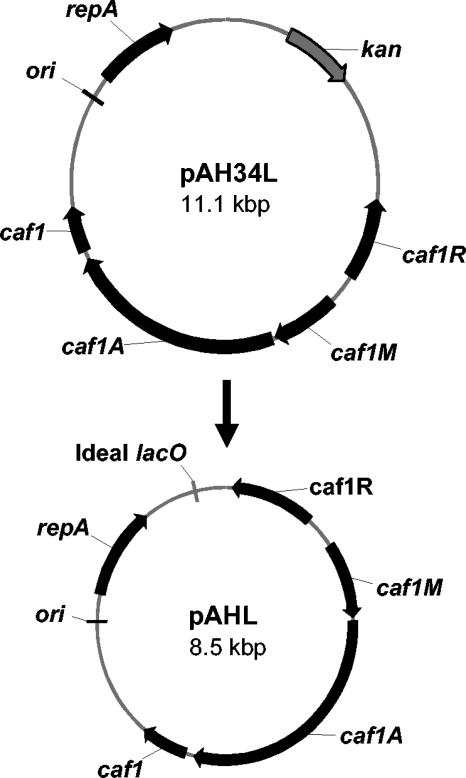
Conversion of the kanamycin-resistant plasmid pAH34L to the ORT plasmid pAHL by replacement of kan with ideal lacO.
FIG. 4.
FIG. 4.
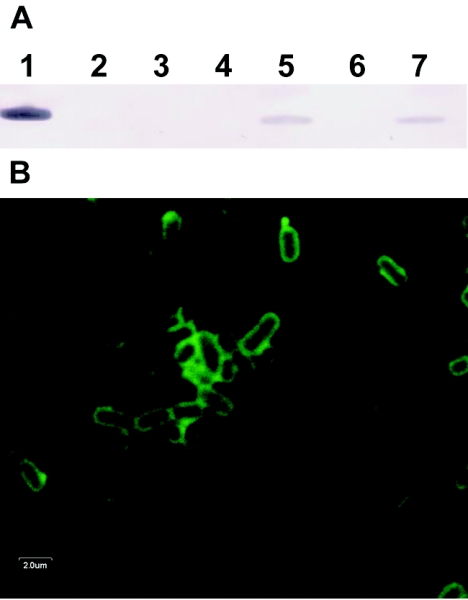
Analysis of Y. pestis F1 antigen expression. (A) Western blot probed with an anti-F1 antigen mouse monoclonal antibody. Lane 1, recombinant F1 antigen reference; lane 2, SL3261 grown at 37°C; lane 3, SLDAPD grown at 37°C; lane 4, SL3261/pAH34L grown at 28°C; lane 5, SL3261/pAH34L grown at 37°C; lane 6, SLDAPD/pAHL grown at 28°C; lane 7, SLDAPD/pAHL grown at 37°C. (B) Expression of F1 antigen on the surface of SLDAPD/pAHL grown at 37°C. Immunofluorescently labeled SLDAPD/pAHL fixed cells were detected by confocal microscopy.
FIG. 5.
FIG. 5.
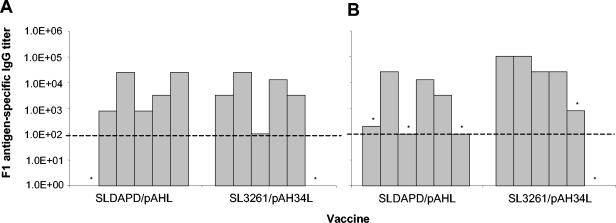
F1 antigen-specific IgG responses induced in individual mice following immunization with Salmonella expressing F1 antigen. Groups of BALB/c mice (n = 6) were orally immunized with a single dose of 1 × 10¹⁰ to 5 × 10¹⁰ CFU of ORT strain SLDAPD/pAHL or original vaccine strain SL3261/pAH34L. Serum samples were removed 41 days after inoculation, and IgG responses were measured by ELISA. The results are expressed as the reciprocal of the end point dilution for each animal group. The limit of detection is indicated by the horizontal dashed line. Mice were subsequently challenged with 185 MLD (A) or 1.85 × 10⁵ MLD (B) of Y. pestis GB. The asterisks indicate mice that did not survive the Y. pestis infection.

References

    1. Amann, E., B. Ochs, and K.-J. Abel. 1988. Tightly regulated tac promoter vectors for the expression of unfused and fused proteins in Escherichia coli. Gene 69:301-315. - PubMed
    1. Cooper, T. F., and J. A. Heinemann. 2000. Postsegregational killing does not increase plasmid stability but acts to mediate the exclusion of competing plasmids. Proc. Natl. Acad. Sci. USA 97:12643-12648. - PMC - PubMed
    1. Cranenburgh, R. M., J. A. J. Hanak, S. G. Williams, and D. J. Sherratt. 2001. Escherichia coli strains that allow antibiotic-free plasmid selection and maintenance by repressor titration. Nucleic Acids Res. 29:e26. - PMC - PubMed
    1. Cranenburgh, R. M., K. S. Lewis, and J. A. J. Hanak. 2004. Effect of plasmid copy number and lac operator sequence on antibiotic-free plasmid selection by operator-repressor titration in Escherichia coli. J. Mol. Microbiol. Biotechnol. 7:197-203. - PubMed
    1. Galán, J. E., K. Nakayama, and R. Curtiss III. 1990. Cloning and characterization of the asd gene of Salmonella typhimurium: use in stable maintenance of recombinant plasmids in Salmonella vaccine strains. Gene 94:29-35. - PubMed

LinkOut - more resources