. 2005 Apr;73(4):2387-99.
doi: 10.1128/IAI.73.4.2387-2399.2005.

Haemophilus ducreyi Outer membrane determinants, including DsrA, define two clonal populations

Affiliations

Haemophilus ducreyi Outer membrane determinants, including DsrA, define two clonal populations

Catherine Dinitra White et al. Infect Immun. 2005 Apr.

Abstract

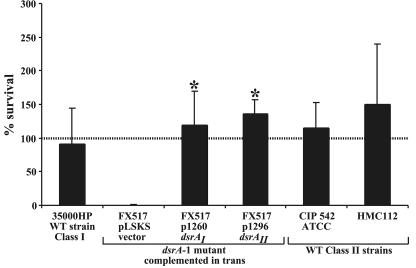
The Haemophilus ducreyi outer membrane component DsrA (for ducreyi serum resistance A) is necessary for complete resistance to normal human serum (NHS). When DsrA expression in 19 temporally and geographically diverse clinical isolates of H. ducreyi was examined by Western blotting, 5 of the strains expressed a different immunotype of the DsrA protein (DsrA(II)) than the well-characterized prototypical strain 35000HP (DsrA(I)). The predicted DsrA proteins expressed by the DsrA(II) strains were 100% identical to each other but only 48% identical to that of strain 35000HP. In addition to the DsrA(II) protein, class II strains also expressed variant forms of other outer membrane proteins (OMPs) including NcaA (necessary for collagen adhesion A), DltA (ducreyi lectin A), Hlp (H. ducreyi lipoprotein), major OMP, and/or OmpA2 (for OMP A2) and synthesized a distinct, faster-migrating lipooligosaccharide. Based on these data, strains expressing DsrA(I) were termed class I, and those expressing DsrA(II) were termed class II. Expression of dsrA(II) from strain CIP 542 ATCC in the class I dsrA(I) mutant FX517 (35000HP background), which does not express a DsrA protein, rendered this strain resistant to 50% NHS. This demonstrates that DsrA(II) protein is also critical to serum resistance. Taken together, these results indicate that there are two clonal populations of H. ducreyi. The implications of two classes of H. ducreyi strains differing in important antigenic outer membrane components are discussed.


Figures
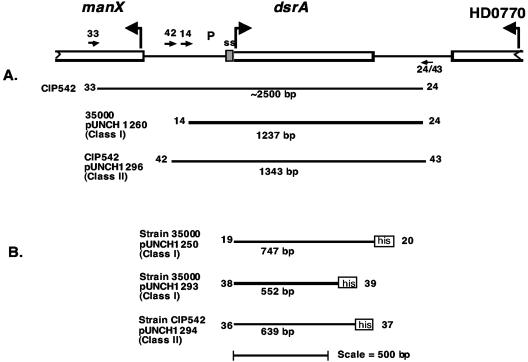
FIG. 1.
FIG. 1.
Diagram of class I and class II dsrA genes and PCR products. The dsrA ORF is boxed. The partial manX ORF is represented by an open box with a jagged line at the upstream end; the partial HD0770 ORF is represented by an open box with a jagged line at the downstream end. The numbered arrows indicate the direction and position of the dsrA oligonucleotides used for PCR. The proposed signal sequence (ss) is indicated by a shaded box. Curved arrows indicate the polarity of each gene. (A) The PCR products used to construct plasmids pUNCH 1260 and pUNCH 1296 are indicated. (B) The dsrA PCR products are represented by a solid black line followed by a hexahistidine fusion tag depicted by an open box. The PCR-His fusion products were used to produce expression plasmids pUNCH 1250, pUNCH 1293, and pUNCH 1294. Strains and vectors used for PCR are specified to the left of the PCR product. his, hexahistidine, composed of 30 amino acids; P, promoter.
FIG. 2.
FIG. 2.
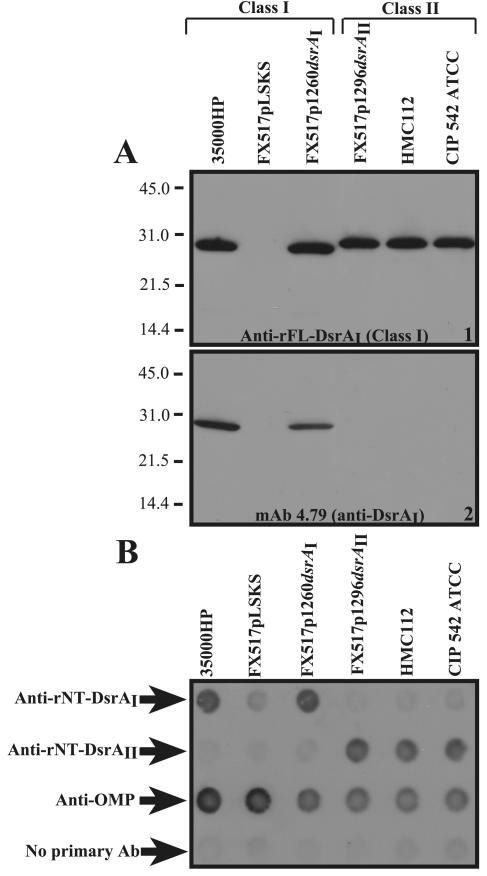
Identification of antigenically variant DsrA proteins. (A) Two identical SDS-PAGE gels were prepared under reducing conditions with total cellular proteins from the indicated H. ducreyi strains and subjected to Western blotting. Panel 1, DsrA expression is detected using polyclonal anti-rFL-DsrAI made to rDsrAI from strain 35000HP; panel 2, DsrA expression is detected with MAb 4.79 made to rDsrAI from strain 35000HP. (B) H. ducreyi strains were examined for surface expression of class I and II DsrA in a dot blot format.
FIG. 3.
FIG. 3.
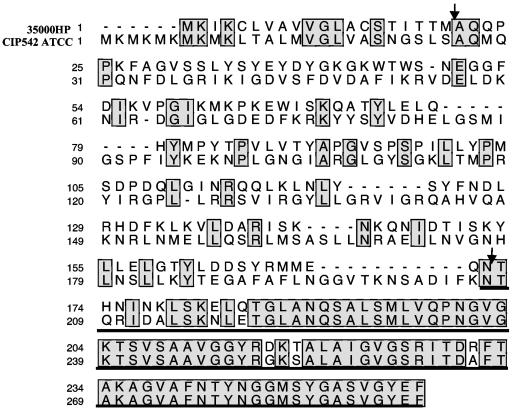
Alignment of DsrAI and DsrAII amino acid sequences. The amino acid sequences of DsrA from 35000HP and DsrA from CIP 542 ATCC are compared. Boxed, shaded residues indicate identity. The first arrow indicates the possible signal peptidase I cleavage site; the second arrow indicates the end of the protein that was used for antibody production. The final 86 amino acids of the C termini are underlined.
FIG. 4.
FIG. 4.
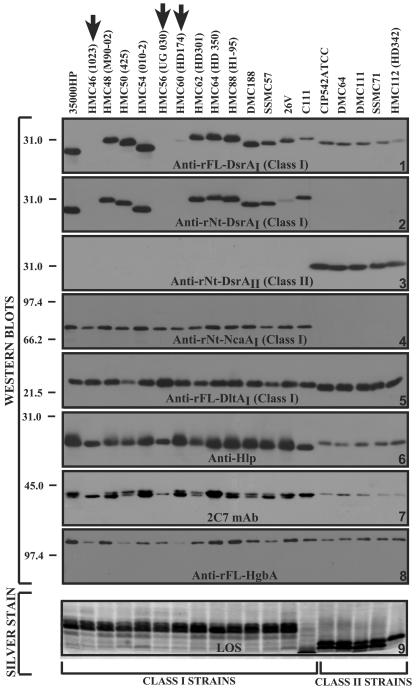
Identification of two classes of OMPs. Nine identically loaded SDS-PAGE gels (panels 1, 3, 6 and 7, 15% PAGE; panel 9, 12.5% PAGE; panels 2 and 5, 12% PAGE; panels 4 and 8, 7.5% PAGE) were prepared under reducing conditions with total cellular proteins or crude LOS from the indicated H. ducreyi strains and subjected to Western blotting, except for gel 9. Crude LOS in gel 9 was prepared as described in Materials and Methods and subjected to silver staining after electrophoresis. The class of each strain is indicated at the bottom of the figure. N-terminal antibodies were made to the N-terminal two-thirds of each recombinant protein (Table 3 and Fig. 1). Arrows indicate strains that reacted weakly with the antisera against DsrAI protein.
FIG. 5.
FIG. 5.
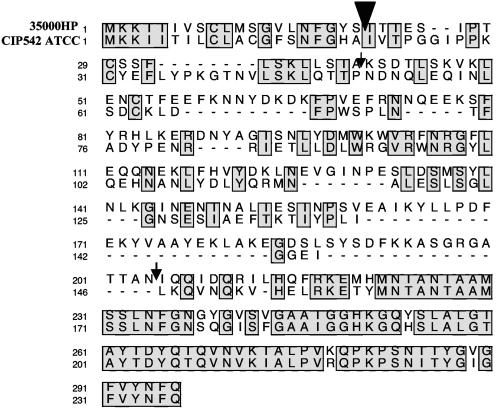
Alignment of NcaAI and NcaAII amino acid sequences. The amino acid sequences of the NcaA proteins from 35000HP and CIP 542 ATCC are compared. Boxed, shaded residues indicate identity. The predicted signal peptidase I cleavage site for 35000HP and CIP 542 ATCC is indicated by the inverted triangle. The segment encompassed by the two arrows represents the N-terminal region of recombinant NcaAI from 35000HP that was used for antibody production.
FIG. 6.
FIG. 6.
Bactericidal killing of strains expressing class I and II DsrA. Bactericidal killing of H. ducreyi strains was performed in 50% NHS. The data are compiled from separate experiments done on at least three different days. The asterisk indicates statistically significant differences between the FX517 dsrA strain (35000HP isogenic dsrAI mutant) containing the empty vector pLSKS and FX517 dsrA complemented in trans with vectors expressing either dsrA class I (pUNCH 1260) or dsrA class II (pUNCH 1296) (P = 0.017 and P = 0.001, respectively). WT, wild type.

References

    1. Aebi, C., E. R. Lafontaine, L. D. Cope, J. L. Latimer, S. L. Lumbley, G. H. McCracken, Jr., and E. J. Hansen. 1998. Phenotypic effect of isogenic uspA1 and uspA2 mutations on Moraxella catarrhalis 035E. Infect. Immun. 66:3113-3119. - PMC - PubMed
    1. Aebi, C., I. Maciver, J. L. Latimer, L. D. Cope, M. K. Stevens, S. E. Thomas, G. H. McCracken, Jr., and E. J. Hansen. 1997. A protective epitope of Moraxella catarrhalis is encoded by two different genes. Infect. Immun. 65:4367-4377. - PMC - PubMed
    1. Albritton, W. L. 1989. Biology of Haemophilus ducreyi. Microbiol. Rev. 53:377-389. - PMC - PubMed
    1. Alfa, M. J., and P. DeGagne. 1997. Attachment of Haemophilus ducreyi to human foreskin fibroblasts involves LOS and fibronectin. Microb. Pathog. 22:39-46 - PubMed
    1. Al-Tawfiq, J. A., K. R. Fortney, B. P. Katz, A. F. Hood, C. Elkins, and S. M. Spinola. 2000. An isogenic hemoglobin receptor-deficient mutant of Haemophilus ducreyi is attenuated in the human model of experimental infection. J. Infect. Dis. 181:1049-1054. - PubMed

Publication types

MeSH terms

Substances

LinkOut - more resources