. 2005 Apr;73(4):2478-85.
doi: 10.1128/IAI.73.4.2478-2485.2005.

Heterologous immunity in the absence of variant-specific antibodies after exposure to subpatent infection with blood-stage malaria

Affiliations

Heterologous immunity in the absence of variant-specific antibodies after exposure to subpatent infection with blood-stage malaria

Salenna R Elliott et al. Infect Immun. 2005 Apr.

Abstract

We examined immunity induced by subpatent blood-stage malaria (undetectable by microscopy) using the rodent malaria parasite, Plasmodium chabaudi chabaudi, postulating that limited infection may allow expansion of antigen-specific T cells that are normally deleted by apoptosis. After three infections drug cured at 48 h, mice were protected against high-dose challenge with homologous or heterologous parasites (different strain or variant). Immunity differed from that generated by three untreated, patent infections. Subpatently infected mice lacked immunoglobulin G (IgG) to variant surface antigens, despite producing similar titers of total malaria-specific IgG to those produced by patently infected mice, including antibodies specific for merozoite surface antigens conserved between heterologous strains. Antigen-specific proliferation of splenocytes harvested prechallenge was significantly higher in subpatently infected mice than in patently infected or naive mice. In subpatently infected mice, lymphoproliferation was similar in response to homologous and heterologous parasites, suggesting that antigenic targets of cell-mediated immunity were conserved. A Th1 cytokine response was evident during challenge. Apoptosis of CD4+ and CD8+ splenic lymphocytes occurred during patent but not subpatent infection, suggesting a reason for the relative prominence of cell-mediated immunity after subpatent infection. In conclusion, subpatent infection with blood stage malaria parasites induced protective immunity, which differed from that induced by patent infection and targeted conserved antigens. These findings suggest that alternative vaccine strategies based on delivery of multiple parasite antigens at low dose may induce effective immunity targeting conserved determinants.


Figures
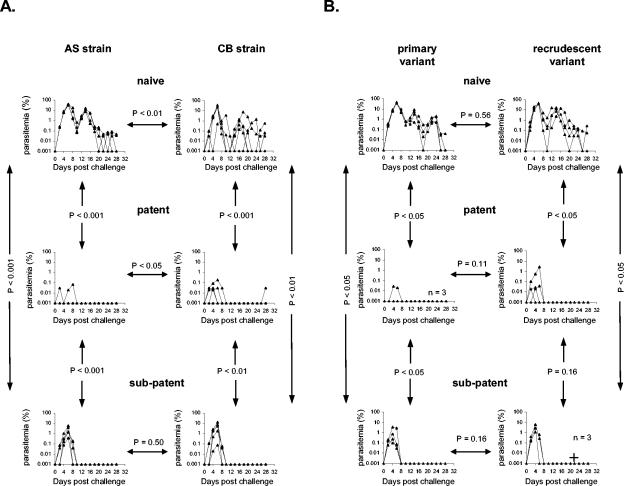
FIG. 1.
FIG. 1.
Specificity of immunity induced by subpatent infection. Subpatently and patently mice infected were infected three times i.v. at monthly intervals with 105 P. c. chabaudi As pRBC. Naive mice were injected i.v. with PBS. Subpatently infected mice were drug cured 48 h postinfection, and naive mice received the drug at the same time. Patently infected mice were allowed to self-cure. (A) Mice were challenged i.v. with 106 homologous P. c. chabaudi AS or heterologous P. c. chabaudi CB pRBC. Data for individual mice are shown (n = 5). This is representative of two similar experiments. Statistical comparisons between groups are indicated. (B) Mice were challenged i.v. with 106 P. c. chabaudi AS homologous primary variant parasites or heterologous recrudescent variant parasites (derived from recrudescence in the same donor mouse). Individual mice are shown (n = 4 except where indicated). The cross indicates the death of one mouse. Statistical comparisons between groups are indicated.
FIG. 2.
FIG. 2.
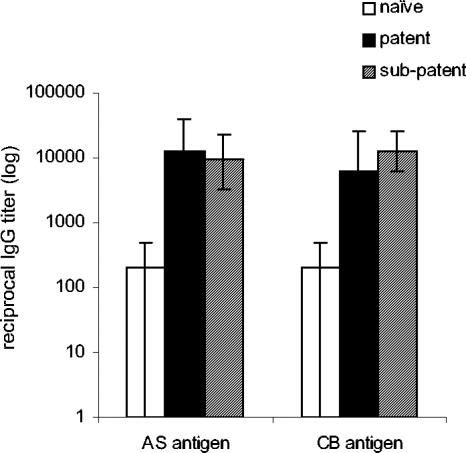
Specificity of antibodies induced by subpatent infection, measured by ELISA. Following three infections with P. c. chabaudi AS and prior to challenge infection, serum was collected from patently and subpatently infected mice as well as naive controls (Fig. 1A). Titers of parasite-specific IgG against homologous P. c. chabaudi AS and heterologous P. c. chabaudi CB crude parasite antigens were measured by ELISA. Reciprocal median IgG titers (and interquartile range) are shown (n = 10). These data are representative of two experiments.
FIG. 3.
FIG. 3.
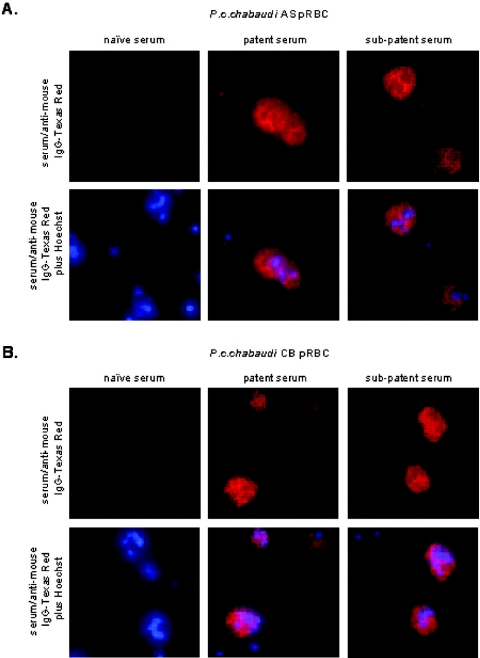
Specificity of antibodies induced by subpatent infection, measured by IFA. Serum was collected from naive, patently infected, and subpatently infected mice prior to the challenge infection (Fig. 1A). Binding of serum IgG to homologous P. c. chabaudi AS (A) and heterologous P. c. chabaudi CB (B) acetone-fixed schizonts was assessed by immunofluorescent staining with Texas Red-conjugated anti-mouse IgG and Hoechst (n = 10). Representative images are shown. Similar results were obtained in two separate experiments.
FIG. 4.
FIG. 4.
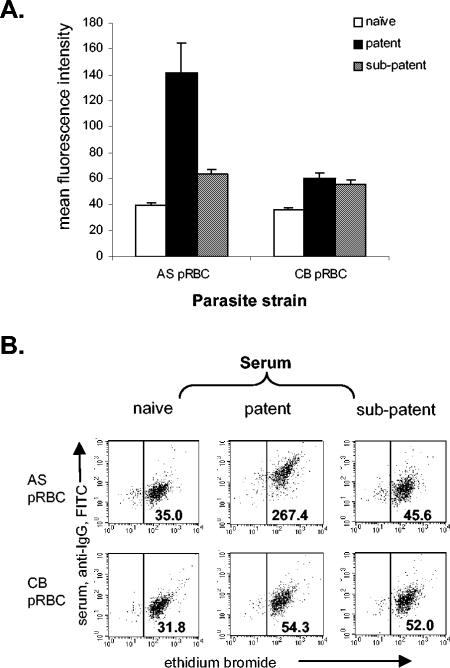
Antibodies to variant parasite antigens on the RBC surface. Serum was collected from naive, patently infected, and subpatently infected mice prior to challenge infection (Fig. 1A). Binding of serum IgG to the surface of homologous P. c. chabaudi AS and heterologous CB pRBC (trophozoite stage) was determined by flow cytometry. (A) Means and SEMs of the mean fluorescence intensity of FITC labeling (ethidium bromide-positive cells) are shown for each group of mice (n = 10). These data are representative of two similar experiments. (B) Representative dot plots of AS and CB pRBC stained with serum, goat anti-mouse IgG, swine anti-goat IgG-FITC, and ethidium bromide are shown, with the mean fluorescence intensity of FITC labeling (ethidium bromide-positive cells) indicated.
FIG. 5.
FIG. 5.
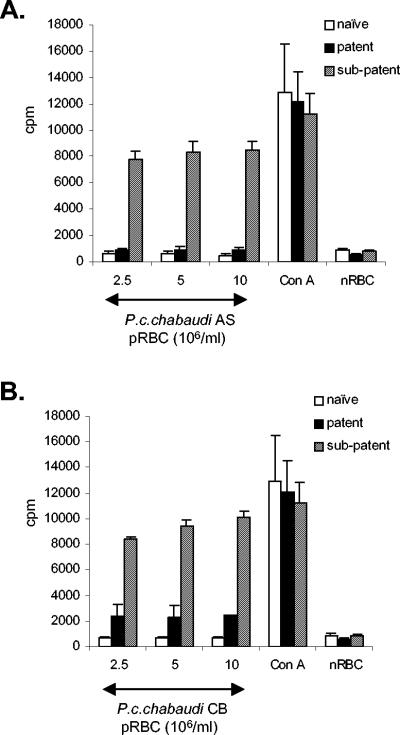
Antigen-specific proliferation of splenic lymphocytes. Subpatently and patently infected mice were sacrificed after completion of three infections with P. c. chabaudi AS, together with naive controls. Splenic lymphocytes from all mice were stimulated for 3 days with freeze-thawed P. c. chabaudi AS (A) or P. c. chabaudi CB (B) pRBC, ConA, and freeze-thawed uninfected mouse RBC (nRBC) and pulsed with [3H] thymidine for a further 18 to 24 h (n = 4). This is representative of two similar experiments.
FIG. 6.
FIG. 6.
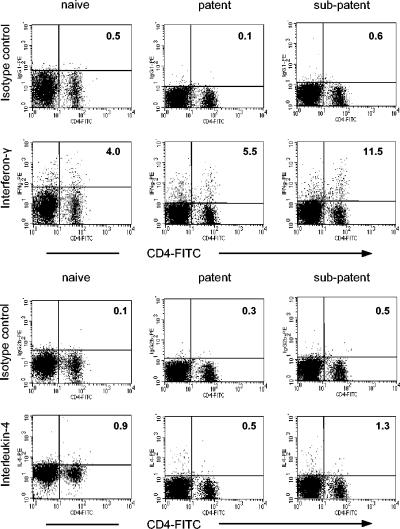
Intracellular cytokine staining of peripheral blood lymphocytes day 6 post-challenge. Peripheral blood was collected and pooled from mice in each group (n = 4) on day 6 post-challenge. After a 4-h stimulation of whole blood with PMA and calcium ionophore, intracellular cytokine staining for IFNγ and IL-4 production by CD4+ lymphocytes was performed. Dot plots from each group are shown. Numbers indicate the percentage of CD4+ lymphocytes producing each cytokine and nonspecific staining with isotype control monoclonal antibody.
FIG. 7.
FIG. 7.
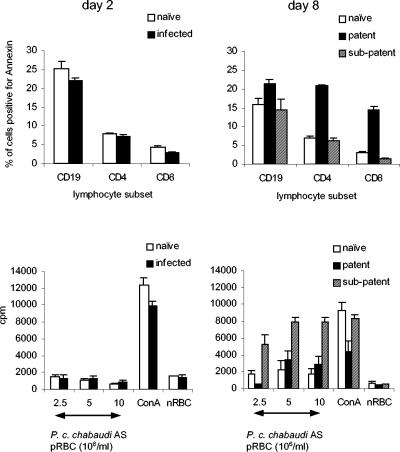
A single subpatent infection primed antigen-specific splenic lymphocytes without inducing lymphocyte apoptosis. Mice were infected with 105 P. c. chabaudi AS pRBC i.v. on day 0. On day 2, the first group of infected mice was killed, along with naive controls (n = 4). Subpatently infected mice were drug-cured on day 2, while patently infected mice were allowed to develop detectable parasitemia. Naive, patently infected, and subpatently infected mice were killed on day 8 (n = 4). Apoptosis of splenic lymphocyte subsets was assessed by staining with annexin V, and proliferation of lymphocytes, stimulated with freeze-thawed P. c. chabaudi AS pRBC was examined on days 2 and 8. Means and SEM are shown. This is representative of two similar experiments.

References

    1. Braley-Mullen, H. 1976. Secondary IgG responses to type III pneumococcal polysaccharide. II. Different cellular requirements for induction and elicitation. J. Immunol. 116:904-910. - PubMed
    1. Branch, O. H., V. Udhayakumar, A. W. Hightower, A. J. Oloo, W. A. Hawley, B. L. Nahlen, P. B. Bloland, D. C. Kaslow, and A. A. Lal. 1998. A longitudinal investigation of IgG and IgM antibody responses to the merozoite surface protein-1 19-kilodalton domain of Plasmodium falciparum in pregnant women and infants: associations with febrile illness, parasitemia, and anemia. Am. J. Trop. Med. Hyg. 58:211-219. - PubMed
    1. Bull, P. C., B. S. Lowe, M. Kortok, C. S. Molyneux, C. I. Newbold, and K. Marsh. 1998. Parasite antigens on the infected red cell surface are targets for naturally acquired immunity to malaria. Nat. Med. 4:358-360. - PMC - PubMed
    1. Carter, R. 1978. Studies on enzyme variation in the murine malaria parasites Plasmodium berghei, P. yoelii, P. vinckei and P. chabaudi by starch gel electrophoresis. Parasitology 76:241-267. - PubMed
    1. Cohen, S., I. A. McGregor, and S. C. Carrington. 1961. Gamma-globulin and acquired immunity to human malaria. Nature 192:733-737. - PubMed

Publication types