


Dramatic variation of the vomeronasal pheromone receptor gene repertoire among five orders of placental and marsupial mammals
- PMID: 15790682
- PMCID: PMC556306
- DOI: 10.1073/pnas.0501589102
Dramatic variation of the vomeronasal pheromone receptor gene repertoire among five orders of placental and marsupial mammals
Abstract
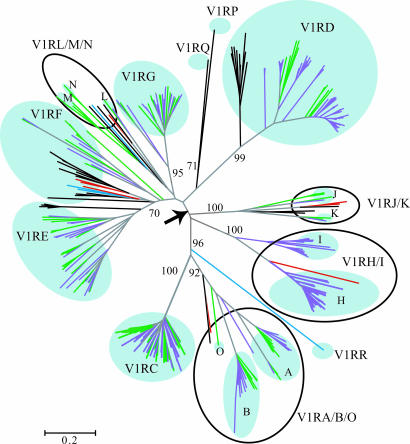
Pheromones are chemicals emitted and sensed by conspecifics to elicit social and sexual responses and are perceived in terrestrial vertebrates primarily by the vomeronasal organ (VNO). Pheromone receptors in the mammalian VNO are encoded by the V1R and V2R gene superfamilies. The V1R superfamily contains 187 and 102 putatively functional genes in the mouse and rat, respectively. To investigate whether this large repertoire size is typical among mammals with functional VNOs, we here describe the V1R repertoires of dog, cow, and opossum based on their draft genome sequences. The dog and cow have only 8 and 32 intact V1R genes, respectively. Thus, the intact V1R repertoire size varies by at least 23-fold among placental mammals with functional VNOs. To our knowledge, this size ratio represents the greatest among-species variation in gene family size of all mammalian gene families. Phylogenetic analysis of placental V1R genes suggests multiple losses of ancestral genes in carnivores and artiodactyls and gains of many new genes by gene duplication in rodents, manifesting massive gene births and deaths. We also identify 49 intact opossum V1R genes and discover independent expansions of the repertoire in placentals and marsupials. We further show a concordance between the V1R repertoire size and the complexity of VNO morphology, suggesting that the latter could indicate the sophistication of pheromone communications within species. In sum, our results demonstrate tremendous diversity and rapid evolution of mammalian V1R gene inventories and caution the generalization of VNO biology from rodents to all mammals.
Figures



Comment in
-
Remarkable diversity of mammalian pheromone receptor repertoires.Proc Natl Acad Sci U S A. 2005 May 10;102(19):6639-40. doi: 10.1073/pnas.0502318102. Epub 2005 May 3. Proc Natl Acad Sci U S A. 2005. PMID: 15870190 Free PMC article. No abstract available.
References
-
- Keverne, E. B. (1999) Science 286, 716–720. - PubMed
-
- Del Punta, K., Leinders-Zufall, T., Rodriguez, I., Jukam, D., Wysocki, C. J., Ogawa, S., Zufall, F. & Mombaerts, P. (2002) Nature 419, 70–74. - PubMed
-
- Dulac, C. & Torello, A. T. (2003) Nat. Rev. Neurosci. 4, 551–562. - PubMed
-
- Dulac, C. & Axel, R. (1995) Cell 83, 195–206. - PubMed
-
- Ryba, N. J. & Tirindelli, R. (1997) Neuron 19, 371–379. - PubMed
Publication types
MeSH terms
Substances
Grants and funding
LinkOut - more resources
Full Text Sources
