


Molecular analysis of isoniazid-resistant Mycobacterium tuberculosis isolates from England and Wales reveals the phylogenetic significance of the ahpC -46A polymorphism
- PMID: 15793126
- PMCID: PMC1068606
- DOI: 10.1128/AAC.49.4.1455-1464.2005
Molecular analysis of isoniazid-resistant Mycobacterium tuberculosis isolates from England and Wales reveals the phylogenetic significance of the ahpC -46A polymorphism
Abstract
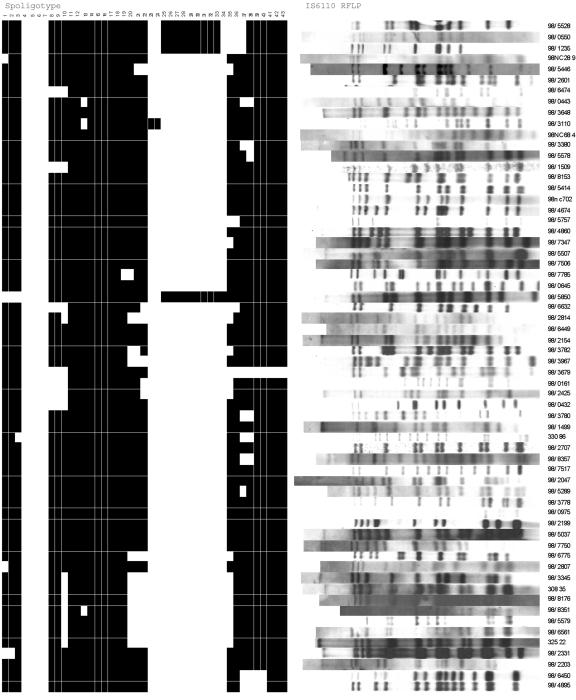
The present study investigated the prevalence and diagnostic potential of the most commonly reported mutations associated with isoniazid resistance, katG 315Thr, katG 315Asn, inhA -15T, inhA -8A, and the oxyR-ahpC intergenic region, in a population sample of 202 isoniazid-resistant Mycobacterium tuberculosis isolates and 176 randomly selected fully sensitive isolates from England and Wales identified by using a directed oligonucleotide array and limited DNA sequencing. The strains were recovered from patients originating from 29 countries; 41 isolates were multidrug resistant. Mutations affecting katG 315, the inhA promoter, and the oxyR-ahpC intergenic region were found in 62.7, 21.9, and 30% of 169 genotypically distinct isoniazid-resistant isolates, respectively, whereas they were found in 0, 0, and 8% of susceptible strains, respectively. The frequency of mutation at each locus was unrelated to the resistance profile or previous antituberculous drug therapy. The commonest mutation in the oxyR-ahpC intergenic region, ahpC -46A, was present in 23.7% of isoniazid-resistant isolates and 7.5% of susceptible isolates. This proved to be a phylogenetic marker for a subgroup of M. tuberculosis strains originating on the Indian subcontinent, which shared IS6110-based restriction fragment length polymorphism and spoligotype features with the Delhi strain and Central Asian strain CAS1; and this marker is strongly associated with isoniazid resistance and the katG 315Thr mutation. In total, 82.8% of unrelated isoniazid-resistant isolates could be identified by analysis of just two loci: katG 315 and the inhA promoter. Analysis of the oxyR-ahpC intergenic region, although phylogenetically interesting, does not contribute significantly to further identification of isoniazid-resistant isolates.
Figures

References
-
- Banerjee, A., E. Dubnau, A. Quemard, V. Balasubramanian, K. S. Um, T. Wilson, D. Collins, G. de Lisle, and W. R. Jacobs, Jr. 1994. inhA, a gene encoding a target for isoniazid and ethionamide in Mycobacterium tuberculosis. Science 263:227-230. - PubMed
-
- Bhanu, N., D. van Soolingen, J. van Embden, L. Dar, R. Pandey, and P. Seth. 2002. Predominace of a novel Mycobacterium tuberculosis genotype in the Delhi region of India. Tuberculosis (Edinburgh) 82:105. - PubMed
-
- Bifani, P. J., B. Mathema, N. E. Kurepina, and B. N. Kreiswirth. 2002. Global dissemination of the Mycobacterium tuberculosis W-Beijing family strains. Trends Microbiol. 10:45-52. - PubMed
Publication types
MeSH terms
Substances
LinkOut - more resources
Full Text Sources
Medical
