


The histidine of the c-type cytochrome CXXCH haem-binding motif is essential for haem attachment by the Escherichia coli cytochrome c maturation (Ccm) apparatus
- PMID: 15801911
- PMCID: PMC1175137
- DOI: 10.1042/BJ20041894
The histidine of the c-type cytochrome CXXCH haem-binding motif is essential for haem attachment by the Escherichia coli cytochrome c maturation (Ccm) apparatus
Abstract
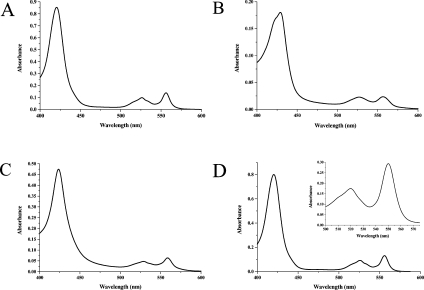
c-type cytochromes are characterized by covalent attachment of haem to the protein by two thioether bonds formed between the haem vinyl groups and the cysteine sulphurs in a CXXCH peptide motif. In Escherichia coli and many other Gram-negative bacteria, this post-translational haem attachment is catalysed by the Ccm (cytochrome c maturation) system. The features of the apocytochrome substrate required and recognized by the Ccm apparatus are uncertain. In the present study, we report investigations of maturation of cytochrome b562 variants containing CXXCR, CXXCK or CXXCM haem-binding motifs. None of them showed any evidence for correct maturation by the Ccm system. However, we have determined, for each variant, that the proteins (i) were expressed in large amounts, (ii) could bind haem in vivo and/or in vitro and (iii) were not degraded in the cell. Together with previous observations, these results strongly suggest that the apocytochrome substrate feature recognized by the Ccm system is simply the two cysteine residues and the histidine of the CXXCH haem-binding motif. Using the same experimental approach, we have also investigated a cytochrome b562 variant containing the special CWSCK motif that binds the active-site haem of E. coli nitrite reductase NrfA. Whereas a CWSCH analogue was matured by the Ccm apparatus in large amounts, the CWSCK form was not detectably matured either by the Ccm system or by the dedicated Nrf biogenesis proteins, implying that the substrate recognition features for haem attachment in NrfA may be more extensive than the CWSCK motif.
Figures
References
-
- Thony-Meyer L. Haem-polypeptide interactions during cytochrome c maturation. Biochim. Biophys. Acta. 2000;1459:316–324. - PubMed
-
- Pettigrew G. W., Moore G. R. Cytochromes c: Biological Aspects. New York: Springer-Verlag; 1987.
-
- Stevens J. M., Daltrop O., Allen J. W. A., Ferguson S. J. c-type cytochrome formation: chemical and biological enigmas. Acc. Chem. Res. 2004;37:999–1007. - PubMed
-
- Itagaki E., Hager L. P. Studies on cytochrome b562 of Escherichia coli: purification and crystallisation of cytochrome b562. J. Biol. Chem. 1966;241:3687–3695. - PubMed
-
- Matthews F. S., Bethge P. H., Czerwinski E. W. The structure of cytochrome b562 from Escherichia coli at 2.5 Å resolution. J. Biol. Chem. 1979;254:1699–1706. - PubMed
Publication types
MeSH terms
Substances
LinkOut - more resources
Full Text Sources
