Reproducibility of forearm vasodilator response to intra-arterial infusion of calcitonin gene-related peptide assessed by venous occlusion plethysmography
- PMID: 15801933
- PMCID: PMC1884797
- DOI: 10.1111/j.1365-2125.2005.02333.x
Reproducibility of forearm vasodilator response to intra-arterial infusion of calcitonin gene-related peptide assessed by venous occlusion plethysmography
Abstract
Aims: To assess the reproducibility of the forearm blood flow (FBF) response to intra-arterial infusion of calcitonin-gene related peptide (CGRP), measured by venous occlusion plethysmography. In addition, to compare different ways of expressing the FBF response and perform sample size calculations.
Methods: On two separate visits, CGRP (10 ng min(-1) dl(-1) forearm) was infused for 45 min into the brachial artery of six healthy subjects. Reproducibility was assessed by calculating mean difference, repeatability coefficient, within-subject coefficient of variation (WCV) and intraclass correlation coefficient.
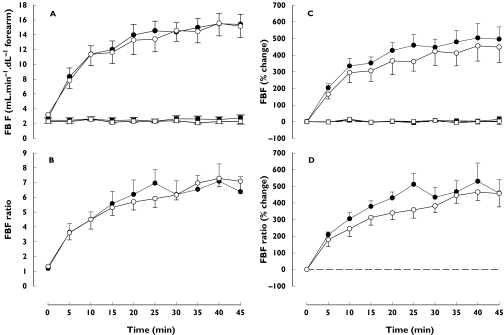
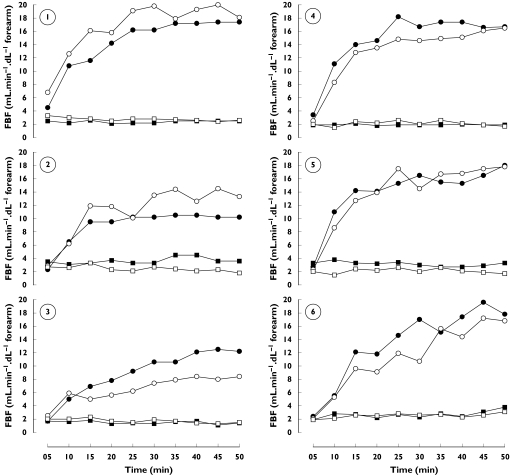
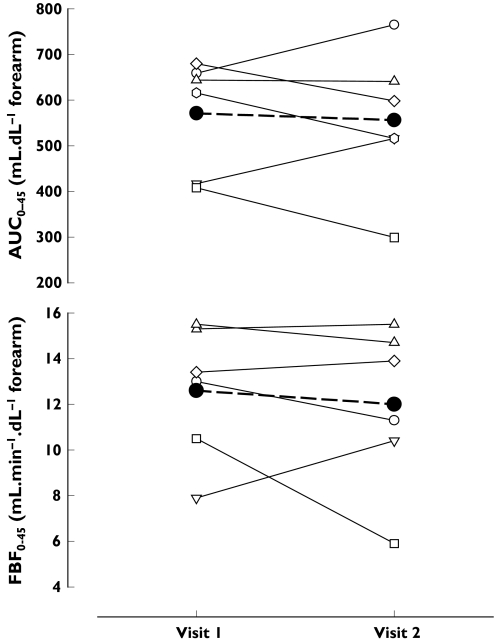
Results: CGRP increased FBF from 2.8 +/- 0.4 and 3.2 +/- 0.7 (at baseline) to 15.4 +/- 1.4 and 15.2 +/- 1.5 ml min(-1) dl(-1) forearm (at 45 min) on visits 1 and 2, respectively (P < 0.0001 for both visits). Mean difference in FBF at 45 min between both visits was 0.3 ml min(-1) dl(-1) forearm (repeatability coefficient: 4.1 ml min(-1) dl(-1) forearm). This FBF response appeared to be more reproducible when expressed as absolute FBF in the infused arm (WCV 11%) compared with absolute FBF-ratio between both arms (WCV 37%), percentage change from baseline in FBF in the infused arm (WCV 29%) and percentage change from baseline in FBF-ratio (WCV 40%). When expressed as absolute FBF, a sample size of five (95% confidence interval: 2-12) subjects gives 90% power at a type I error probability of 0.05 to detect a 25% shift in FBF response.
Conclusions: Intra-arterial infusion of CGRP results in a forearm vasodilator response which is reproducible between days. This response is most reproducible when expressed as absolute FBF. The presented methodology provides a suitable pharmacodynamic model to assess the in vivo activity of CGRP-receptor antagonists in a small number of subjects.
Figures
References
-
- van Rossum D, Hanisch UK, Quirion R. Neuroanatomical localization, pharmacological characterization and functions of CGRP, related peptides and their receptors. Neurosci Biobehav Rev. 1997;21:649–78. - PubMed
-
- Edvinsson L, Ekman R, Jansen I, McCulloch J, Uddman R. Calcitonin gene-related peptide and cerebral blood vessels: distribution and vasomotor effects. J Cereb Blood Flow Metab. 1987;7:720–8. - PubMed
-
- Brain SD, Williams TJ, Tippins JR, Morris HR, MacIntyre I. Calcitonin gene-related peptide is a potent vasodilator. Nature. 1985;313:54–6. - PubMed
-
- Bell D, McDermott BJ. Calcitonin gene-related peptide in the cardiovascular system: characterization of receptor populations and their (patho) physiological significance. Pharmacol Rev. 1996;48:253–88. - PubMed
-
- Edvinsson L. Calcitonin gene-related peptide (CGRP) and the pathophysiology of headache: therapeutic implications. CNS Drugs. 2001;15:745–53. - PubMed
Publication types
MeSH terms
Substances
LinkOut - more resources
Full Text Sources
Research Materials
Miscellaneous