


Preserved contribution of nitric oxide to baseline vascular tone in deconditioned human skeletal muscle
- PMID: 15802292
- PMCID: PMC1464521
- DOI: 10.1113/jphysiol.2005.085936
Preserved contribution of nitric oxide to baseline vascular tone in deconditioned human skeletal muscle
Abstract
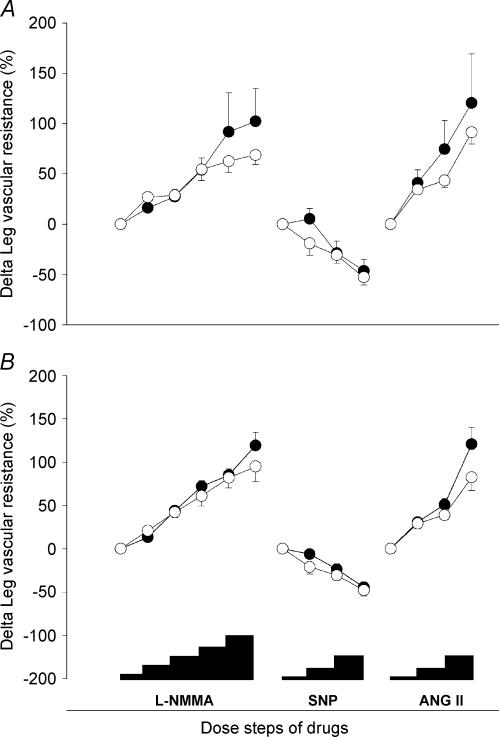
Deconditioning is a risk factor for cardiovascular disease. Exercise reduces this risk, possibly by improving the vascular endothelial nitric oxide (NO) pathway. The effect of deconditioning on the NO pathway is largely unknown. This study was designed to assess baseline NO availability in the leg vascular bed after extreme, long-term deconditioning (spinal cord-injured individuals, SCI) as well as after moderate, short-term deconditioning (4 weeks of unilateral lower limb suspension, ULLS). For this purpose, seven SCI were compared with seven matched controls. Additionally, seven healthy subjects were studied pre- and post-ULLS. Leg blood flow was measured by venous occlusion plethysmography at baseline and during infusion of 5 incremental dosages of N(G)-monomethyl-L-arginine (L-NMMA) into the femoral artery. Sodium nitroprusside (SNP) was infused to test vascular responsiveness to NO. Baseline leg vascular resistance tended to be higher in SCI compared with controls (37+/-4 versus 31+/-2 arbitrary units (AU), P=0.06). Deconditioning altered neither the vasoconstrictor response to L-NMMA (increase in resistance in SCI versus controls: 102+/-33% versus 69+/-9%; pre- versus post-ULLS: 95+/-18% versus 119+/-15%), nor the vascular responsiveness to NO. In conclusion, two human in vivo models of deconditioning show a preserved baseline NO availability in the leg skeletal muscle vascular bed.
Figures
References
-
- Allen JD, Geaghan JP, Greenway F, Welsch MA. Time course of improved flow-mediated dilation after short-term exercise training. Med Sci Sports Exerc. 2003;35:847–853. - PubMed
-
- Berg HE, Tesch PA. Changes in muscle function in response to 10 days of lower limb unloading in humans. Acta Physiol Scand. 1996;157:63–70. - PubMed
-
- Blair SN, Kohl HW, 3rd, Barlow CE, Paffenbarger RS, Jr, Gibbons LW, Macera CA. Changes in physical fitness and all-cause mortality. A prospective study of healthy and unhealthy men. JAMA. 1995;273:1093–1098. - PubMed
-
- Bleeker MW, De Groot PC, Poelkens F, Rongen GA, Smits P, Hopman MT. Vascular adaptation to 4 wk of deconditioning by unilateral lower limb suspension. Am J Physiol Heart Circ Physiol. 2005;288:H1747–H1755. - PubMed
Publication types
MeSH terms
Substances
LinkOut - more resources
Full Text Sources
Medical
