


Intermediates in the oxygenation of a nonheme diiron(II) complex, including the first evidence for a bound superoxo species
- PMID: 15802473
- PMCID: PMC556236
- DOI: 10.1073/pnas.0409640102
Intermediates in the oxygenation of a nonheme diiron(II) complex, including the first evidence for a bound superoxo species
Abstract
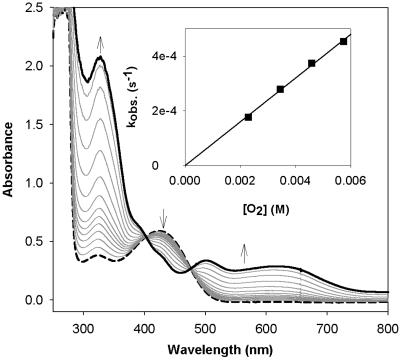
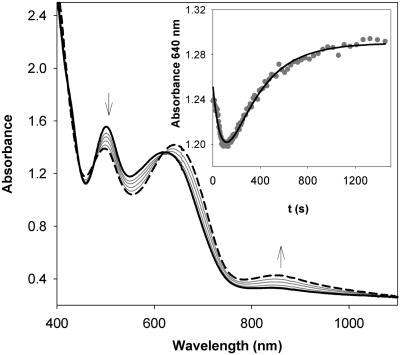
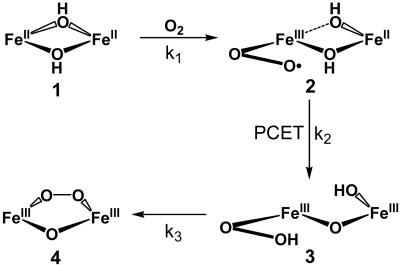
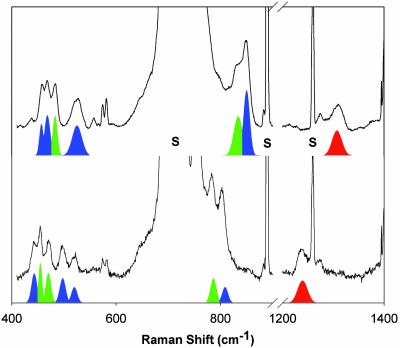
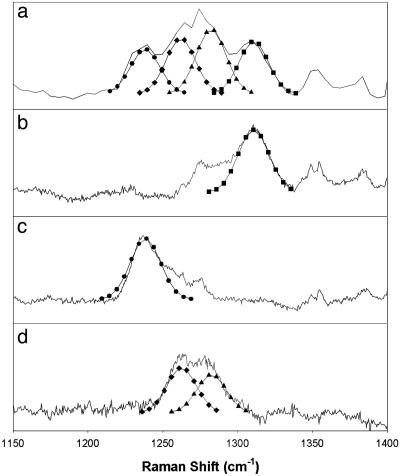
The reaction of [Fe(2)(mu-OH)(2)(6-Me(3)-TPA)(2)](2+) (1) [6-Me(3)-TPA, Tris(6-methyl-2-pyridylmethyl)amine] with O(2) in CH(2)Cl(2) at -80 degrees C gives rise to two new intermediates, 2 and 3, before the formation of previously characterized [Fe(2)(O)(O(2))(6-Me(3)-TPA)(2)](2+) (4) that allow the oxygenation reaction to be monitored one electron-transfer step at a time. Raman evidence assigns 2 and 3 as a diiron-superoxo species and a diiron-peroxo species, respectively. Intermediate 2 exhibits its nu(O-O) at 1,310 cm(-1) with a -71-cm(-1) (18)O isotope shift. A doublet peak pattern for the (16)O(18)O isotopomer of 2 in mixed-isotope Raman experiments strongly suggests that the superoxide ligand of 2 is bound end-on. This first example of a nonheme iron-superoxo intermediate exhibits the highest frequency nu(O-O) yet observed for a biomimetic metal-dioxygen adduct. The bound superoxide of 2, unlike the bound peroxide of 4, is readily reduced by 2,4-di-tert-butylphenol via a proton-coupled electron-transfer mechanism, emphasizing that metal-superoxo species may serve as oxidants in oxygen activation mechanisms of metalloenzymes. The discovery of intermediates 2 and 3 allows us to dissect the initial steps of dioxygen binding at a diiron center leading to its activation for substrate oxidation.
Figures
References
-
- Lippard, S. J. & Berg, J. M. (1994) Principles of Bioinorganic Chemistry (University Science Books, Mill Valley, CA).
-
- Sono, M., Roach, M. P., Coulter, E. D. & Dawson, J. H. (1996) Chem. Rev. 96, 2841–2887. - PubMed
-
- Ferguson-Miller, S. & Babcock, G. T. (1996) Chem. Rev. 96, 2889–2907. - PubMed
-
- Blackman, A. G. & Tolman, W. B. (2000) Struct. Bonding 97, 179–211.
-
- Costas, M., Mehn, M. P., Jensen, M. P. & Que, L., Jr. (2004) Chem. Rev. 104, 939–986. - PubMed
Publication types
MeSH terms
Substances
Grants and funding
LinkOut - more resources
Full Text Sources
Research Materials
