


Natural killer cell education in mice with single or multiple major histocompatibility complex class I molecules
- PMID: 15809355
- PMCID: PMC2213126
- DOI: 10.1084/jem.20050167
Natural killer cell education in mice with single or multiple major histocompatibility complex class I molecules
Abstract
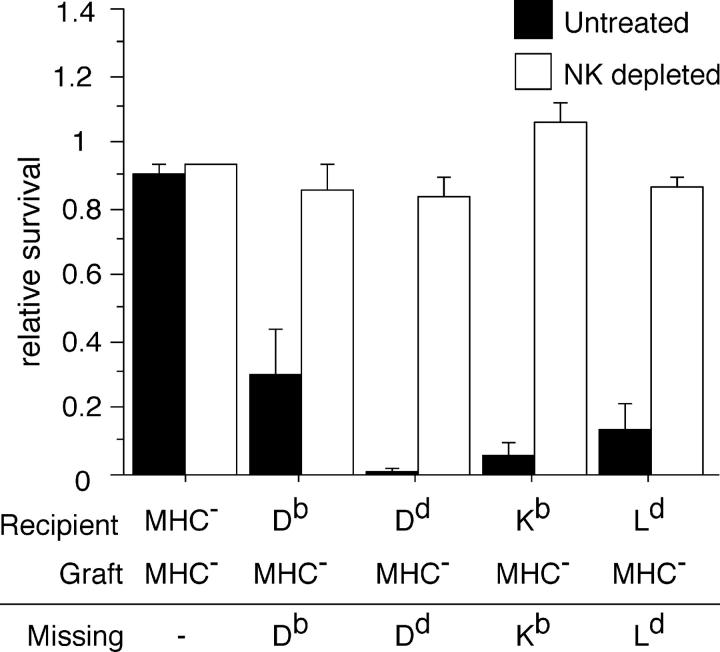
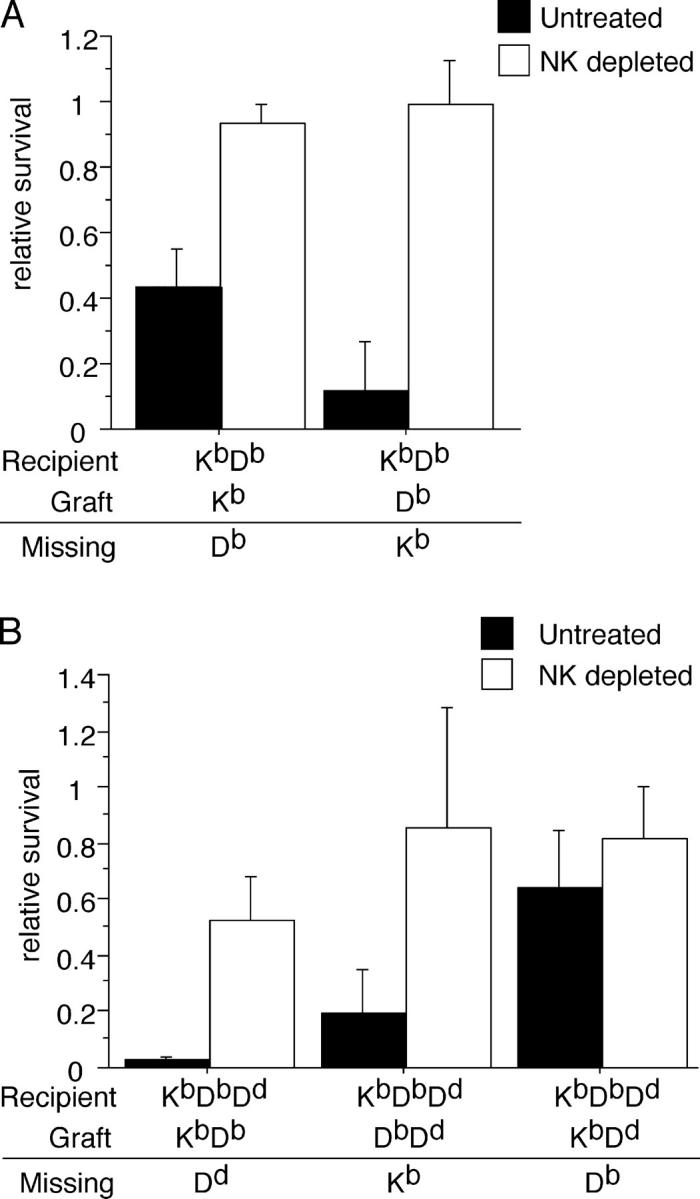
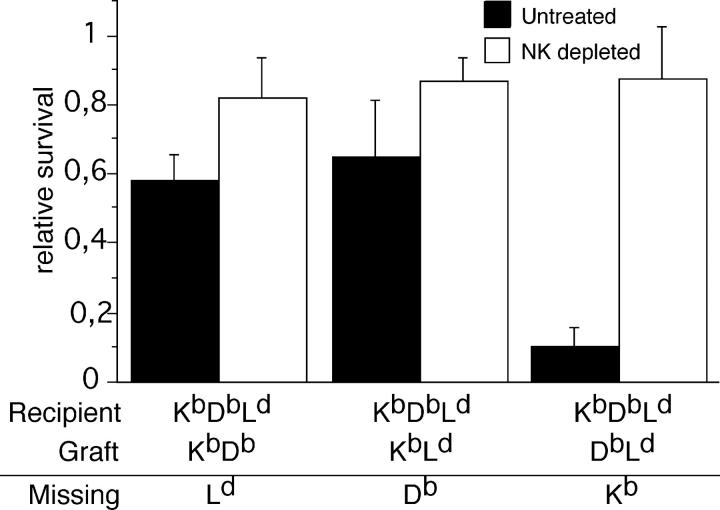
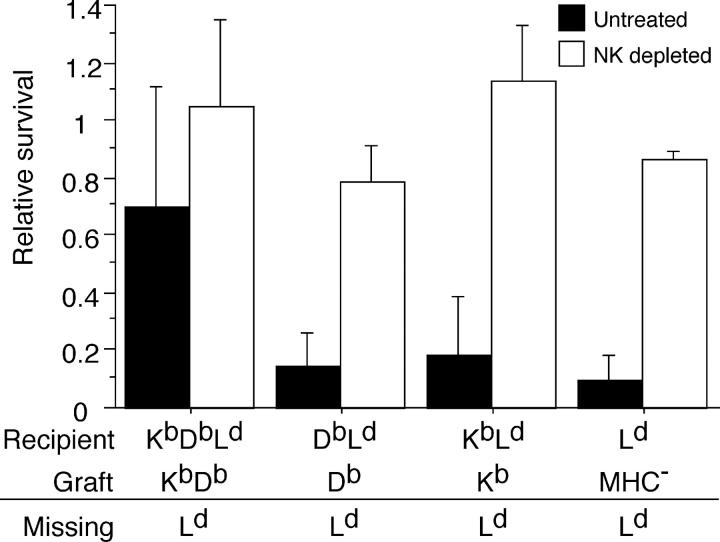
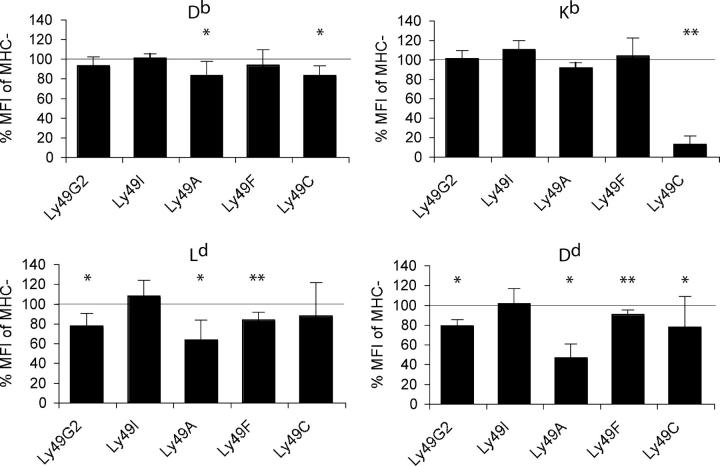
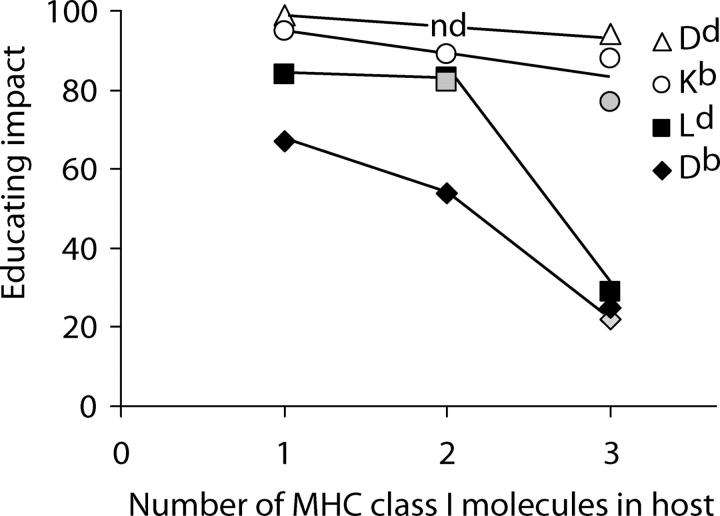
The ability of murine NK cells to reject cells lacking self MHC class I expression results from an in vivo education process. To study the impact of individual MHC class I alleles on this process, we generated mice expressing single MHC class I alleles (K(b), D(b), D(d), or L(d)) or combinations of two or more alleles. All single MHC class I mice rejected MHC class I-deficient cells in an NK cell-dependent way. Expression of K(b) or D(d) conveyed strong rejection of MHC class I-deficient cells, whereas the expression of D(b) or L(d) resulted in weaker responses. The educating impact of weak ligands (D(b) and L(d)) was further attenuated by the introduction of additional MHC class I alleles, whereas strong ligands (K(b) and D(d)) maintained their educating impact under such conditions. An analysis of activating and inhibitory receptors in single MHC class I mice suggested that the educating impact of a given MHC class I molecule was controlled both by the number of NK cells affected and by the strength of each MHC class I-Ly49 receptor interaction, indicating that NK cell education may be regulated by a combination of qualitative and quantitative events.
Figures
Similar articles
-
Major histocompatibility complex class I-dependent skewing of the natural killer cell Ly49 receptor repertoire.Eur J Immunol. 1996 Oct;26(10):2286-92. doi: 10.1002/eji.1830261003. Eur J Immunol. 1996. PMID: 8898935
-
External and internal calibration of the MHC class I-specific receptor Ly49A on murine natural killer cells.J Immunol. 1998 Dec 1;161(11):6133-8. J Immunol. 1998. PMID: 9834098
-
Host MHC class I molecules modulate in vivo expression of a NK cell receptor.J Immunol. 1994 Sep 15;153(6):2407-16. J Immunol. 1994. PMID: 8077656
-
Activation of natural killer cells: underlying molecular mechanisms revealed.Scand J Immunol. 2004 Jul-Aug;60(1-2):14-22. doi: 10.1111/j.0300-9475.2004.01475.x. Scand J Immunol. 2004. PMID: 15238069 Review.
-
Regulation of the natural killer cell receptor repertoire.Annu Rev Immunol. 2001;19:291-330. doi: 10.1146/annurev.immunol.19.1.291. Annu Rev Immunol. 2001. PMID: 11244039 Review.
Cited by
-
Enhanced NK-cell development and function in BCAP-deficient mice.Blood. 2008 Jul 1;112(1):131-40. doi: 10.1182/blood-2007-08-107847. Epub 2008 Mar 12. Blood. 2008. PMID: 18337558 Free PMC article.
-
Educated natural killer cells show dynamic movement of the activating receptor NKp46 and confinement of the inhibitory receptor Ly49A.Sci Signal. 2018 Feb 13;11(517):eaai9200. doi: 10.1126/scisignal.aai9200. Sci Signal. 2018. PMID: 29440510 Free PMC article.
-
Uterine Natural Killer Cells: Functional Distinctions and Influence on Pregnancy in Humans and Mice.Front Immunol. 2017 Apr 24;8:467. doi: 10.3389/fimmu.2017.00467. eCollection 2017. Front Immunol. 2017. PMID: 28484462 Free PMC article. Review.
-
Current perspectives of natural killer cell education by MHC class I molecules.Nat Rev Immunol. 2010 Oct;10(10):724-34. doi: 10.1038/nri2835. Epub 2010 Sep 6. Nat Rev Immunol. 2010. PMID: 20818413 Review.
-
A Conserved HIV-1-Derived Peptide Presented by HLA-E Renders Infected T-cells Highly Susceptible to Attack by NKG2A/CD94-Bearing Natural Killer Cells.PLoS Pathog. 2016 Feb 1;12(2):e1005421. doi: 10.1371/journal.ppat.1005421. eCollection 2016 Feb. PLoS Pathog. 2016. PMID: 26828202 Free PMC article.
References
-
- Kärre, K., H.G. Ljunggren, G. Piontek, and R. Kiessling. 1986. Selective rejection of H-2-deficient lymphoma variants suggests alternative immune defence strategy. Nature. 319:675–678. - PubMed
-
- Cerwenka, A., and L.L. Lanier. 2001. Ligands for natural killer cell receptors: redundancy or specificity. Immunol. Rev. 181:158–169. - PubMed
-
- Vilches, C., and P. Parham. 2002. KIR: diverse, rapidly evolving receptors of innate and adaptive immunity. Annu. Rev. Immunol. 20:217–251. - PubMed
-
- Gunturi, A., R.E. Berg, and J. Forman. 2004. The role of CD94/NKG2 in innate and adaptive immunity. Immunol. Res. 30:29–34. - PubMed
-
- Long, E.O. 1999. Regulation of immune responses through inhibitory receptors. Annu. Rev. Immunol. 17:875–904. - PubMed
Publication types
MeSH terms
Substances
LinkOut - more resources
Full Text Sources
Other Literature Sources
Molecular Biology Databases
Research Materials
Miscellaneous
