


doi: 10.1128/AEM.71.4.2170-2174.2005.
Anaerobic, nitrate-dependent oxidation of U(IV) oxide minerals by the chemolithoautotrophic bacterium Thiobacillus denitrificans
Affiliations
- PMID: 15812053
- PMCID: PMC1082518
- DOI: 10.1128/AEM.71.4.2170-2174.2005
Item in Clipboard
Anaerobic, nitrate-dependent oxidation of U(IV) oxide minerals by the chemolithoautotrophic bacterium Thiobacillus denitrificans
Appl Environ Microbiol.
2005 Apr.
Abstract
Under anaerobic conditions and at circumneutral pH, cells of the widely distributed, obligate chemolithoautotrophic bacterium Thiobacillus denitrificans oxidatively dissolved synthetic and biogenic U(IV) oxides (uraninite) in nitrate-dependent fashion: U(IV) oxidation required the presence of nitrate and was strongly correlated with nitrate consumption. This is the first report of anaerobic U(IV) oxidation by an autotrophic bacterium.
Figures
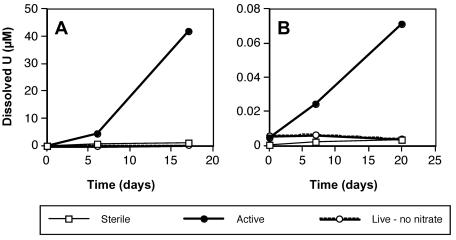
Anaerobic, oxidative dissolution of two different synthetic U(IV) oxides by washed cell suspensions of T. denitrificans: (A) freshly prepared U(IV) oxide with a slurry consistency and (B) aggregated grains of U(IV) oxide that had dried under anaerobic conditions. Datum points represent the averages of duplicate suspensions.
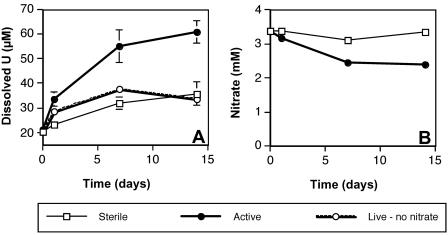
Production of dissolved uranium (A) and consumption of nitrate (B) during anaerobic, oxidative dissolution of biogenic uraninite by washed cell suspensions of T. denitrificans. Datum points represent the averages of triplicate suspensions, and error bars represent 1 standard deviation (error bars are plotted for all datum points but are obscured by the symbol in some cases).
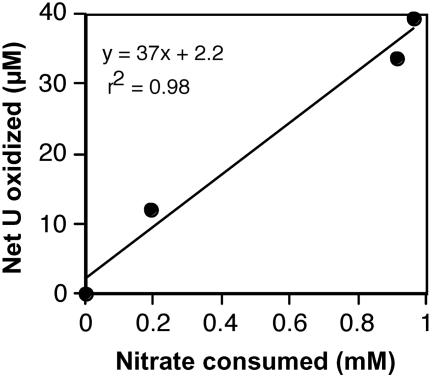
Correlation between net U(IV) oxidation and nitrate consumption during the oxidative dissolution of biogenic uraninite by washed cells of T. denitrificans (experiment represented in Fig. 2). Datum points represent the averages of triplicate suspensions. A linear regression fit is plotted.
References
-
- Brina, R., and A. G. Miller. 1992. Direct detection of trace levels of uranium by laser-induced kinetic phosphorimetry. Anal. Chem. 64:1413-1418.
-
- DiSpirito, A. A., and O. H. Tuovinen. 1982. Uranous ion oxidation and carbon dioxide fixation by Thiobacillus ferrooxidans. Arch. Microbiol. 133:28-32.
-
- Finneran, K. T., M. E. Housewright, and D. R. Lovley. 2002. Multiple influences of nitrate on uranium solubility during bioremediation of uranium-contaminated subsurface sediments. Environ. Microbiol. 4:510-516. - PubMed
-
- Fredrickson, J. K., J. M. Zachara, D. W. Kennedy, M. C. Duff, Y. A. Gorby, S. W. Li, and K. M. Krupka. 2000. Reduction of U(VI) in goethite (α-FeOOH) suspensions by a dissimilatory metal-reducing bacterium. Geochim. Cosmochim. Acta 64:3085-3098.
Publication types
MeSH terms
Substances
LinkOut - more resources
Full Text Sources
