


Molecular evidence for multiple host-specific strains in the genus Rhinosporidium
- PMID: 15815010
- PMCID: PMC1081358
- DOI: 10.1128/JCM.43.4.1865-1868.2005
Molecular evidence for multiple host-specific strains in the genus Rhinosporidium
Abstract
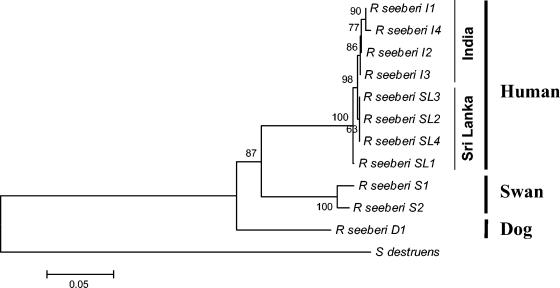
The taxonomic relationship of Rhinosporidium seeberi with other organisms remained controversial for over a century. Recently, molecular studies have shown R. seeberi to be a protistal microbe in the newly described class Mesomycetozoea at the animal-fungal boundary. Phylogenetic analyses of R. seeberi using 18S small-subunit (SSU) rRNA genes from several hosts suggested Rhinosporidium as a monotypic genus. To test this hypothesis, the internal transcribed spacer 1 (ITS1), 5.8S, and ITS2 from eight humans, two swans, and a dog with rhinosporidiosis were sequenced. The ITS regions were amplified by PCR using a primer designed from a unique region of R. seeberi's 18S SSU rRNA genes in combination with the ITS4 universal primer. In addition, the universal ITS4 and ITS5 primers were also used. R. seeberi's ITS sequences showed differences in the numbers of nucleotides among strains. For instance, the eight human ITS sequences were uniformly similar with only a few mismatches and approximately 1,060 bp long. In contrast, sequences from one of the swans and the dog were 1,356 bp and approximately 1,147 bp long, respectively. Clustal analysis of all of the ITS sequences showed multiple 50- to 60-bp gaps and several mismatches among them. Parsimony analysis placed the Rhinosporidium ITS sequences in three well-supported sister groups according to the hosts' identities. This analysis strongly suggests that the genus Rhinosporidium may possess multiple host-specific strains. No correlation was found between this finding and the phenotypic features of R. seeberi in the studied samples.
Figures
References
-
- Ajello, L. 1998. Ecology and epidemiology of hydrophilic infectious fungi and parafungi of medical mycological importance: a new category of pathogens, p. 67-73. In L. Ajello and R. J. Hay (ed.), Topley & Wilson's microbiology and microbial infections, 9th ed., vol. 4. Arnold, London, England.
-
- Arseculeratne, S. N., and L. Ajello. 1998. Rhinosporidium seeberi, p. 596-615. In L. Ajello and R. J. Hay (ed.), Topley & Wilson's microbiology and microbial infections, 9th ed., vol. 4. Arnold, London, England.
-
- Arseculeratne, S. N., F. N. Hussein, D. N. Atapattu, and R. Pathmanathan. 2000. Failure to infect congenitally immunodeficient SCID and NUD mice with Rhinosporidium seeberi. Med. Mycol. 30:393-395. - PubMed
-
- Ashwoth, H. 1923. On Rhinosporidium seeberi (Wernicke, 1903) with special reference to its sporulation and affinities. Trans. R. Soc. Edinb. 53:301-342.
-
- Bossuyt, F., M. Meegaskumbura, N. Beenaerts, D. J. Gower, R. Pethiyagoda, K. Roelants, A. Mannaert, M. Wilkinson, M. M. Bahir, K. Manamendra-Arachchi, P. K. L. Ng, C. J. Schneider, O. V. Oommen, and M. C. Milinkovitch. 2004. Local endemism within the western Ghats-Sri Lanka biodiversity hotspot. Science 306:479-481. - PubMed
MeSH terms
Substances
Associated data
- Actions
- Actions
- Actions
- Actions
- Actions
- Actions
- Actions
- Actions
- Actions
- Actions
- Actions
LinkOut - more resources
Full Text Sources
Molecular Biology Databases
