. 2005 Apr;11(4):572-8.
doi: 10.3201/eid1104.040920.

European bat lyssavirus in Scottish bats

Affiliations

European bat lyssavirus in Scottish bats

Sharon M Brookes et al. Emerg Infect Dis. 2005 Apr.

Abstract

We report the first seroprevalence study of the occurrence of specific antibodies to European bat lyssavirus type 2 (EBLV-2) in Daubenton's bats. Bats were captured from 19 sites across eastern and southern Scotland. Samples from 198 Daubenton's bats, 20 Natterer's bats, and 6 Pipistrelle's bats were tested for EBLV-2. Blood samples (N = 94) were subjected to a modified fluorescent antibody virus neutralization test to determine antibody titer. From 0.05% to 3.8% (95% confidence interval) of Daubenton's bats were seropositive. Antibodies to EBLV-2 were not detected in the 2 other species tested. Mouth swabs (N = 218) were obtained, and RNA was extracted for a reverse transcription-polymerase chain reaction (RT-PCR). The RT-PCR included pan lyssavirus-primers (N gene) and internal PCR control primers for ribosomal RNA. EBLV-2 RNA was not detected in any of the saliva samples tested, and live virus was not detected in virus isolation tests.


Figures
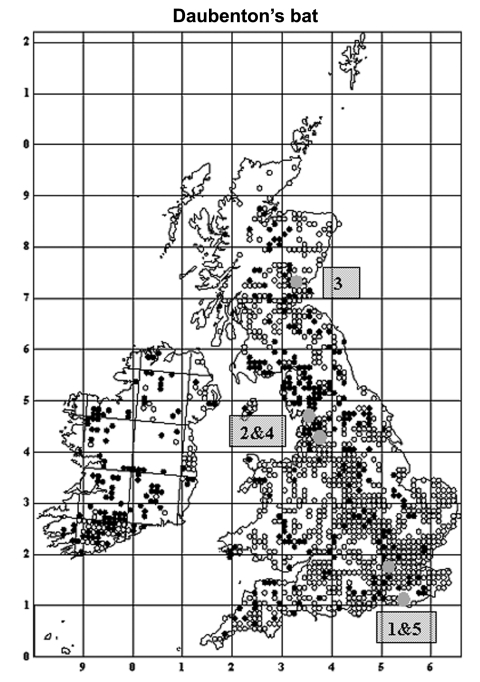
Figure 1
Figure 1
Distribution of Daubenton's bats in the United Kingdom and Ireland showing 5 cases of infection with European Bat lyssavirus type 2 (EBLV-2). Open circles are sites where Daubenton's bats were observed away from their roosts, and the closed circles are roosts of Daubenton's bats (summer and winter). The 5 numbered gray circles are sequential sites where EBLV-2–positive cases were found. Reprinted with permission of The Bat Conservation Trust (London, United Kingdom) from Distribution of Bats in Britain and Ireland 1980–1999.
Figure 2
Figure 2
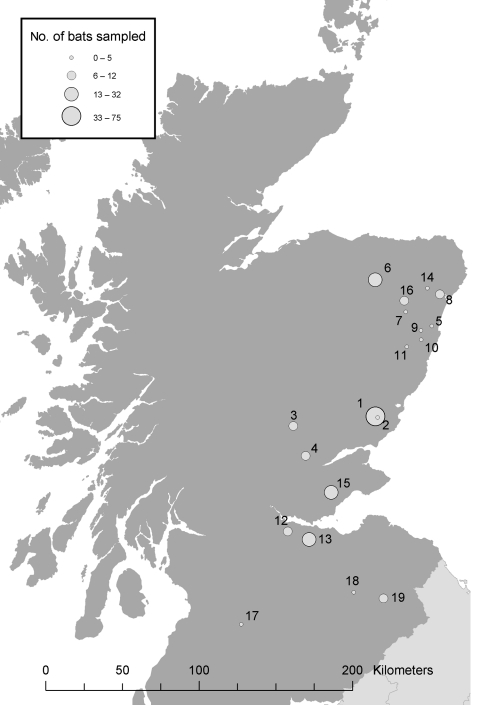
Bat sampling locations in southern and eastern Scotland. The circles indicate both the location (number) and an estimate of the number (size) of bats sampled.
Figure 3
Figure 3
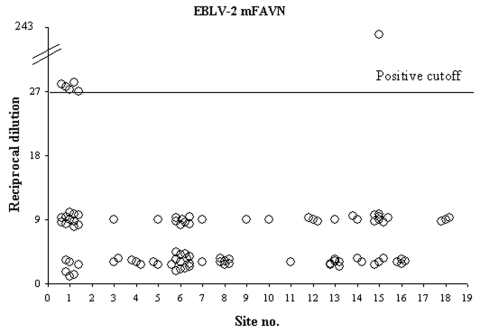
Antibody titers to European bat lyssavirus type 2 (EBLV-2) in bat sera from Scotland. An EBLV-2–specific modified fluorescent antibody virus neutralization (mFAVN) test was used to determine the level of circulating antibody in Daubenton's bats from 19 sites in Scotland. The test uses a 3-fold dilution series (9, 27, 81, 243, etc.) and the positive/negative cutoff is a titer (reciprocal dilution) of 27. Circles on the graph represent either single serum samples or pools of sera (88 for Daubenton's bats, 5 for Natterer's bats, and 1 from Pipistrelle's bats). All titers >27 are Daubenton's bats from 2 sites (5 from site 1 and 1 from site 15). No data were available for sites 2, 17, and 19.

References

    1. Muller WW. Review of reported rabies case data in Europe to the WHO Collaborating Centre Tübingen from 1977 to 2000. Rabies Bull Europe. 2000;4:11–9.
    1. Botvinkin AD, Poleschuk EM, Kuzmin IV, Borisova TI, Gazaryan SV, Yager P, et al. Novel lyssaviruses isolated from bats in Russia. Emerg Infect Dis. 2003;9:1623–5. - PMC - PubMed
    1. Fooks AR. The challenge of emerging lyssaviruses. Expert Rev Vaccines. 2004;3:89–92. 10.1586/14760584.3.4.333 - DOI - PubMed
    1. Muller T, Cox J, Peter W, Schaefer R, Johnson N, McElhinney LM, et al. Spill-over of European bat lyssavirus type-1 into a stone marten (Martes foina) in Germany. J Vet Med B Infect Dis Vet Public Health. 2004;51:49–54. 10.1111/j.1439-0450.2003.00725.x - DOI - PubMed
    1. Fooks AR, Brookes SM, Johnson N, McElhinney LM, Hutson AM. European bat lyssaviruses: an emerging zoonosis. Epidemiol Infect. 2003;131:1029–39. 10.1017/S0950268803001481 - DOI - PMC - PubMed

Publication types

MeSH terms

Substances

LinkOut - more resources