Review
. 2005 May;91 Suppl 2(Suppl 2):ii7-13; discussion ii31, ii43-8.
doi: 10.1136/hrt.2005.062026.

Epidemiology and management of heart failure and left ventricular systolic dysfunction in the aftermath of a myocardial infarction

Affiliations
Review

Epidemiology and management of heart failure and left ventricular systolic dysfunction in the aftermath of a myocardial infarction

J G F Cleland et al. Heart. 2005 May.

Abstract

Robust epidemiological data on the incidence of myocardial infarction (MI) are hard to find, but synthesis of data from a number of sources indicates that the average hospital in the UK should admit about two patients with a first MI and one recurrent MI per 1000 population per year. Possibly the most relevant data on the incidence, prevalence, and persistence of post-MI heart failure can be derived from the TRACE study. Most patients will develop heart failure or major left ventricular systolic dysfunction (LVSD) at some time after an MI, most commonly during the index admission. In up to 20% of cases this will be transient, but such patients still have a poor prognosis. There is likely to be around one patient discharged per thousand population per year with heart failure or major LVSD after an acute MI. It is important to organise care structures to ensure that patients with post-MI heart failure and LVSD are identified and managed appropriately.


Figures
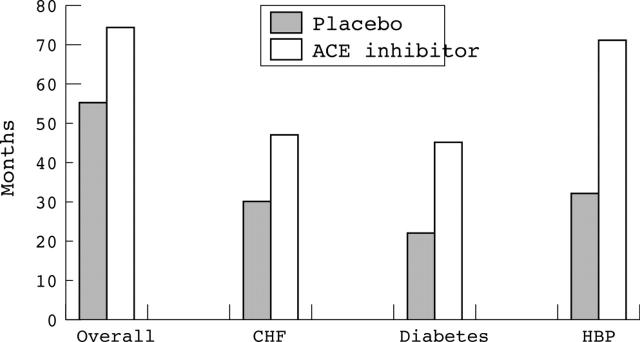
Figure 1
Figure 1
Median life expectancy after a myocardial infarction complicated by major left ventricular systolic dysfunction in the TRACE study.48 Comparison between the effect of placebo and trandolapril. ACE, angiotensin converting enzyme; CHF, congestive heart failure; HBP, high blood pressure.
Figure 2
Figure 2
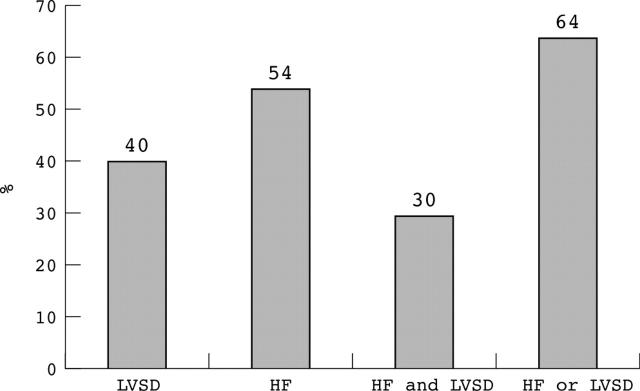
Proportion of patients with heart failure and left ventricular systolic dysfunction within the first few days after a myocardial infarction in the TRACE study.27
Figure 3
Figure 3
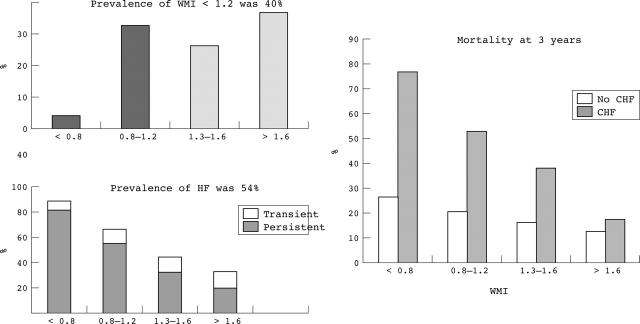
Proportion of patients with left ventricular systolic dysfunction, transient or persistent heart failure (HF) and their outcome in the TRACE study.28 WMI, wall motion index.
Figure 4
Figure 4
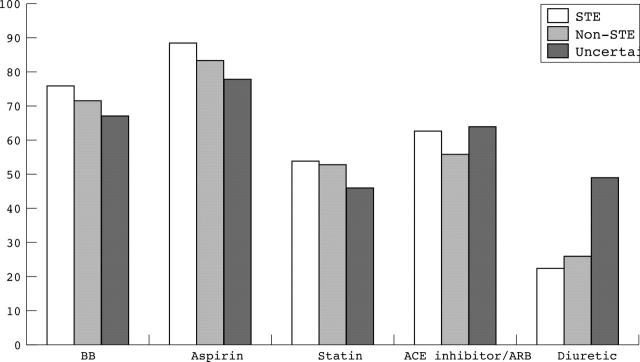
Pharmacological treatment after ST segment elevation (STE), non-ST segment elevation (Non-STE), and "ECG indeterminant" (Uncertain) myocardial infarction in the EuroHeart acute coronary syndrome survey. ACE, angiotensin converting enzyme; ARB, angiotensin II receptor blocker; BB, ß blocker.
Figure 5
Figure 5
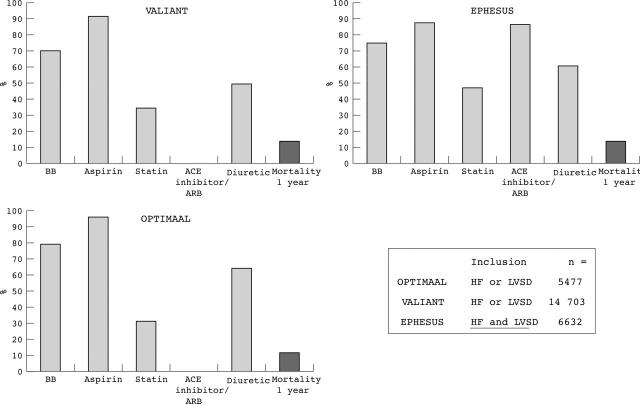
Pharmacological treatment after a myocardial infarction complicated by heart failure and/or left ventricular systolic dysfunction in three contemporary clinical trials.41,45–47 In VALIANT and OPTIMAAL patients already taking ACE inhibitors or angiotensin receptor blockers were excluded. ACE, angiotensin converting enzyme; ARB, angiotensin II receptor blocker; BB, ß blocker; HF, heart failure; LVSD, left ventricular systolic dysfunction.

References

    1. Am J Cardiol. 1995 Jul 1;76(1):1-5 - PubMed
    1. N Engl J Med. 1998 Sep 24;339(13):861-7 - PubMed
    1. Am J Cardiol. 1996 Nov 15;78(10):1124-8 - PubMed
    1. Am J Cardiol. 1997 Jul 15;80(2):207-9 - PubMed
    1. Curr Opin Cardiol. 1997 May;12(3):276-87 - PubMed